...

By Jordan King
Reporter
0
Share
Newsweek is a Trust Project member
See more of our trusted coverage when you search.Prefer Newsweek on Googleto see more of our trusted coverage when you search.
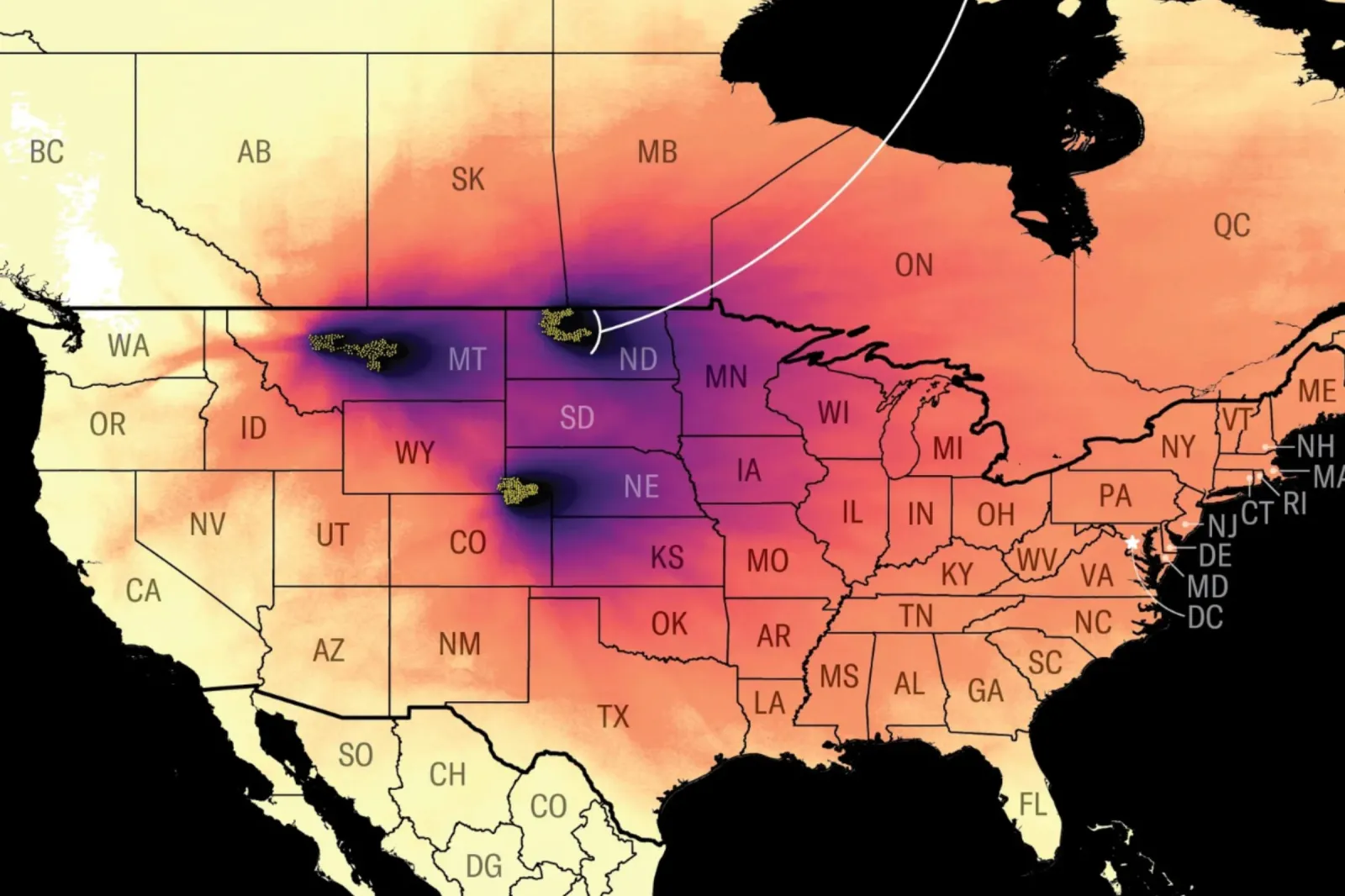
A Newsweek map shows the safest states to live in during a simulated nuclear attack on U.S. silo fields, according to a scientific study, although experts have warned that "nowhere is truly safe" in the event of a such an attack.
Global tensions, especially between the U.S. and Russia, have resulted in much talk about nuclear war. Newsweek has mapped the impact of Russian nuclear bombs on U.S. cities and NATO countries and has also compared the effects of U.S. nuclear weapons with those of North Korea, Russia and China.
Now, Newsweek has looked at Scientific American's previous fallout maps of a nuclear attack on missile silos in the U.S. heartland—Colorado, Wyoming, Nebraska, Montana and North Dakota—to see which states would be the least affected and therefore the safest, according to the simulation.
Read More on News
In an average-case scenario, the "safest states" would be Maine, New Hampshire, Vermont, Massachusetts, Rhode Island, Connecticut, New York, New Jersey, Pennsylvania, Delaware, Maryland, District of Columbia, Virginia, West Virginia, North Carolina, South Carolina, Georgia, Florida, Alabama, Mississippi, Tennessee, Kentucky, Ohio, Indiana and Michigan.
Other states that would be less affected include Washington, Oregon, Idaho, Nevada, California, Utah, Arizona, New Mexico, Texas, Arkansas and Illinois.

This is based on the average radiation exposure risk calculated for each latitude and longitude point, using a scale measuring the estimated cumulative radiation dose after four days in grays (Gy), a unit of ionizing radiation dose.
The "safest" states' exposure ranges from 0.001 Gy to 0.5 Gy, compared with the states in the most danger (Montana, Wyoming, Colorado, Nebraska, South Dakota, North Dakota, Iowa and Minnesota), where estimated exposure ranges from 1 Gy to 84 Gy. Scientists regard more than 8 Gy as lethal.
In a worst-case scenario the "safest states" would be Maine, New Hampshire, Vermont, Massachusetts, Rhode Island, Connecticut, New York, New Jersey, Pennsylvania, Delaware, Maryland, District of Columbia, Virginia, West Virginia, North Carolina, South Carolina, Georgia, Florida, Alabama and Mississippi.
These states would be exposed to an estimated 0.1 Gy to 2 Gy, as opposed to almost the rest of the country, which would be exposed to between 2 Gy and 84 Gy.
This scenario is based on a simulated attack on a specific day in 2021, taking into account wind directions.

Both scenarios are based on a simulation with the detonation of one or two nuclear warheads, with explosive yields equivalent to 100,000 tons of TNT, which is what is required to attack a missile silo, according to Scientific American.
Several experts told Newsweek that the entire country, and indeed the world, would be heavily impacted by a nuclear attack no matter the details.
"While those who live near military facilities, ICBM silos in the Midwest or submarine bases along the coasts might bear the most immediate and severe consequences of a nuclear attack, there's no question: ANY nuclear war or weapons detonation would be bad for everyone," John Erath, the Senior Policy Director for the Center for Arms Control and Non-Proliferation, told Newsweek.
"Nowhere is truly 'safe' from fallout and other consequences like contamination of food and water supplies and prolonged radiation exposure," he said.
"Administrations of both parties have long understood nuclear weapons are only for defense and deterrence, not for starting a nuclear war. We would all do well to remember former President Ronald Reagan's words, recently reaffirmed by President Joe Biden: 'A nuclear war cannot be won and must never be fought.'"
Christian G. Appy, Director of the Ellsberg Initiative for Peace and Democracy at the University of Massachusetts Amherst, told Newsweek: "Even a relatively 'small' nuclear war would cause a nuclear winter famine that would kill at least a billion people."
He said it was "morally repugnant to think about the safest places to survive a nuclear war" because "a major nuclear war would throw so much soot and debris into the stratosphere that it would produce a nuclear winter that would kill all or nearly all of those who survived the blast, firestorms, and radiation of the war."
Braden Goddard, an associate professor at the Virginia Commonwealth University's Department of Mechanical and Nuclear Engineering, doubted that silos would be the target of a nuclear attack, telling Newsweek he believes it would most likely be Washington, D.C.
Newsweek has contacted the U.S. Department of Defense, via email, for comment.
...
Nuclear Risk in 2026: Why Experts Say the Threat Is Growing
The global nuclear threat has continued to worsen in 2026, according to the Bulletin of the Atomic Scientists, which moved its Doomsday Clock to 85 seconds to midnight—the closest point to catastrophe in its history. Experts cited mounting tensions between nuclear powers, the continued war in Ukraine, renewed conflict risks involving Iran, India and Pakistan, and the breakdown of arms-control efforts between the U.S. and Russia.
The group also warned that countries under the U.S. nuclear umbrella, including allies in Europe and Asia, are increasingly debating whether they need their own nuclear deterrents.
View 0 Comments
Submit Correction
View Editorial & AI Guidelines