...

By Aristos Georgiou
Science and Health Reporter
0
Share
Newsweek is a Trust Project member
See more of our trusted coverage when you search.Prefer Newsweek on Googleto see more of our trusted coverage when you search.
A prehistoric saber-toothed cat once roamed what is now the Gulf Coast of Texas, a "treasure" of a fossil has revealed.
Researchers determined that the fossil belongs to an individual from the extinct genus (or group of species) called Homotherium, a study published in The Anatomical Record reported. The members of this group were large saber-toothed cats that inhabited the Americas, Eurasia and Africa between roughly 4 million and 12,000 years ago.
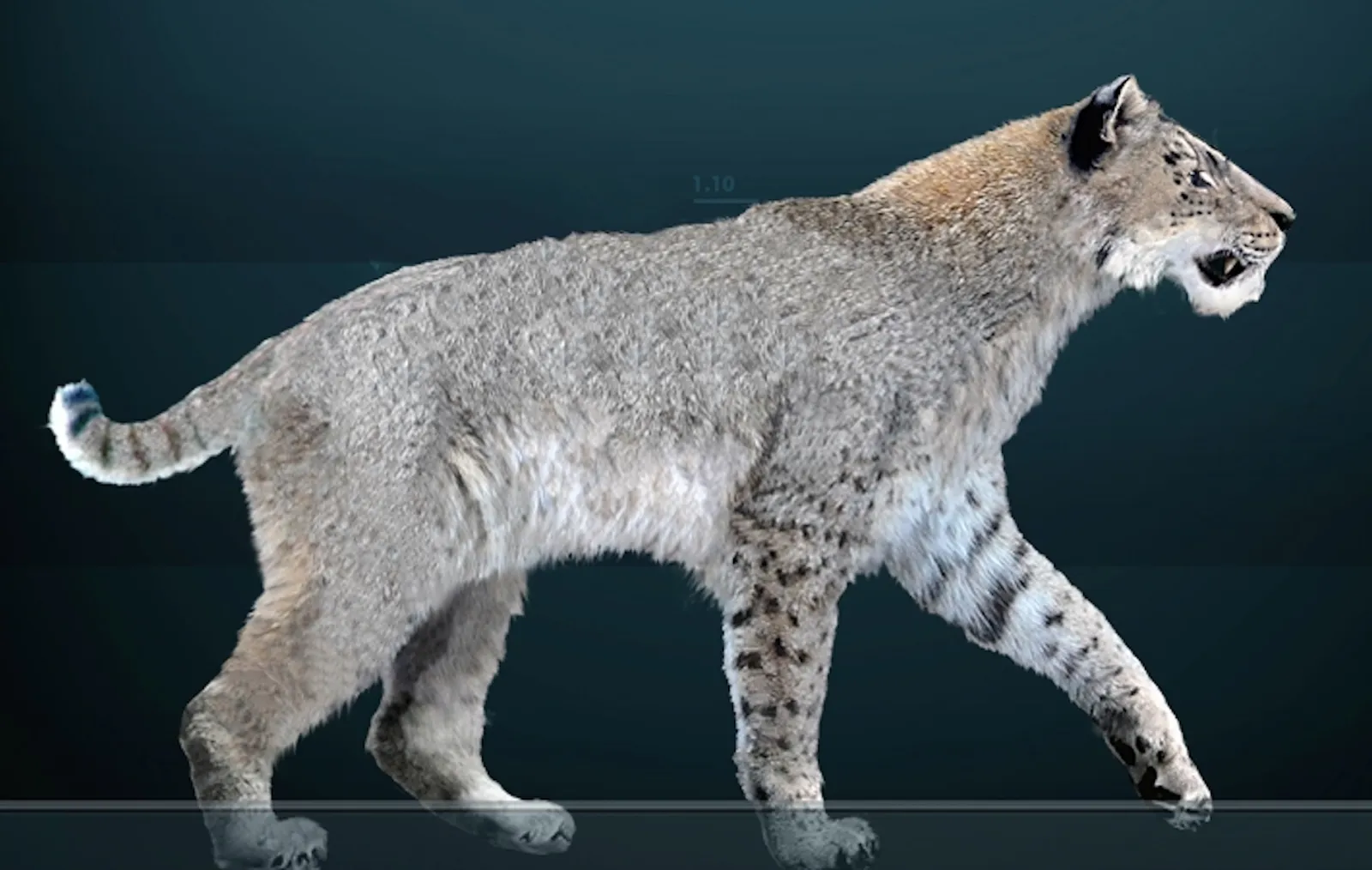
These cats were large and robust, measuring around the same size as a jaguar. They had an elongated face, lanky front legs, a sloping back and a bobtail. Their characteristic "saber"-like canine teeth were serrated and covered by large gum flaps.
Read More on Science
Homotherium remains have been uncovered in other parts of Texas. But the fossil that was analyzed in the latest study is thought to have originated from submerged deposits of the continental shelf below the Gulf of Mexico. This represents the first occurrence of this group from the continental shelf, according to the study.
...
A continental shelf is an area of seabed around a large land mass, like North America, and is characterized by relatively shallow seas, compared with the open ocean. In the northern Gulf of Mexico, the continental shelf extends approximately 60 to 120 miles offshore, according to the National Oceanic and Atmospheric Administration.
The Gulf's continental shelf is now submerged, but it was once exposed above sea level—to varying degrees—during glacial periods of the Late Pleistocene, which lasted between roughly 129,000 and 12,000 years ago. During glacial periods, or intervals, sea levels were significantly lower than they are today, with large amounts of water locked up in vast continental ice sheets or mountain glaciers.
"The extent that [the continental shelf] was exposed would have varied depending on global climate and the amount of global water that was tied up in glaciers covering much of the Northern Hemisphere," John Moretti, a doctoral student at the Jackson School of Geosciences at the University of Texas at Austin, who led the study, told Newsweek.
The "occurrence on McFaddin Beach places Homotherium on this lost landscape of the continental shelf."
The Homotherium fossil analyzed in the new study was originally found more than 60 years ago, having been washed up on McFaddin Beach, south of Beaumont, Texas. The researchers interpret it as being of Late Pleistocene age.
"That fossil, then, is another datapoint that helps us plot the geographic distribution of this saber-tooth cat," Moretti said. "Homotherium was widespread across the world and does not appear to have been tied to a particular habitat or climatic setting—the McFaddin Beach record helps to support that interpretation of Homotherium as an ecological generalist."
At first glance, the roughly 2-inch-long specimen looks unremarkable, resembling a lumpy, rounded rock with a couple of exposed teeth that had been heavily eroded after thousands of years of being submerged in the Gulf. In fact, the teeth are so eroded that they are not identifiable.
"You can't even tell what it is, let alone which animal it came from," said John Moretti, a doctoral student at the Jackson School of Geosciences at the University of Texas at Austin, in a news release.
"It's like a geode. It's ugly on the outside, and the treasure is all inside," said Moretti, who led the study.
When Moretti and his colleagues conducted X-ray scans of the fossil, they spotted something that was not previously visible—a hidden canine tooth that had not yet erupted from the jawbone. This tooth, which is in far better condition than the exposed ones, enabled the researchers to identify the fossil as belonging to a species of Homotherium.

...
The individual cat was not fully grown when it died, and the hidden tooth had not yet emerged from the jaw, protecting it from the elements.
"Had that saber tooth been all the way erupted and fully in its adult form, and not some awkward teenage in-between stage, it would have just snapped right off," Moretti said. "It wouldn't have been there, and we wouldn't have that to use as evidence."
The finding expands the geographic footprint of Homotherium in Texas, indicating that it would have roamed the formerly exposed continental shelf. The latest study lends support to the idea that the shelf once served as a "corridor," facilitating the dispersal of animals in the Gulf region.
"Multiple authors...[have] proposed that an exposed continental shelf could have allowed animals to disperse/move from present-day Mexico and Central America into southern Texas and Florida, and that corridor would help to explain why the Pleistocene fauna of Florida and south Texas were so similar," Moretti told Newsweek.
Do you have an animal or nature story to share with Newsweek? Do you have a question about paleontology? Let us know via science@newsweek.com.
Update 06/03/24, 5:24 a.m. ET: This article was updated with additional comment from John Moretti.
View 0 Comments
Submit Correction
View Editorial & AI Guidelines