...


By Hollie Silverman and John Feng
0
Share
Newsweek is a Trust Project member
See more of our trusted coverage when you search.Prefer Newsweek on Googleto see more of our trusted coverage when you search.
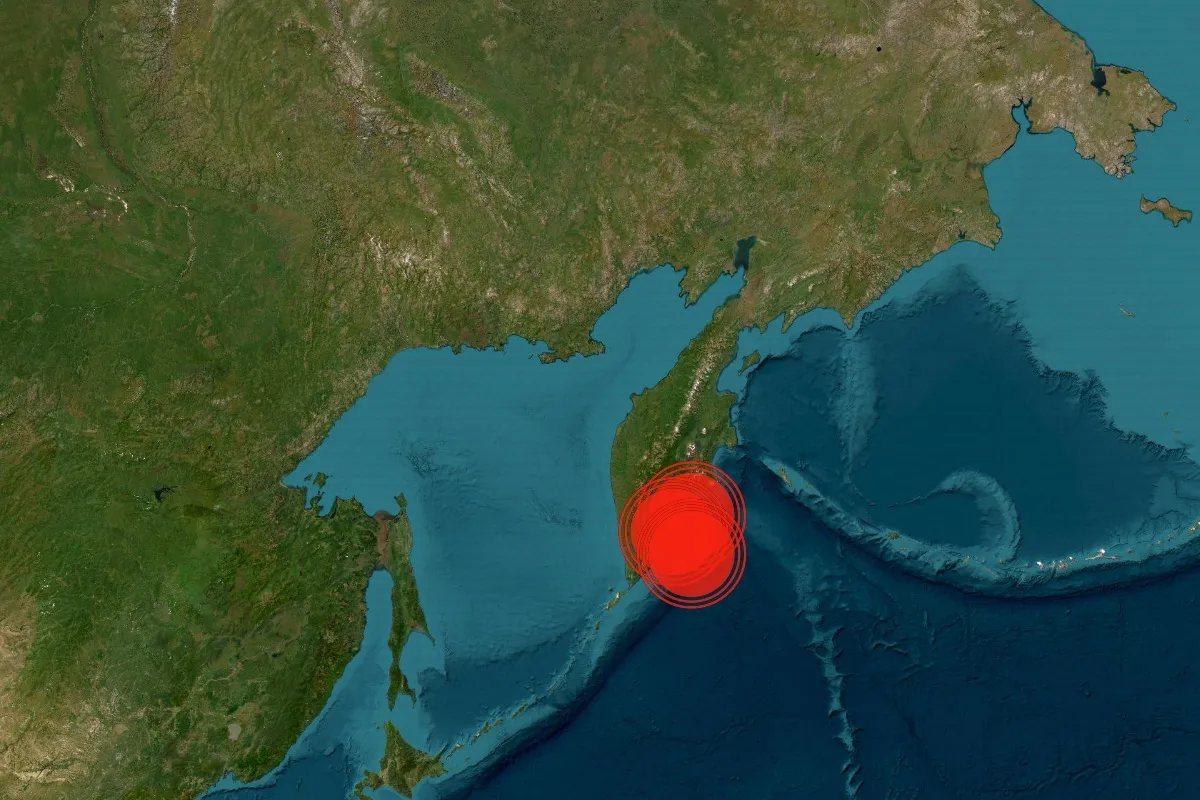
Three earthquakes struck off the coast of Russia's Kamchatka Peninsula early Monday, continuing a period of heightened seismic activity in one of the world’s most geologically active regions.
Officials from the U.S. Geological Survey (USGS) tracked a series of quakes measuring at 4.6, 4.7, and 4.8 in magnitude, respectively.
There have been no immediate reports of damage or injuries, and no tsunami alerts have been reported.
Read More on World
"On July 29, 2025, the Kamchatka Peninsula, Russia, experienced a M8.8 earthquake. This was tied for sixth largest earthquake ever recorded," Steve Sobie, spokesperson for the USGS told Newsweek in an email Monday. "Since then, there have been at least 2,877 aftershocks in the region. Aftershocks from such a large earthquake will continue for weeks, months, or even years later."
Why It Matters
The Kamchatka Peninsula sits on the Pacific Ring of Fire, where shifting tectonic plates frequently trigger earthquakes and volcanic eruptions.
The recent seismic sequence followed an even larger, 8.8 magnitude earthquake that struck the region in July, which briefly raised global concern about possible tsunamis impacting communities far beyond Russia, including parts of the United States.
Ongoing tremors and tsunami warnings underscore the ongoing risk that such events pose to both local populations and countries across the Pacific Rim.
Geologists and emergency officials remain vigilant as seismic disturbances in eastern Russia can send waves and aftershocks rippling across the world’s largest ocean.
What To Know
On Monday, three moderate earthquakes struck off Kamchatka’s eastern coast, according to the USGS earthquake tracker.
The cluster follows the major 7.8 magnitude quake that hit roughly 80 miles off the coast on September 18 at a depth of 6 miles, and a sequence of aftershocks up to magnitude 5.8, the USGS confirmed.
The Kamchatka Peninsula is considered Russia’s most earthquake-prone area, often experiencing large quakes above magnitude 7.
Petropavlovsk-Kamchatsky, the region’s capital, sits directly in this zone, surrounded by volcanoes and rugged terrain. Although the earthquakes have disrupted daily life, prompting rapid inspections of buildings and precautionary evacuations, no casualties or major destruction have been reported.
...
The region’s latest turmoil follows an 8.8-magnitude undersea quake in July 2025 that triggered tsunami alerts for the entire North Pacific and led to evacuations and temporary warnings as far south as Chile and French Polynesia.
Afterwards, heavy aftershocks continued off Kamchatka and the Kuril Islands, with at least five registering above magnitude 6. The region also saw an eruption from one of its most active volcanoes shortly after the quake.
While experts have noted the clustering of quakes, seismologists have not yet determined if the recent tremors are part of a single sequence or represent independent fault ruptures.
What People Are Saying
Steve Sobie, spokesperson for the USGS told Newsweek in an email Monday: "On July 29, 2025, the Kamchatka Peninsula, Russia, experienced a M8.8 earthquake. This was tied for sixth largest earthquake ever recorded. Since then, there have been at least 2,877 aftershocks in the region. Aftershocks from such a large earthquake will continue for weeks, months, or even years later. The largest aftershock we've seen was a M7.8 on Sept 19. The recent M4.7 and M4.6 from earlier today (Sept 29) are further examples of common activity after such a large event...There is a greater than 99% chance that magnitude 4.0+, 5.0+, and even M6.0+ will continue to occur over the first year after the quake."
The USGS said on its website after the quake on September 19: "At the earthquake's location, the Pacific Plate is moving west-northwest relative to the North American Plate at a rate of approximately 80 mm/year.
"The earthquake's location and faulting mechanism are consistent with faulting along the subduction zone plate interface of the Kuril-Kamchatka arc.
"Although earthquakes are often represented as points on maps, events of this magnitude are better described as slip across a broad fault area. Reverse faulting earthquakes of this size typically involve rupture dimensions of approximately 70 km in length and 35 km in width."
The USGS said on its website following the quake in July: "Following the M8.8 Russian Kamchatka Peninsula Earthquake, the USGS has released new aftershock forecasts that detail the likelihood and magnitude of future earthquakes expected in the region.
"Within the first week following the magnitude 8.8 event, scientists calculated:
- 2% chance of additional magnitude 8 or larger aftershocks
- 24% chance of additional magnitude 7 or larger aftershocks
- 96% chance of additional magnitude 6 or larger aftershocks
- greater than 99% chance of more magnitude 5 or larger aftershocks
- greater than 99% chance of more magnitude 4 or larger aftershocks
- greater than 99% chance of more magnitude 3 or larger aftershocks"
"These forecasts prove vital for residents and responders who must remain vigilant and prepared for subsequent tremors that can continue for weeks, months, or even years after a major earthquake. Forecasts will be updated as more information becomes available."
What Happens Next
Seismologists will continue monitoring Kamchatka and the North Pacific for further aftershocks and signs of escalating seismic activity. Any significant new quake could trigger additional tsunami warnings for Russia, Japan, Alaska, Hawaii, or the Pacific coast of the United States.
Update 9/29/25, 3:05 p.m. This article was updated with additional information.
Update 9/29/25, 4:17 p.m. This article was updated with additional information.
View 0 Comments
Submit Correction
View Editorial & AI Guidelines