...

By Maya Mehrara
News Reporter
0
Share
Newsweek is a Trust Project member
See more of our trusted coverage when you search.Prefer Newsweek on Googleto see more of our trusted coverage when you search.
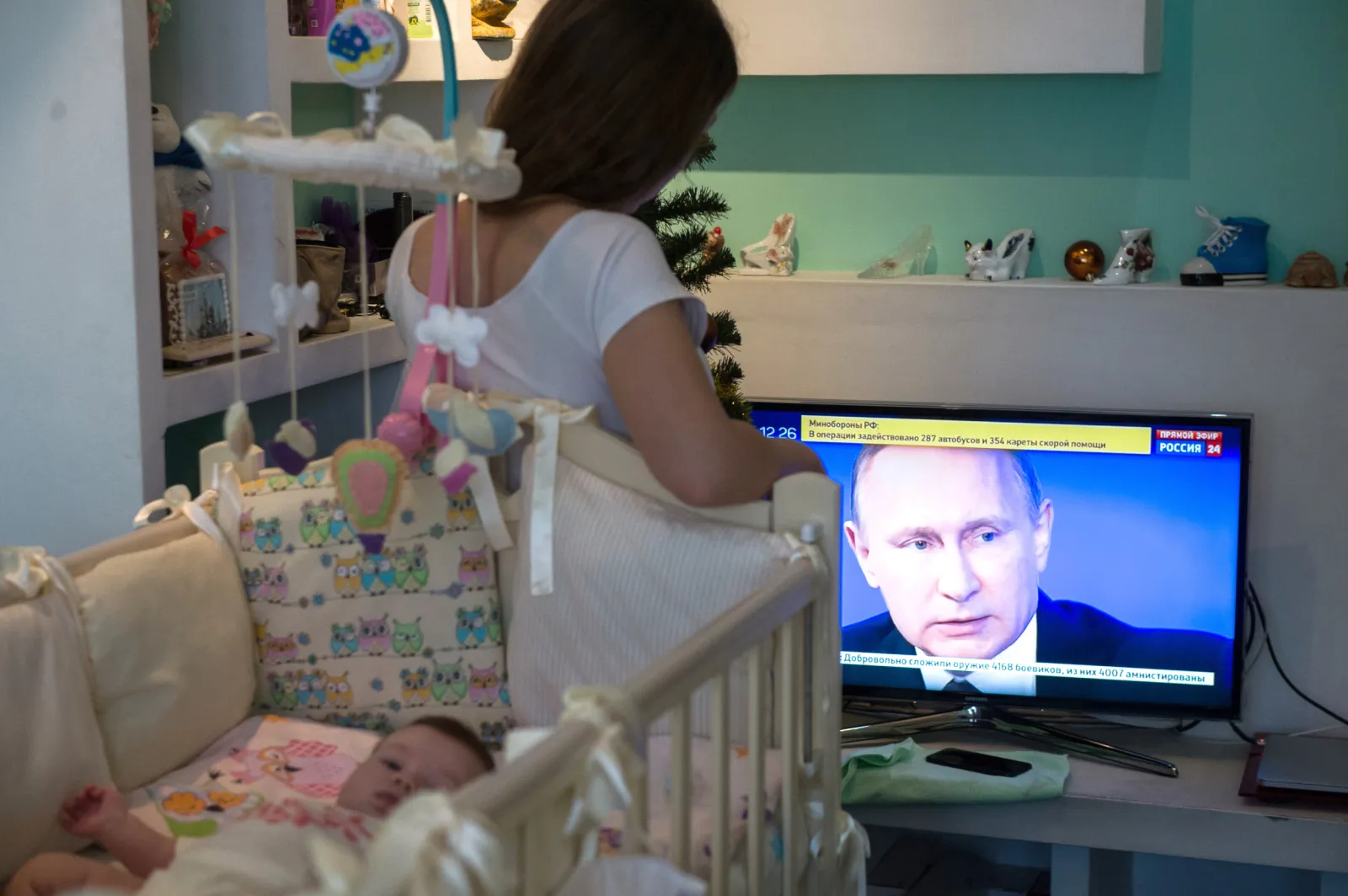
Russia is considering starting a new government ministry and would pay female students to have a child in order to combat the countrywide birth rate crisis, according to Indian newspaper The Economic Times.
The Russian government is looking at opening a "ministry of sex," in addition to paying female students between the ages of 18 and 23 in some regions, including Khabarovsk, £900 (about $1,160) to have one child, the report said.
If implemented on January 1, 2025, the new measures will aim to reverse the rapidly declining birth rate, which has been attributed to deaths in the Russia-Ukraine war.
Read More on World
...
Newsweek reached out to Russia's Ministry of Foreign Affairs for comment via email.
In September, Russia recorded its lowest birth rate in 25 years in the first six months of 2024, with the number of infant deliveries dropping below 100,000.
The current Russian birth rate is 1.5 children per woman, compared with 1.8 per woman in the U.S. A birth rate of 2.1 is needed to sustain a population.
The compensation for having a child differs in various Russian regions, with the payment for giving birth to one child as high as £8,500 (nearly $11,000) for a firstborn in the city of Chelyabinsk.
In the Karelia region, female students will be paid $1,100 in exchange for giving birth to a healthy baby, according to a Moscow Times report in July.
There is a caveat to the payments, as the government will not pay female students for stillbirths. The policy also says that the mother-to-be must be a full-time student at a local university or college and under 25 years old.
Michele Rivkin-Fish, a sociocultural and medical anthropologist and associate professor at the University of North Carolina Chapel Hill, told Newsweek that using financial incentives to encourage young women to have children has never been very effective, and accused the Russian government of trying to "engineer fertility and population behavior, rather than think about what people in their everyday lives need."
To increase the birth rate, Russia needs to improve the "conditions for raising children, which include not simply money, although money is part of it," she said. "They need a robust system of child care. They need workplaces that understand and care about work family balance."
Rivkin-Fish added, "They need conditions where there is both a recognition of the need for children to have excellent education and opportunities and the ability to make a stable income. So a lot of people are working very hard and their jobs are not secure, they don't have maybe a formal contract, and they're continually worried that they could lose their job. And that all contributes to a sense of vulnerability and precarity that makes women in particular reluctant to have more than one child."
The Russian government has previously discussed and implemented numerous incentives to convince the population to have more children. Moscow has even proposed to use public funds to pay for newlywed couples' wedding-night hotel stays, for up to 26,300 rubles (around $275), to promote pregnancies.
In addition, women have been encouraged to try to conceive at work.
One regional health minister, Yevgeny Shestopalov, said on Russian TV that women should "engage in procreation on breaks."
He added, "Being very busy at work is not a valid reason but a lame excuse. You can engage in procreation during breaks, because life flies by too quickly."
Last year, Russian Duma member Valery Seleznyov pushed for female prisoners to be released to have children in order to increase the country's birth rate. The remainder of their sentences would be canceled for doing so.
In 2022, President Vladimir Putin reintroduced the 20th-century "Mother Heroine" award, which rewards women who have 10 or more children with a one-off payment of 1 million rubles (about $10,000) as well as a title.
Moscow has also proposed new legislation that would prosecute those deemed to be promoting a "child-free" lifestyle, as part of the Kremlin's plan to "ban everything that does not fit into its so-called traditional values."
The bill includes fines of up to 400,000 rubles ($4,300) for people convicted of pushing "child-free" propaganda, 800,000 rubles ($8,602) for state officials doing so and 5 million rubles ($53,763) for companies.
The Russian government has also implemented methods to restrict access to abortion. They include passing laws in two regions that punish individuals found to "coerce" women into having abortions, limiting the number of abortions performed and approving legislation restricting access to abortion drugs, according to Al Jazeera.
Rivkin-Fish, author of Unmaking Russia's Abortion Culture: Family Planning and the Struggle for a Liberal Biopolitics, said a widespread "anti-abortion mood and perspective" spread after Russian women gained access to contraceptives in the 1990s, "even among Russians who believe that abortion should stay legal and accessible, because abortion is associated, symbolically, with the Soviet era of deficits and hardship and a kind of dehumanization of women and the value of life per se."
"That language of reproductive choice and reproductive autonomy has been coming out more presently since about 2015. Since then, you hear pro-choice as a term used in Russian. You hear talk about individual rights and individual autonomy," she said.
Referring to measures restricting access to abortion, Rivkin-Fish described a "a big move to promote the traditional family" and said that the Russian anti-abortion movement "has followed many of the strategies that the American anti-abortion movement has undertaken. So restricting access immediately and requiring waiting periods, the so-called week of silence, requiring people to have an ultrasound where they hear the heartbeat or see the fetus and hear the heartbeat."
"There's a lot actually of moves now in regions around Russia, local ordinances that prohibit private clinics from providing abortions, which means women would need to go to the state clinic, which just gives us fewer choices. In some of these regions, there's also a kind of penalty if someone has been trying to persuade a woman against having abortion, they can be fined. There's also bonuses, financial bonuses to clinicians who talk women out of having an abortion," she said.
"These are a lot of different kinds of pressures that are coming to bear on women to try to raise the birth rate in part through changing their values and in part through restrictive measures," Rivkin-Fish added.
Putin spoke about women's roles in Russian society at the Eurasia Women's Forum in September. "Russia is traditionally respectful of women. In this regard, our state policy relies on the National Strategy of Action in the Interests of Women," he said.
He continued, "Several initiatives have been put forward toward this end, and proper conditions are being created for women to succeed professionally while remaining guardians of the hearth and linchpins of large families with many children."
Russian manpower losses in the war in Ukraine have reached 710,660, with the highest loss of soldiers in one day at 1,770.
Other nations around the world have considered paying citizens to have children in reaction to falling birth rates, including South Korea, Japan and China.
Update 12/19/2024, 11:05 a.m. ET. This article has been updated with comment from Michele Rivkin-Fish.
View 0 Comments
Submit Correction
View Editorial & AI Guidelines