
By Brendan Cole
Senior Reporter
0
Share
Newsweek is a Trust Project member
See more of our trusted coverage when you search.Prefer Newsweek on Googleto see more of our trusted coverage when you search.
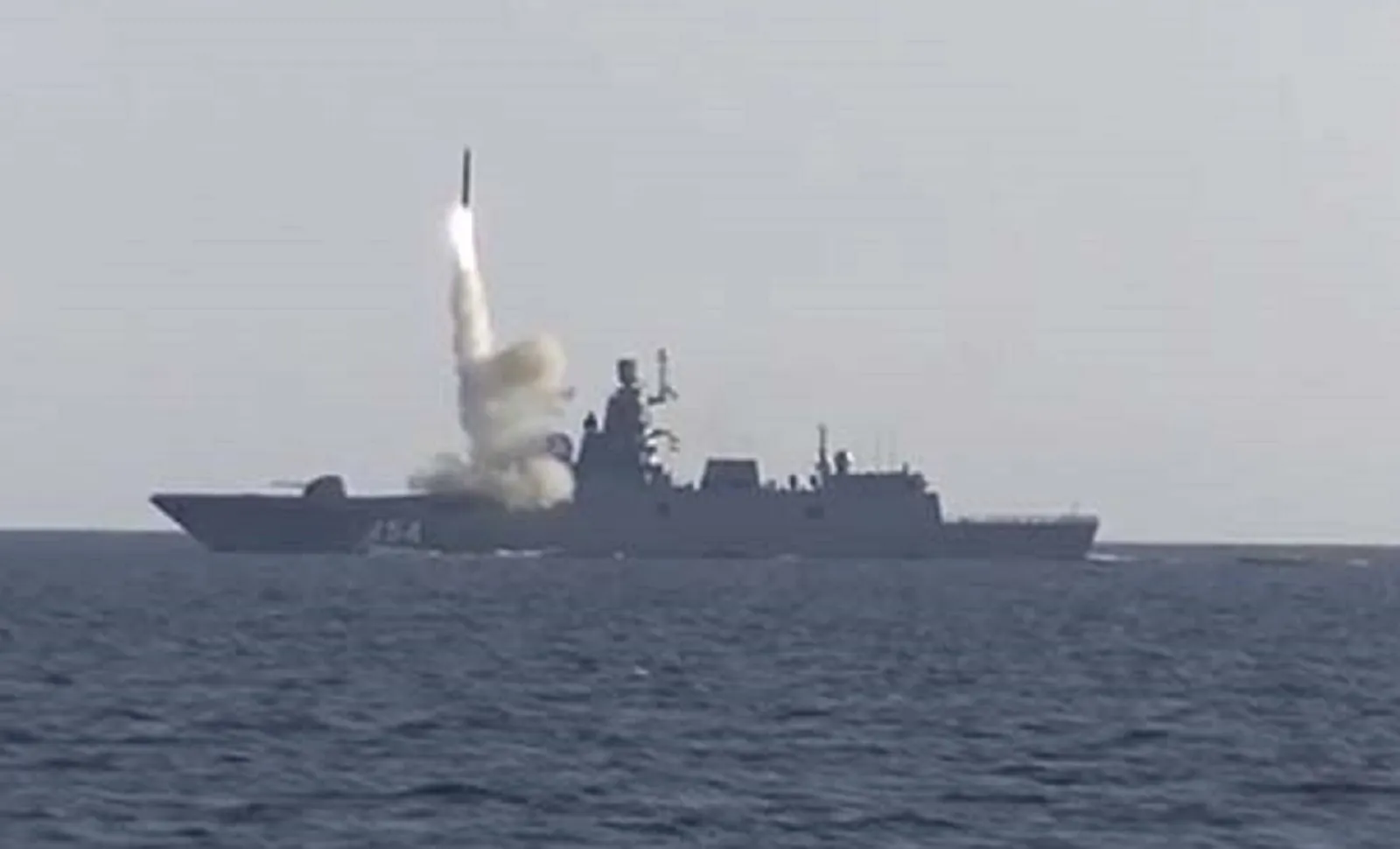
Moscow has warned the Pentagon that the U.S. deploying hypersonic missiles in Europe could unintentionally spark hostilities, just hours after Russia test-fired a weapon it wants to equip its warships and submarines with.
On Monday, Pentagon Press Secretary John Kirby was asked about Russia's claims that it had successfully tested a Tsirkon hypersonic cruise missile.
Russia's Defense Ministry had earlier said that the Admiral Gorshkov frigate had successfully test-fired the missile. Fired from Russia's Arctic region, it reached a speed of Mach 7 and hit a surface target about 217 miles away, on the coast of the Barents Sea, Tass news agency reported on Monday.
Read More
Russia Tests Hypersonic Missile, Hits Target More Than 200 Miles Away3 min read

Russia Sends Fighter Jets to Intercept U.S. Strategic Bombers3 min read

Russia Warns U.K. and NATO Next Black Sea Spat Will Be Met With ‘Most Severe’ Response3 min read

"The tactical and technical characteristics of the Tsirkon missile were confirmed during the tests," the Defense Ministry said, also releasing video of the weapon, which President Vladimir Putin had previously boasted would be able to reach speeds of Mach 9, and hit targets up to 700 miles away.
When asked about the test, Kirby said: "We're certainly aware of President Putin's claims, [...] it's important to note that Russia's new hypersonic missiles are potentially destabilizing and pose significant risks because they are nuclear capable systems."
Kirby added: "By contrast, the United States is developing solely non-nuclear hypersonic strike capabilities. So alongside our NATO allies we remain committed to deterrence while promoting greater stability in the region."
With Moscow still upset over alliance-led military exercises in the Black Sea, Kirby's comments spurred a stern response from the Russian Embassy in Washington.
In a tweet in which it shared a screen grab of a transcript of Kirby's remarks, a red exclamation mark, a missile and flag emojis, the embassy said: "We would like to remind @PentagonPresSec that potential deployment of any [U.S flag] hypersonic [missile] in Europe would be extremely destabilizing."
"Their short flight time would leave [Russian flag] little to no decision time and raise [the] likelihood of inadvertent conflict."
Meanwhile, Russian Senator Alexei Pushkov also took a swipe at Kirby's comments.
He wrote on Telegram that Russia was acting within the context of "the approach of NATO towards Russia's borders," the U.S. withdrawal from the Intermediate Range Nuclear Forces (INF) Treaty as well as within the context in which "the introduction of 75 different sanctions are a series of acts of economic war."
"Is Kirby aware of all this?" Pushkov wrote.
Western experts are still examining the capability of Russia's new generation of hypersonic weapons, of which the speed and maneuverability are acknowledged as making them difficult to track and intercept.
After boasting in 2018 that Russia was developing a range of new hypersonic weapons, Putin then threatened to station them on ships and submarines near American territorial waters if the U.S. deployed intermediate-range nuclear weapons in Europe.
In April, the Russian Black Sea Fleet's Moskva missile cruiser test-fired the Vulkan missile in a a show of force to NATO.
Newsweek has contacted the Pentagon for comment.
...
View 0 Comments
Submit Correction
View Editorial & AI Guidelines