...


By Shane Croucher and John Feng
0
Share
Newsweek is a Trust Project member
See more of our trusted coverage when you search.Prefer Newsweek on Googleto see more of our trusted coverage when you search.
Russia's Defense Ministry said it used its new hypersonic Oreshnik ballistic missile, an intermediate-range, nuclear-capable weapon, in a "massive strike" on Ukraine to avenge the alleged attempt to strike Russian President Vladimir Putin's state residence.
The U.S. has said it does not believe Ukraine attempted to strike Putin's residence, and Kyiv has called the Kremlin's claim a lie.
- Essential Reading: Trump Loves Gold—and Venezuela’s Got Plenty
- Conventional Wisdom: Trump Lawfare Update Edition
Read More on World
The ministry in Moscow said Russia's strikes overnight on Friday were "in response to the terrorist attack by the Kiev regime" on Putin's residence in the Novgorod region.
Russian forces "launched a massive strike with high-precision long-range ground- and sea-based weapons, including the Oreshnik mobile ground-based medium-range missile system as well as attack unmanned aerial vehicles at critically important facilities on the territory of Ukraine," the Defense Ministry said.
...
It is only the second time the Oreshnik—the "hazel tree"—has been used. The missile's hypersonic speed and nuclear capability pose a major security threat to European NATO allies.
Putin confirmed its use in November 2024 for an attack on Dnipro, Ukraine, in a test of its combat readiness. A system armed with Oreshniks entered combat duty in Belarus in December 2025.
Russia's Oreshnik Strike Hits Kyiv, Lviv
The U.S. had earlier warned that it received information of a "potentially significant" air attack on Ukraine. The U.S. Embassy in Kyiv warned American citizens to immediately shelter in place in the event of such a strike.
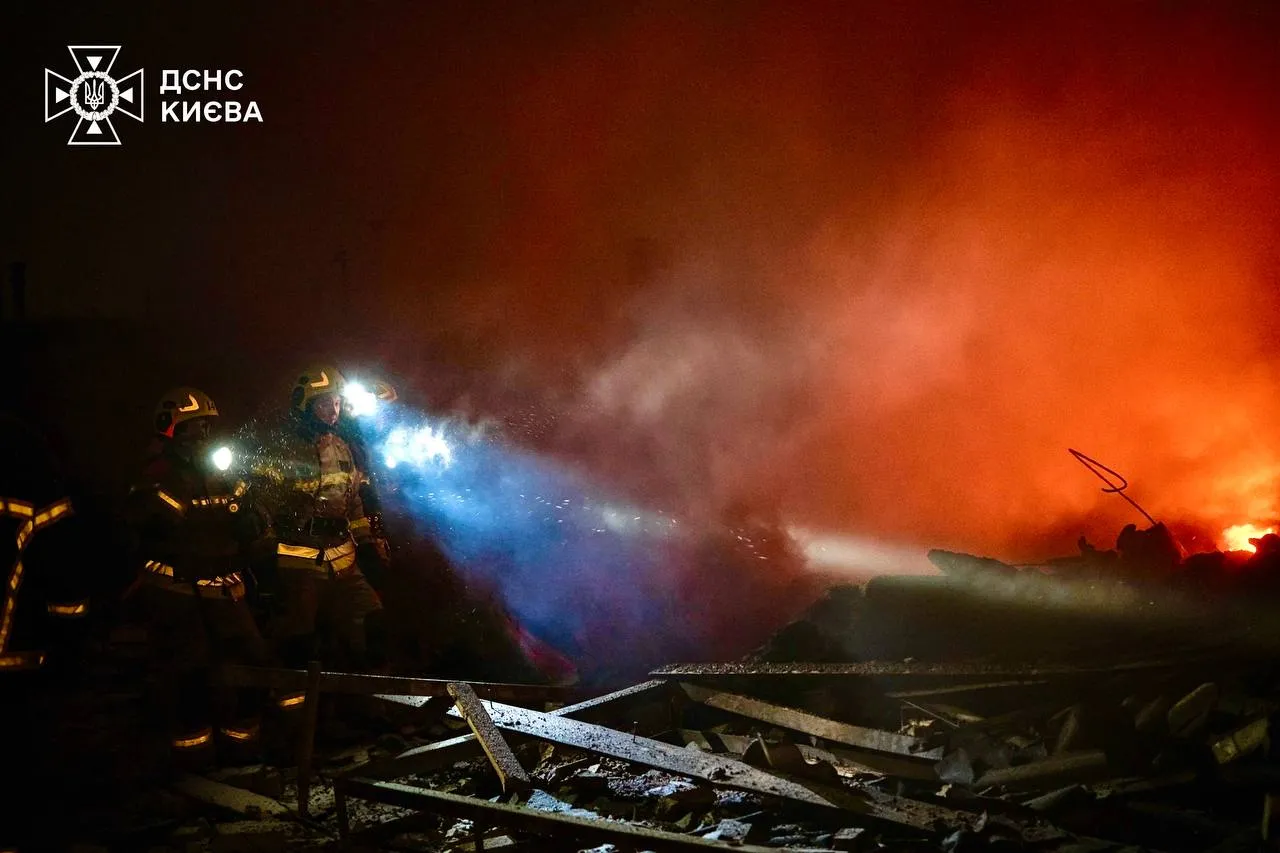
The State Emergency Service of Ukraine said four people had died so far in the attack on Kyiv, and 22 more were injured, including five rescuers.
"The enemy struck residential areas of the capital. Fires and damage to residential buildings, civilian and industrial facilities were recorded," the emergency service said.
The Russian Defense Ministry said it had targeted "production facilities of unmanned aerial vehicles that were used during the terrorist attack as well as power infrastructure enterprises that supported the defense industry of Ukraine."
The ministry warned, "Any terrorist actions by the criminal Ukrainian regime will not remain unanswered in the future."
Lviv in western Ukraine was also struck. The Western Command of Ukraine's Air Force had earlier said a ballistic missile traveling at more than 8,000 mph had hit the city.
"The type of rocket with which Russian aggressors attacked the city will be established after studying all its elements," the command said on its Facebook page, originally in Ukrainian.
Home security camera footage circulating on social media showed what appeared to be Oreshnik missiles raining down on Lviv.
Lviv Mayor Andriy Sadovyi said "critical infrastructure" had been hit in the attack and local gas supplies had been affected.
"This is the first case of such a strike on Lviv during a full-scale war," Sadovyi wrote on Telegram, originally in Ukrainian, after citing the apparent speed of the ballistic missile, likely an Oreshnik.
With the city less than 70 kilometers from the border with the European Union, he added that the strike was "a clear signal to our international partners: Russia's war does not stop at any borders."
What Is the Oreshnik Missile?
The Oreshnik derives from Russia's previous RS-26 Rubezh system and is capable of hitting hypersonic speeds of Mach 10.
In its analysis at the time of the 2024 use, the Institute for the Study of War, a nonprofit research group and think tank, identified the Oreshnik as "an experimental medium-range ballistic missile with reentry vehicles—likely a modified RS-26 'Rubezh' intermediate-range ballistic missile (IRBM)" fired from Astrakhan Oblast into central Ukraine.
The latest missile can carry a nuclear or conventional payload containing the warheads, or have multiple independently targetable reentry vehicles that transport explosives to numerous targets.
The Belarusian Defense Ministry said the Oreshnik had a range of up to 3,100 miles.
Russian state media boasted that it would take the missile only 11 minutes to reach an air base in Poland and 17 minutes to reach NATO headquarters in Brussels. There's no way to know whether it's carrying a nuclear or conventional warhead before it hits a target.
Intermediate-range missiles can fly between 310 and 3,400 miles. Such weapons were banned under a Soviet-era treaty that Washington and Moscow abandoned in 2019.
This article includes reporting by the Associated Press.
Updated, 1/9/26, 7:17 a.m. ET: This article was updated with more information.
The news cycle is loud. Algorithms push us to extremes. In the middle—where facts, ideas and progress live—there's a void. At Newsweek, we fill it with fearless, fair and fiercely independent journalism.
Common ground isn't just possible—it's essential. Our readers reflect America's diversity, united by a desire for thoughtful, unbiased news. Independent ratings confirm our approach: NewsGuard gives us 100/100 for reliability, and AllSides places us firmly in the political center.
In a polarized era, the center is dismissed as bland. Ours is different: The Courageous Center—it's not "both sides," it's sharp, challenging and alive with ideas. We follow facts, not factions. If that sounds like the kind of journalism you want to see thrive, we need you.
When you become a Newsweek Member, you support a mission to keep the center strong and vibrant. Members enjoy:
Help keep the center courageous. Join today.


View 0 Comments
Submit Correction
View Editorial & AI Guidelines