...

By Gabe Whisnant
News Editor
0
Share
Newsweek is a Trust Project member
See more of our trusted coverage when you search.Prefer Newsweek on Googleto see more of our trusted coverage when you search.
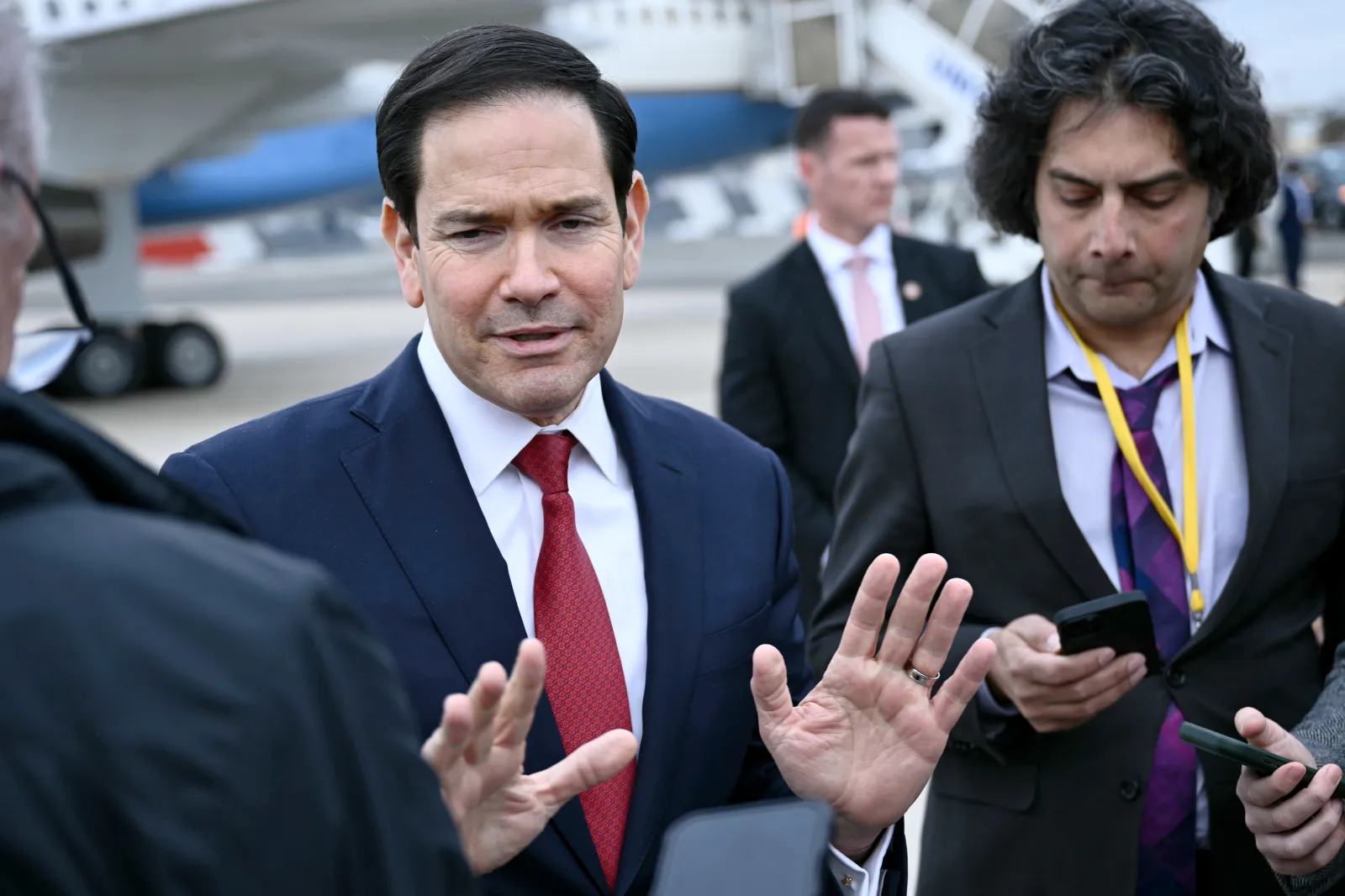
Secretary of State Marco Rubio said Friday that the United States can achieve its military objectives in Iran without deploying ground forces, even as thousands of U.S. troops move into the region.
“I won’t discuss military tactics,” Rubio said, adding that most U.S. objectives are “ahead of schedule” and can be met “without any ground troops.”
When pressed on what role the incoming forces could play short of a ground invasion, Rubio said President Donald Trump must be prepared for multiple contingencies. He said U.S. forces are positioned to give the president “maximum optionality” should conditions change.
Read More on World
...
At least 1,000 troops from the Army 82nd Airborne Division are among those en route to the region.
Rubio Warns Strait of Hormuz Could Be Post‑War Challenge
Rubio said ensuring shipping access through the Strait of Hormuz could pose an immediate challenge even after U.S. military operations end.
Speaking after a G7 meeting in France, he said Iran could attempt to impose restrictions or tolls on the strategic waterway, which he said would be illegal and economically damaging.
“The world has to have a plan,” Rubio said, adding that the U.S. would seek international cooperation to keep the strait open.
Rubio Downplays Russia’s Role in Assisting Iran
Rubio dismissed reports that Russia has provided Iran with intelligence to target U.S. personnel and assets during the conflict.
“There is nothing Russia is doing for Iran that is in any way impeding or affecting our operation,” he said.
No Ukraine Aid Diverted, Rubio Says—for Now
Rubio said no U.S. military aid has been diverted from Ukraine to the Middle East, though he acknowledged it could happen if U.S. needs require it.
Patriot air-defense systems have been moved from Europe to the region. Ukrainian President Volodymyr Zelensky has warned the shift could lead to shortages in Ukraine.
“As of now, that has not happened,” Rubio said.
G7 Statement Calls for Civilian Protections and 'Toll‑Free' Hormuz Access
The Group of Seven’s (G7) foreign ministers issued a joint statement at the close of their meeting in Vaux‑de‑Cernay in northern France, calling for “an immediate cessation of attacks against civilians and civilian infrastructures,” while also condemning attacks on diplomatic facilities. The statement said the ministers discussed limiting the war’s impact on regional partners, civilian populations and critical infrastructure, and stressed coordination of humanitarian aid efforts.
The G7 also placed special emphasis on the Strait of Hormuz, describing the “absolute necessity” of restoring “safe and toll free freedom of navigation” through the waterway. In the same statement, the ministers said they focused on ways to mitigate broader economic fallout, including disruptions to “economic, energy, fertilizer and commercial supply chains,” which they warned can have direct impacts on citizens in their countries.
In addition to urging restoration of navigation, the G7 framed Hormuz access as a rules‑based issue, explicitly tying the demand to U.N. Security Council Resolution 2817 and the Law of the Sea. That language gives you clean copy to connect the diplomatic push not just to energy-market pressure, but also to how allies are trying to define a post‑conflict security baseline for international waterways.

...
Rubio’s Pitch: No Ground War, But a Post‑War Hormuz 'Plan' Is Coming
Speaking to reporters after the G7 meetings, Rubio reiterated that he would not discuss tactics, but said U.S. objectives in Iran were “on or ahead of schedule” and that Washington expected the operation to conclude “in a matter of weeks, not months.”
Rubio’s most developed argument centered on what comes next: He warned that once U.S. operations end, one immediate challenge could be Iran attempting to impose a “tolling system” in the Strait of Hormuz. Rubio called that possibility “illegal” and “unacceptable,” and said it would be “dangerous to the world."
He also positioned Hormuz security as an international burden‑sharing test. Rubio said the U.S. is prepared to be part of a broader effort, but emphasized that many countries—including in Asia—have significant stakes in the free flow of shipping and should contribute. In separate remarks a day earlier, Rubio made the same point more bluntly, saying that other countries “get far more of their fuel from there than we do,” and arguing it is in their national interests to help keep the passage open.
Updates: 3/27/26, 6:06 p.m. ET: This article was updated with new information and remarks.
This article includes reporting by the Associcated Press.
View 0 Comments
Submit Correction
View Editorial & AI Guidelines