...

By Andrew Stanton
Reporter
0
Share
Newsweek is a Trust Project member
See more of our trusted coverage when you search.Prefer Newsweek on Googleto see more of our trusted coverage when you search.
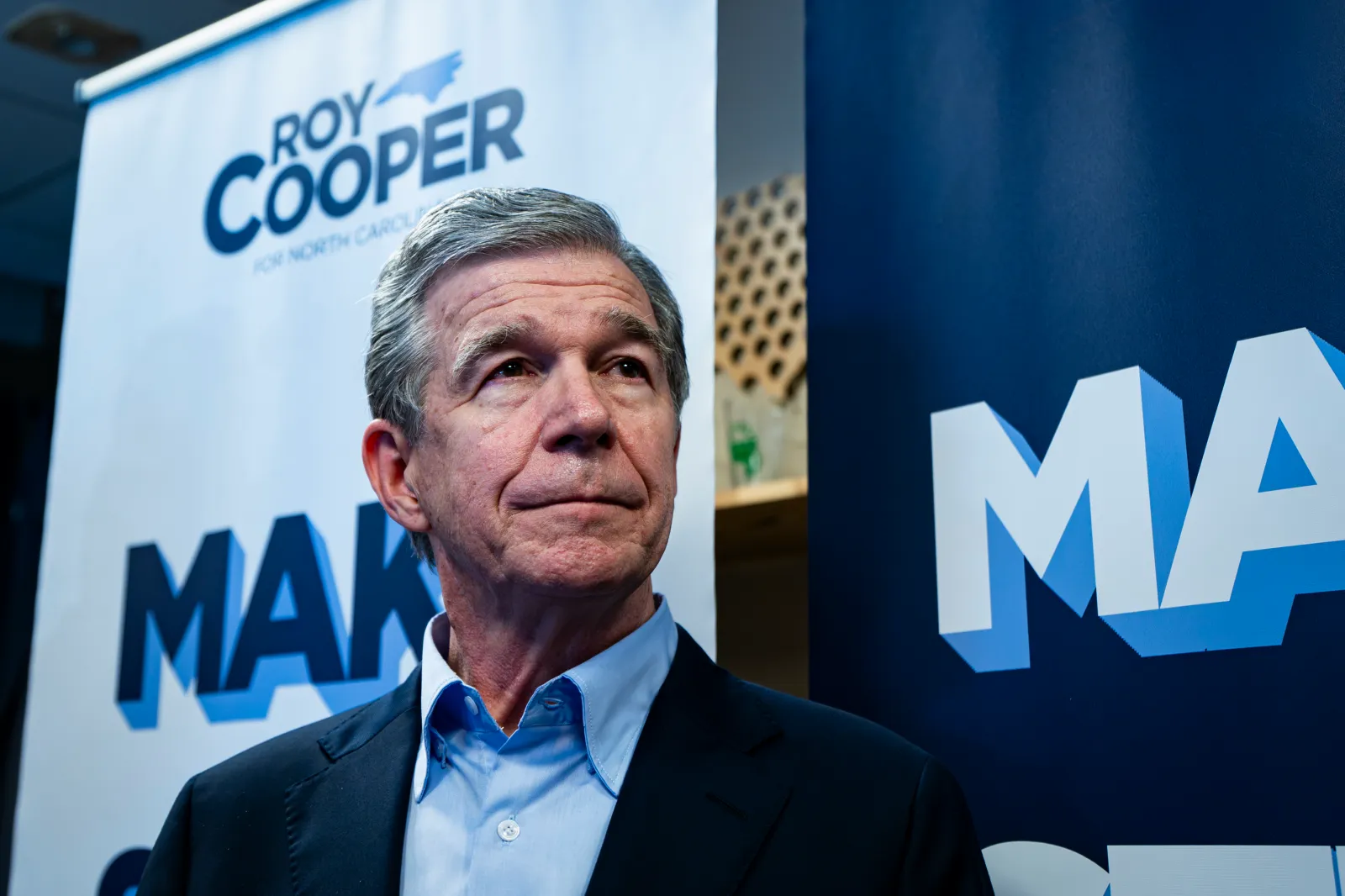
Former Governor Roy Cooper, a Democrat, held a double-digit lead over ex-Republican National Committee Chair Michael Whatley in the latest poll of North Carolina’s U.S. Senate race, released on Tuesday.
Democrats view the North Carolina seat held by retiring Republican Senator Thom Tillis as perhaps their best opportunity to flip a Senate seat in the 2026 midterm elections, as they battle for majority control in November. The Tar Heel State narrowly backed President Donald Trump in 2024 and is seen as a battleground that's about evenly divided between Democrats and Republicans.
Democrats haven’t won a Senate seat in North Carolina since 2008, but believe a favorable national environment and the candidacy of a popular, well-known former governor put them in a strong position to win in November.
Read More on News
Roy Cooper Leads Michael Whatley in New Poll
A new poll from Catawba College released on Tuesday found Cooper with a 14-point lead, supported by 48 percent of respondents, compared to Whatley’s 34 percent. Fifteen percent were undecided. That’s the same margin Cooper led in the pollster’s survey from March.
Michael Bitzer, director of Catawba College's Center for North Carolina Politics & Public Service, wrote in a polling release that Cooper’s lead is “being driven by independents, who currently support him by more than two-to-one over Whatley.”
...
“In addition, this year appears to be setting up as a classic mid-term environment: a referendum on the president and his party. Cooper has a commanding portion of those North Carolinians who disapprove of the president, which is a majority of likely voters so far,” he wrote.
The poll surveyed 1,000 North Carolina voters from June 1 to June 10 and had a margin of error of plus or minus 3.83 percentage points.
Jeff Allen, a Cooper spokesperson, responded to the poll in a statement to Newsweek.
"Roy Cooper has spent his career putting North Carolinians first, while Washington DC insider Michael Whatley spent his delivering for billionaires and special interests at the expense of the middle class. A Democrat has not won statewide federal office in North Carolina in nearly two decades and we know this race will be very close, which is why we’re building a campaign to earn every vote and make sure North Carolinians know that Roy Cooper will fight for them in the Senate," he wrote.
Newsweek also reached out to Whatley's campaign via email for comment.
What Do Other Polls Show?
Cooper, who benefits from high name recognition in North Carolina, has carved out an early polling lead.
A recent Harper Polling/Carolina Journal poll showed Cooper leading Whatley by more than 11 points, with 49.8 percent of respondents saying they would support him in November. Whatley received 38.7 percent of the vote. The poll surveyed 600 likely voters on May 10 and May 11, with a margin of error of plus or minus 4 percentage points.
A High Point University/YouGov poll released last month showed Cooper up 8 points with likely voters. Fifty percent of respondents said they would support him, while 42 percent said they intend to cast their ballots for Whatley. It surveyed 703 people from March 26 to April 6, with a margin of error of plus or minus 4.3 percentage points.

...
A Quantus Insights poll suggested a closer race, with 49 percent of respondents supporting Cooper and 44 percent backing Whatley. It surveyed 987 likely voters on March 31 and April 1, with a margin of error of plus or minus 3.5 percentage points.
Cooper Leads in Prediction Markets
Prediction markets also favor Cooper, who held an 85 percent chance of victory on Kalshi and an 86 percent chance on Polymarket as of Tuesday.
Prediction markets allow traders to buy and sell contracts tied to political outcomes and current events, aggregating real‑money wagers into probability estimates.
Prices fluctuate as traders react to polling, fundraising, candidate developments and broader political trends. They measure trader sentiment at a given moment but do not always accurately predict the future.
Democrats’ Elusive Swing State
Democrats have performed well in recent gubernatorial elections in the state but have fallen short in federal elections. The late Senator Kay Hagan was the last to win a Senate race in 2008, when former President Barack Obama also won the state.
In 2022, Democrat Cheri Beasley lost to Republican Ted Budd, then a member of the House, by about 3 points. Tillis defeated Democrat Cal Cunningham by less than 2 points in 2020. In 2016, former GOP Senator Richard Burr defeated Democrat Deborah Ross, now a member of Congress, by nearly 6 points.
At the same time, Democrats have held a grip on the governor's mansion. Democrat Josh Stein, who succeeded Cooper, won November's race by nearly 15 points after Republican Mark Robinson faced a series of scandals on the campaign trail.
Over the past decade, Democrats have gained ground in the suburbs around Charlotte and Raleigh but have struggled in more rural parts of the state, which were once more competitive when Obama won the state in 2008.
Trump also carried the state in each of his three runs, albeit by narrow margins—about 3.6 points in 2016, 1.3 points in 2020 and 3.2 points in 2024.
As of June 20, there were 2,315,070 registered Democrats in North Carolina, and 2,325,777 registered Republicans. However, 3,096,420 North Carolina voters were registered as unaffiliated, according to the North Carolina State Board of Elections.
North Carolina Considered a Must-Win for Democrats
The stakes are high for Democrats in North Carolina, as the overall Senate map presents Democrats with an uphill battle.
Republicans hold a 53-47 majority, meaning Democrats must flip four seats to regain control of the upper chamber.
In addition to North Carolina, Democrats view the seat in Maine, held by Republican Senator Susan Collins, as another top target, as it is a Democratic-leaning state that backed former Vice President Kamala Harris by about 7 points in 2024.
Democrats are also on the defensive in two Trump-won states, Georgia and Michigan.
But even if Democrats win all four of those races, Republicans would still have a 51-49 majority, so they are eyeing states where Trump won by double digits, such as Alaska, Iowa, Ohio and Texas, as potential flip opportunities. Those states are more conservative, but polls suggest races could be close.
What Happens Next
Polls will continue to be closely watched in the coming months as key barometers for where voters stand in this swing state. Forecasters like Cook Political Report and Sabato’s Crystal Ball rate the North Carolina race as leaning Democratic, but still consider it competitive.
Contact Newsweek editors on this story: Gabe Whisnant, Ed Cummins and Sam Wilson.
View 0 Comments
Submit Correction
View Editorial & AI Guidelines