...

By Adeola Adeosun
Weekend Night Editor
0
Share
Newsweek is a Trust Project member
See more of our trusted coverage when you search.Prefer Newsweek on Googleto see more of our trusted coverage when you search.
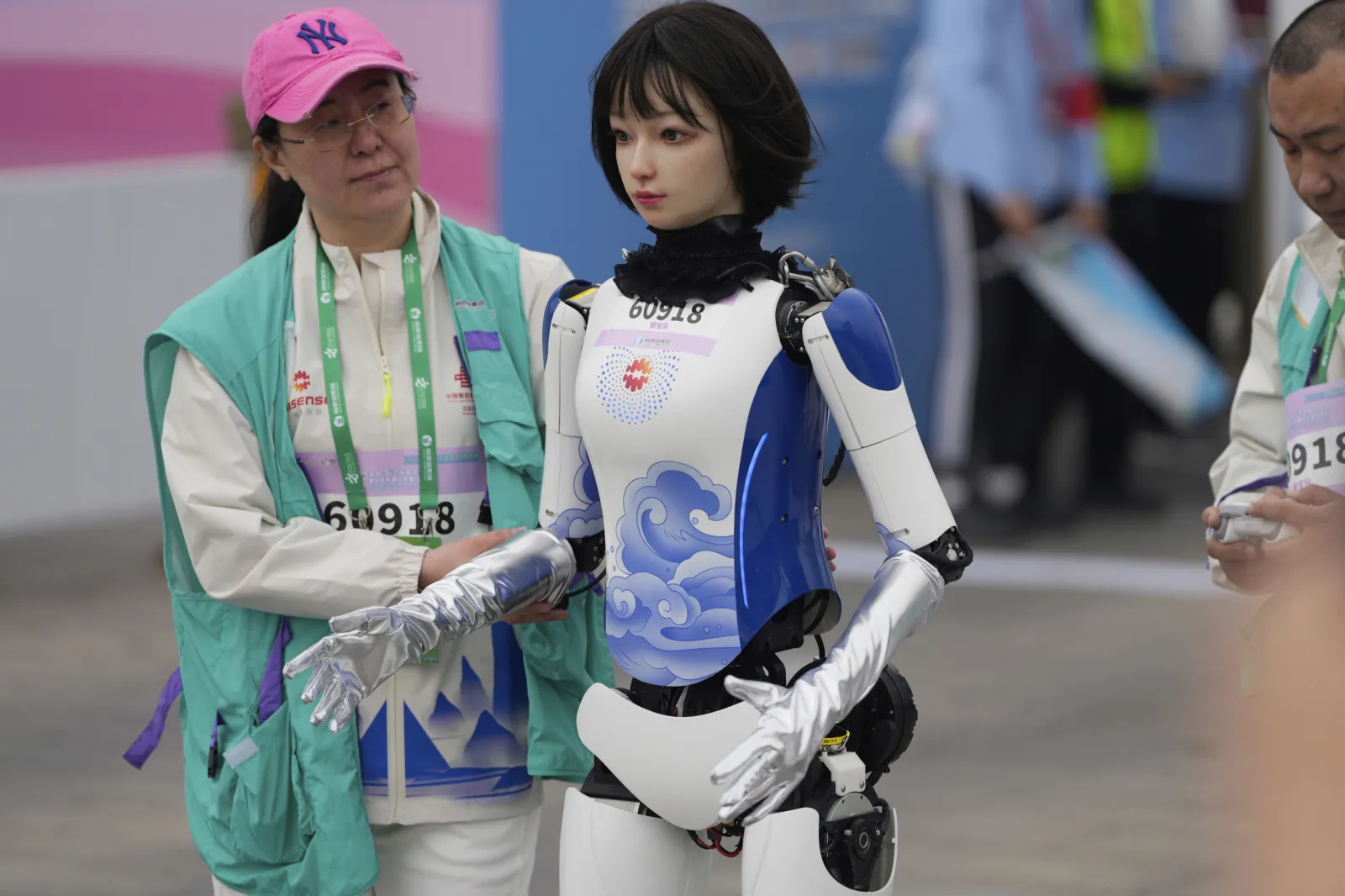
Twenty-one humanoid robots competed alongside thousands of human runners in Beijing on Saturday in what organizers claim is the world's first bipedal robot half-marathon.
Newsweek reached out to Noetix Robotics, one of the companies with robots competing, via email on Saturday for comment.
Why It Matters
A bipedal robot is a machine designed to move using two legs rather than wheels or tracks, similar to how humans walk. The term "bipedal" literally means "two-footed," referring to the robot's ability to balance and move on two limbs.
Read More on Tech
This historic event showcased the current state of humanoid robot technology, particularly highlighting hardware robustness rather than artificial intelligence (AI) capabilities.
While impressive as a technological demonstration, it revealed progress and significant limitations in bipedal robotics. Only six robots reportedly successfully completed the entire course, with most encountering difficulties early in the race.
...
What To Know
Teams fielded various machines to navigate the 21.1-kilometer course, with robots running on a separate track divided by approximately 12,000 human participants. The Tiangong Ultra robot (also known as Sky Project Ultra) from the Beijing Innovation Center of Human Robotics finished first among the robots, with a time of 2 hours, 40 minutes, and 42 seconds, according to Wired.
Some robots reportedly collapsed face-down during the latter part of the race, with one robot's head becoming completely detached from its body. A robot named "Xuanfeng Xiaozi" finished the race with a cooling pad attached to its front and its feet out of synchronization, wobbling across the finish line.
The robots competed under specially tailored rules, including allowances for battery swap pit stops. Various designs and strategies were employed, with some robots wearing sneakers, others equipped with knee pads, and many eliminating unnecessary components to reduce weight.
Human operators accompanied each robot, providing guidance, changing batteries, and performing emergency repairs—often with duct tape. The fastest robot barely met the minimum qualifying time for human runners.
Is China Mass Producing Robots?
In December, AgiBot, a Chinese technology company, announced that it has begun mass production of general-purpose robots. AgiBot, also known as Zhiyuan, a start-up that launched in February 2023, released a video on its website of its new robots on December 16. The firm has manufactured nearly 1,000 of the humanoid robots so far, according to The Global Times.
The U.S. has also been pushing the development of humanoid robots, with Tesla showcasing the latest iteration of its own bot at the We, Robot event last October.
CEO Elon Musk said on X, formerly Twitter, in 2024 that Tesla would have its robots ready for release by 2026.
What People Are Saying
Alan Fern, robotics professor at Oregon State University, told Wired: "Until five years ago or so, we didn't really know how to get robots to walk reliably. And now we do, and this will be a good demonstration of that."
Tang Jian, chief technology officer for the robotics center, in a statement following the race said, per Reuters: "I don't want to boast, but I think no other robotics firms in the West have matched Tiangong's sporting achievements."

...
What Happens Next
The viral event has generated significant public interest and demonstrated the current limitations of humanoid robotics.
The race revealed that while bipedal locomotion technology has improved, issues like overheating, balance, and endurance remain significant challenges for robotics engineers.
Reporting from the Associated Press contributed to this article.
View 0 Comments
Submit Correction
View Editorial & AI Guidelines