10
Loading video...

By Jordan King
Reporter
0
Share
Newsweek is a Trust Project member
See more of our trusted coverage when you search.Prefer Newsweek on Googleto see more of our trusted coverage when you search.
Republicans have edged ahead in the market odds for the Wisconsin governor’s race after a series of late withdrawals and campaign reversals threw the Democratic primary into turmoil.
Prediction-market trading platform Kalshi gave the Republican Party a 53 percent chance of winning the governorship compared with 48 percent for Democrats, as of early Monday morning. As recently as early August 1, Democrats held a 55 percent to 46 percent lead.
The Democratic contest has been disrupted by a series of withdrawals and reversals. Milwaukee County Executive David Crowley left the race to endorse Lt. Gov. Sara Rodriguez, then reentered after the latter withdrew amid a campaign finance controversy.
Read More on News
Former Lieutenant Governor Mandela Barnes later dropped out less than two weeks before the primary following reports that the state Democratic Party had reviewed allegations of inappropriate behavior against him. Barnes denied wrongdoing, and a legal review found nothing actionable
Wisconsin will hold its primary on August 11, with democratic socialist state Representative Francesca Hong and Crowley the leading Democratic contenders.
A Marquette University Law School poll released before Barnes' withdrawal, showed Hong with a double-digit lead at 38 percent, ahead of her rivals. Barnes was in second place with 16 percent of the support. Crowley has made a direct plea to Barnes’ supporters to back him.
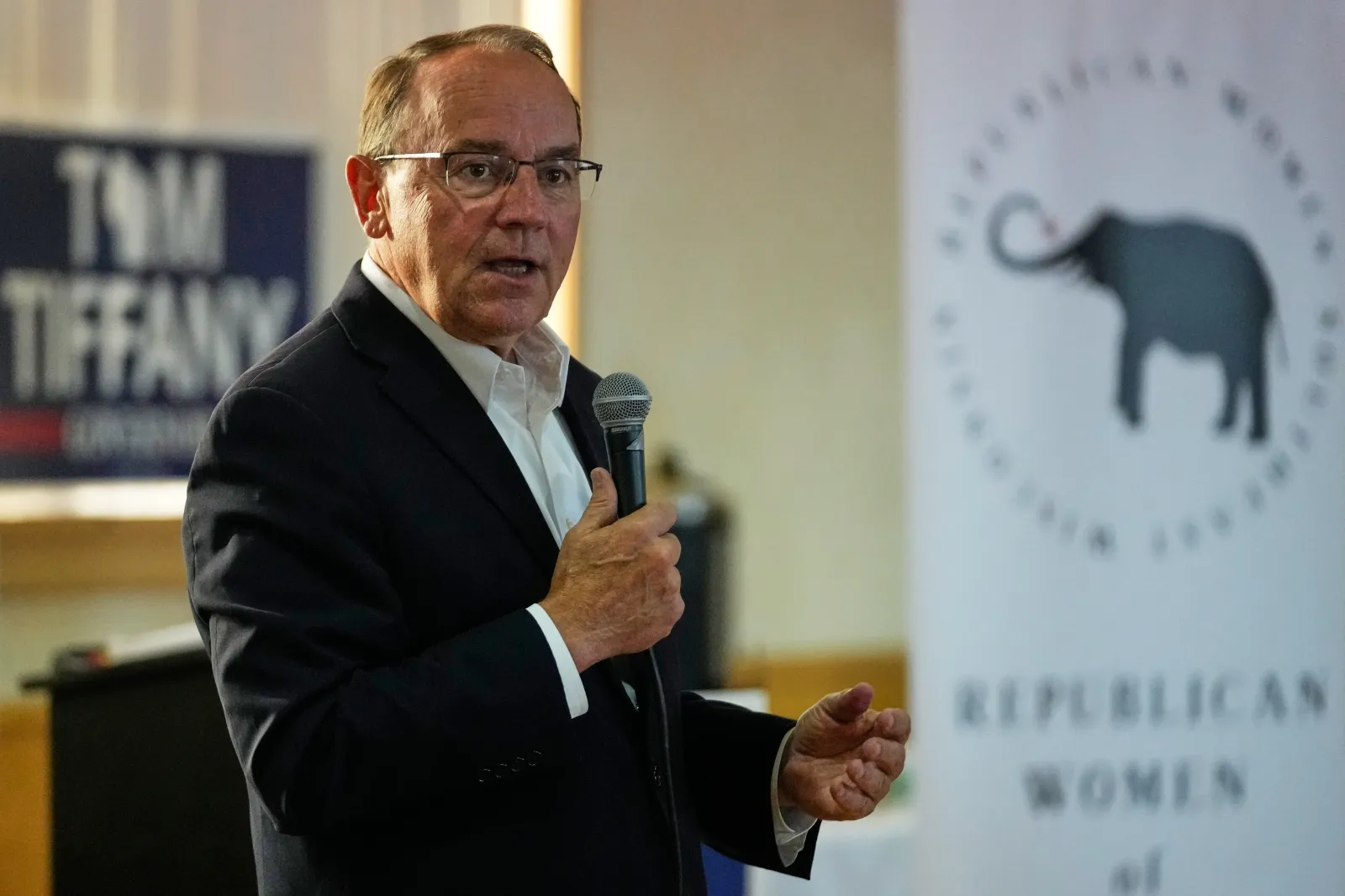
The winner will likely face Republican Representative Tom Tiffany, who is expected to win the GOP nomination for the November 3 general election.
...
Tiffany, who has been endorsed by President Donald Trump, has said the choice is between a “socialist agenda” or “common sense.”
The race is particularly important because Wisconsin is one of the country’s most closely divided swing states, where statewide elections are often decided by narrow margins.
Control of the governor’s office could also shape the direction of state policy and influence the balance of power with the Republican-led Legislature, which has frequently clashed with Democratic Governor Tony Evers.
Democrats are seeking to retain the governorship while also positioning themselves to challenge GOP control of the legislature, which would give either party unified control of state government.
How Wisconsin’s Democratic Primary Descended Into Turmoil
When Crowley suspended his campaign on July 8 and endorsed Lieutenant Governor Sara Rodriguez, the latter had been considered one of the leading candidates. But her campaign later revealed that it had hundreds of thousands of dollars less than expected after donations were counted twice and expenses were underreported.
Advertising invoices had also gone unpaid, preventing scheduled television commercials from airing. Rodriguez fired her campaign manager and reported the discrepancies to the Wisconsin Ethics Commission before withdrawing from the race on July 17, saying the financial problems had become too much of a distraction.
Crowley reversed course the following day and resumed his campaign, now with the endorsement of outgoing Democratic Governor Tony Evers. The move drew criticism from Barnes’ campaign, which argued that Crowley’s return risked further dividing Democrats and helping Republicans in the general election.
The race was thrown into further uncertainty when Barnes withdrew less than two weeks before the primary. His departure followed reports that the state Democratic Party had reviewed anonymous allegations of inappropriate behavior dating from 2024 and 2025. Barnes denied wrongdoing, while a legal review commissioned by the party found nothing actionable, according to The Associated Press, which cited a person with direct knowledge of the party’s actions.
The timing has complicated matters for voters. By the time Barnes left the race, nearly 128,000 people had already returned absentee ballots, and Wisconsin was on the third day of in-person early voting. Some of those ballots may contain votes for candidates who are no longer running, but state law does not allow voters to retrieve a returned absentee ballot and replace it with another.
On Wednesday, Dane County Circuit Judge David Conway rejected a lawsuit brought by three voters and supported by the Democratic Party that sought to let those who had already returned absentee ballots cancel them and vote again.
Democrats argued that preventing voters from changing their ballots would disenfranchise those whose candidates had withdrawn. Conway ruled, however, that the law’s language does not permit an absentee ballot to be “spoiled” after it has been returned. The decision left votes cast for departed candidates in place as the remaining campaigns entered the primary’s final days.
Wisconsin Tests Democratic Socialism’s Reach
The democratic socialist movement has seen several electoral wins in cities including New York, Philadelphia and Denver.
The Democratic Socialists of America’s own live 2026 results tracker listed 38 wins, 87 candidates still running and 38 losses as of early August, with its June 23 results including wins by Darializa Avila Chevalier in New York’s 13th Congressional District, Claire Valdez in New York’s 7th and Alexandria Ocasio-Cortez in New York’s 14th District.
A Hong nomination would turn the general election into a major test of whether democratic socialism can succeed beyond heavily Democratic urban districts.
Unlike many candidates associated with the movement, Hong would be competing statewide in a closely divided electorate where Democrats also need support from independents and moderate voters.
Hong is a member of the Democratic Socialists of America and the Wisconsin Assembly’s Socialist Caucus. Her campaign calls for higher taxes on millionaires and large corporations, universal child care, greater public ownership of infrastructure and a moratorium on new data centers until protections for the state’s energy grid, water and farmland are established.
She also supports abolishing Immigration and Customs Enforcement, although she has sought to distance herself from parts of the national DSA platform and has retreated from earlier calls to defund the police.
“The governor cannot defund police and I’m not here to govern by slogan,” she said.
New York City Mayor Zohran Mamdani became the movement’s most prominent figure after winning office on an affordability-focused platform that included free buses, universal child care and a freeze on rents for stabilized apartments.
Candidates aligned with him have also performed strongly in New York’s congressional primaries.
In a Denver-based Colorado district, DSA-backed Melat Kiros defeated 15-term Representative Diana DeGette, while Chris Rabb won a Democratic primary for an open seat centered on Philadelphia.
But these recent breakthroughs for the movement have largely occurred in deep-blue cities where winning the Democratic primary is often effectively decisive.
In Wisconsin, Hong would instead have to persuade a broader statewide electorate,
Contact Newsweek editors on this story: Tobias Meyjes and Yannick Demoustier.
View 0 Comments
Submit Correction
View Editorial & AI Guidelines