
...

By Sam Stevenson
Associate News Editor
0
Share
Newsweek is a Trust Project member
See more of our trusted coverage when you search.Prefer Newsweek on Googleto see more of our trusted coverage when you search.
President Donald Trump is facing a gradual but significant decline in support among Republicans, according to national polling data conducted one year into his second term.
The White House directly refuted this in comments sent to Newsweek, with a spokesperson pointing to what they described as "recent credible polling" that continues to show that "every one of President Trump’s common sense policies is supported by a majority of the American people."
Why It Matters
New findings from the Pew Research Center point to softening among Republicans and Republican-leaning independents on whether they back Trump’s policies, his ethics in office, and whether GOP lawmakers owe him automatic support, dynamics that could shape legislative bargaining and the 2026 midterms.
Read More on Politics
It comes as the president this week railed against what he described as “fake and fraudulent polling," adding in a post on his Truth Social platform: “My polling is highest ever.”
What To Know
Pew Research Center's findings, drawn from one of the country’s most comprehensive national surveys, point to a steady erosion inside the GOP on questions of Trump’s leadership, ethics, and policy agenda, even as the White House projects confidence and Trump himself cites friendlier polling numbers.
The broad national survey, conducted among 8,512 adults on Pew’s American Trends Panel, shows that Republicans are becoming less convinced by Trump’s policies, less confident in his fitness for office, and increasingly unwilling to say GOP lawmakers owe him automatic loyalty.
It also showed overall approval at 37 percent, down from 40 percent in the fall, and broad skepticism about Trump’s mental fitness and respect for democratic values, underscoring the challenge of expanding beyond his core coalition even as pro-Trump analyst Patrick Allocco argues the president’s base remains resilient.
...
Growing Republican Doubt
According to Pew Research Center data, only 27 percent of Americans support all or most of Trump’s policies, down from 35 percent last year, with the decline coming entirely from Republicans.
A year ago, two‑thirds of Republicans and GOP‑leaning independents (67 percent) said they supported all or most of Trump’s policies and plans. Today, that number has fallen to 56 percent, a decline concentrated entirely inside the party rather than among Democrats, whose views were already overwhelmingly negative.
On Trump’s personal qualities and governing abilities, the movement was similar. Republicans remained more positive than the general public, but their confidence has slipped markedly.
The share believing Trump acts ethically in office has dropped from 55 percent to 42 percent, a 13‑point slide within the party. Republican confidence in his respect for democratic values has also fallen, from 60 percent last year to 52 percent now.
Even his perceived mental fitness—once a GOP stronghold—has dipped from three‑quarters to 66 percent.
Perhaps the clearest sign of unease comes over congressional loyalty. When asked whether Republican lawmakers have an obligation to support Trump’s policies simply because he is a Republican president, 61 percent of Republicans now say they do not. Last year, that number was 55 percent.
For a sitting president, especially one whose political identity has long been anchored in party dominance, this represents a meaningful shift. It suggests Republican voters are carving out more space for dissent, echoing patterns last seen in parts of Trump’s first term.
Poll Methodology
This data comes from Pew Research Center’s American Trends Panel, a nationally representative probability sample recruited through address‑based sampling and surveyed from January 20–26, 2026.
The panel’s unusually high 92 percent response rate, combined with online and live telephone interviews in English and Spanish, provides the results with an uncommon degree of statistical stability.
Oversamples of non‑Hispanic Asian adults and 18‑ to 29‑year‑olds were weighted back to national proportions, producing a margin of sampling error of plus or minus 1.4 percentage points—notably tight for a survey of more than 8,500 adults.
Pew described multiple quality controls, including instrument testing on web and mobile platforms, data checks for satisficing that led to removing two respondents prior to weighting, and differential post-paid incentives of 5 to 20 dollars to improve participation among harder-to-reach groups, with weighting calibrated to national benchmarks and trimmed at the 1st and 99th percentiles to improve precision
A Very Different Picture From Trump‑Aligned Pollsters
The broader national trend stands in stark contrast to pro‑Trump polling promoted by his allies.
In a recent Newsmax TV interview, Republican pollster Patrick Allocco insisted that Trump’s support remains sturdy among Republican and Republican‑leaning voters who backed his agenda in both campaigns and believe mainstream media surveys undercount them.
"Poll after poll is showing us that between 88 percent and 96 percent of Republicans who voted for him in 2024 are still supportive of him today," Allocco said.
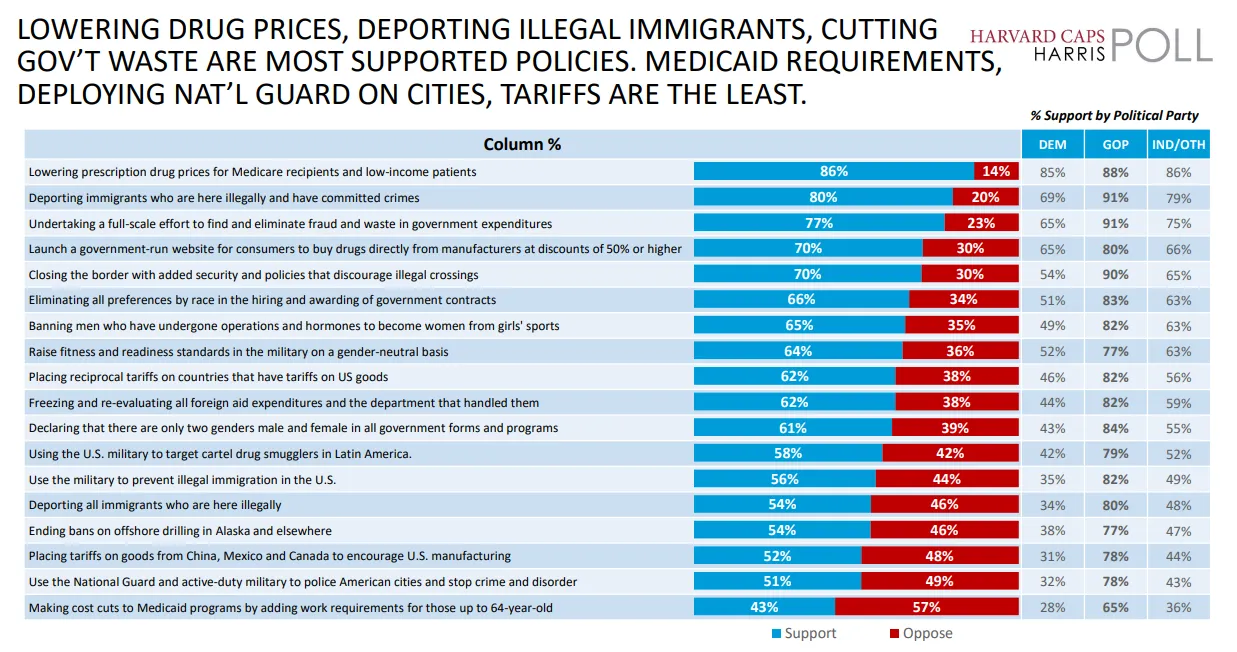
The White House has pointed to a Harvard CAPS Harris Poll conducted online within the United States on December 2-4, 2025, among 2,204 registered voters, with a margin of sampling error of plus or minus 1.99 percentage points on a 95 percent confidence level.
It found that the national outlook had rebounded, with 39 percent saying the country was on the right track - up from 35 percent in the last poll, and 36 percent believing the economy was on the right track, up from 33 percent in the last poll.
...
What People Are Saying
A White House spokesperson told Newsweek: “President Trump is the sharpest, most energetic, and hardest working President in modern American history. The President is in perfect health, which is why he was able to accomplish more in one year than many presidents did in eight.
"President Trump remains the unequivocal leader of the Republican Party, and his support with Republicans remains as strong as ever. Additionally, recent credible polling continues to show that every one of President Trump’s common sense policies is supported by a majority of the American people.”
Republican pollster Patrick Allocco told Newsmax that Trump “continues to draw support beyond the Republican base,” citing “30 percent of independents” and “4 percent of Democrats,” adding that “59 percent of blue-collar workers are still with him: that's huge going into the midterms,” while noting the Trump team is struggling to connect with women ages 21 to 44.
He added, “If you were against his economic policies, if you're against his foreign policies, if you're against his immigration policies, chances are you didn't vote for President Trump in 2024. What we're seeing right now is...this uprising of anger that's bubbling up to the surface.”
"We're at a D-plus-3 right now on the generic ballot," Allocco said, calling it "just a lean toward Democrats. It's not a wave of any sort." He said: "No forecaster right now is looking at a 26-seat flip of the House."
What Happens Next
Republican leaders may weigh the Pew findings against messages from pro-Trump pollsters and commentators as they decide when to align with or distance from the White House on controversial votes, given that 61 percent of Republicans and GOP leaners told Pew that lawmakers do not have an obligation to support Trump if they disagree.
In a polarized era, the center is dismissed as bland. At Newsweek, ours is different: The Courageous Center—it's not "both sides," it's sharp, challenging and alive with ideas. We follow facts, not factions. If that sounds like the kind of journalism you want to see thrive, we need you.
When you become a Newsweek Member, you support a mission to keep the center strong and vibrant. Members enjoy: Ad-free browsing, exclusive content and editor conversations. Help keep the center courageous. Join today.


View 0 Comments
Submit Correction
View Editorial & AI Guidelines