
...

By Billal Rahman
Immigration Reporter
0
Share
Newsweek is a Trust Project member
See more of our trusted coverage when you search.Prefer Newsweek on Googleto see more of our trusted coverage when you search.
House Republicans are pushing a major expansion of a farmworker visa program, seeking to let more agricultural employers hire foreign workers for nearly year-round jobs as farmers warn that labor shortages are threatening the nation’s food supply.
The Securing Agriculture’s Workforce Act, introduced June 30 by House Agriculture Committee Chairman Glenn Thompson, a Pennsylvania Republican, would expand the H-2A visa program that currently allows farmers to hire foreign workers for temporary or seasonal agricultural jobs when domestic labor is unavailable.
The bipartisan legislation would make the program available to many year-round operations, including dairy and livestock producers, while also changing wage rules and simplifying the hiring process.
Read More on News
The program has traditionally been used for temporary or seasonal agricultural jobs, but Thompson’s bill would broaden it to cover work contracts lasting up to 350 days, opening the door for more year-round operations such as dairy, livestock and poultry employers to use it.
...
The proposal reflects a growing acknowledgment among Republicans from agricultural states that immigrant workers are central to the U.S. farm economy, even as immigration remains one of the party’s most divisive issues.
“It’s time to bring the H-2A program into the 21st century,” Thompson said in a press release. “Producers have been sounding the alarm for years that Congress needs to address the workforce crisis we have on our hands in farm country. The H-2A visa program is woefully outdated, and it no longer meets the needs of American agricultural production.”
Supporters say farms cannot find enough U.S. workers to fill physically demanding agricultural jobs, while immigrant advocates and labor groups have long warned that guest worker programs can leave workers dependent on employers for their jobs, housing and legal status.
Despite the partisan divide over many immigration issues, the legislation attracted a bipartisan coalition of 45 Republicans and four Democrats as original co-sponsors, many from states with large farming industries.
What Does the Bill Do?
The legislation would make some of the most significant statutory changes to the H-2A program since it was created in 1986. The legislation would replace language limiting the program to work “of a temporary or seasonal nature” with a broader definition of “temporary” work, defined as a contract lasting up to 350 days.
Dairy farms, livestock operations and other farms with year-round work have often struggled to use H-2A because the program is tied to temporary or seasonal labor needs. The Trump administration last month issued guidance clarifying that dairy farms may qualify for H-2A workers if they can show a temporary or seasonal need under existing law, but that did not create a new year-round visa category. Thompson’s bill would go further by rewriting the statute itself.
Under the bill, the Labor Department could issue H-2A labor certifications valid for up to three consecutive years. Employers would also be allowed to stagger the entry and exit of H-2A workers when labor needs vary during a contract, and workers could begin employment with a new certified agricultural employer once that employer files a non-frivolous petition on their behalf.
Related Story

Green Card Update: Trump Admin Proposes Major Crackdown on Visa Program
The measure would also create a limited pathway for some undocumented farmworkers already in the United States to move into H-2A status. The bill says certain immigration violations could be waived for workers who were unlawfully present in the United States on May 31, 2026, and who performed agricultural labor or services for at least 5.75 hours during each of at least 180 days in the two years before the bill is enacted.
Employers would be required to provide written employment records to workers seeking to prove eligibility. The bill would also shield certain employment records from being used in civil or criminal investigations against employers for the prior unlawful employment of those workers, unless the records are fraudulent.
Supporters say the provision would give legal certainty to experienced farmworkers already doing the work. The American Business Immigration Coalition’s Agricultural Council endorsed the bill, saying that about 70 percent of U.S. farmworkers are foreign-born and nearly 40 percent are undocumented. The group said only 182 domestic job applications were submitted in 2025 for nearly 415,000 advertised agricultural positions.
Rebecca Shi, CEO of ABIC Action, said in a press statement that the bill "opens the door to address the urgent needs of farmers by providing workers a path to legal status to keep food on tables across this nation.”
The bill would also revise wage rules for H-2A workers. Under the measure, employers would have to offer at least the highest of the collectively bargained wage, the applicable federal, state or local minimum wage for agricultural workers, or the adverse effect wage rate, if it applies. The legislation would change how that adverse effect wage rate is calculated and limit annual fluctuations, barring the rate from falling more than 1.5 percent or rising more than 3.25 percent from the previous year.
Farm groups have argued that H-2A wage requirements have become unpredictable and expensive. Worker advocates have generally opposed efforts to lower or restrain wage rates, arguing that the rules are intended to prevent foreign labor from undercutting wages for U.S. workers.
Matt Teagarden, CEO of the Kansas Livestock Association, said in a statement: “A stable workforce that farmers can rely on, one where workers feel secure in their status without fear, will provide real relief for our agricultural sector, farmers, and ranchers. This is a step forward that acknowledges what Americans already know: immigrants are essential to agriculture.”
The legislation would require the Department of Homeland Security, in consultation with the Labor, Agriculture and State departments, to create a single online H-2A platform within one year of enactment. The platform would allow employers to submit information, respond to government requests, track applications and pay fees through one system. The bill says the goal is to reduce duplicate paperwork, eliminate redundant reviews, and speed up processing.
It would also make H-2A processing an essential government function during a lapse in appropriations, meaning certification and admission of H-2A workers would continue during a government shutdown.
The proposal includes worker protection provisions. Employers using H-2A workers would have to maintain a heat-illness prevention plan that includes access to water and shade, breaks, training and emergency response protocols. The plans would have to be posted at the worksite in English and, when needed, in a language workers understand.
The bill would also update housing rules for H-2A workers. Employers would still have to provide housing, but the Labor Department would be directed to create rules tied to local, state or federal health and safety standards. The bill would allow housing certifications to last up to three years and would direct the Government Accountability Office to study housing availability, affordability and enforcement within two years of enactment.
The legislation comes as agricultural employers have pressed Congress and the Trump administration for broader access to foreign labor. The Agriculture Department said in June that dairy operations may use H-2A when they can demonstrate a qualifying temporary or seasonal labor need, a clarification it said would give dairy farmers more certainty under existing law.
But that guidance was narrower than Thompson’s bill. It did not remove the program’s temporary or seasonal limits, and dairy employers must still prove that their labor need qualifies case by case. The bill would instead redefine temporary agricultural work to include contracts of up to 350 days, a statutory change that would require congressional approval.
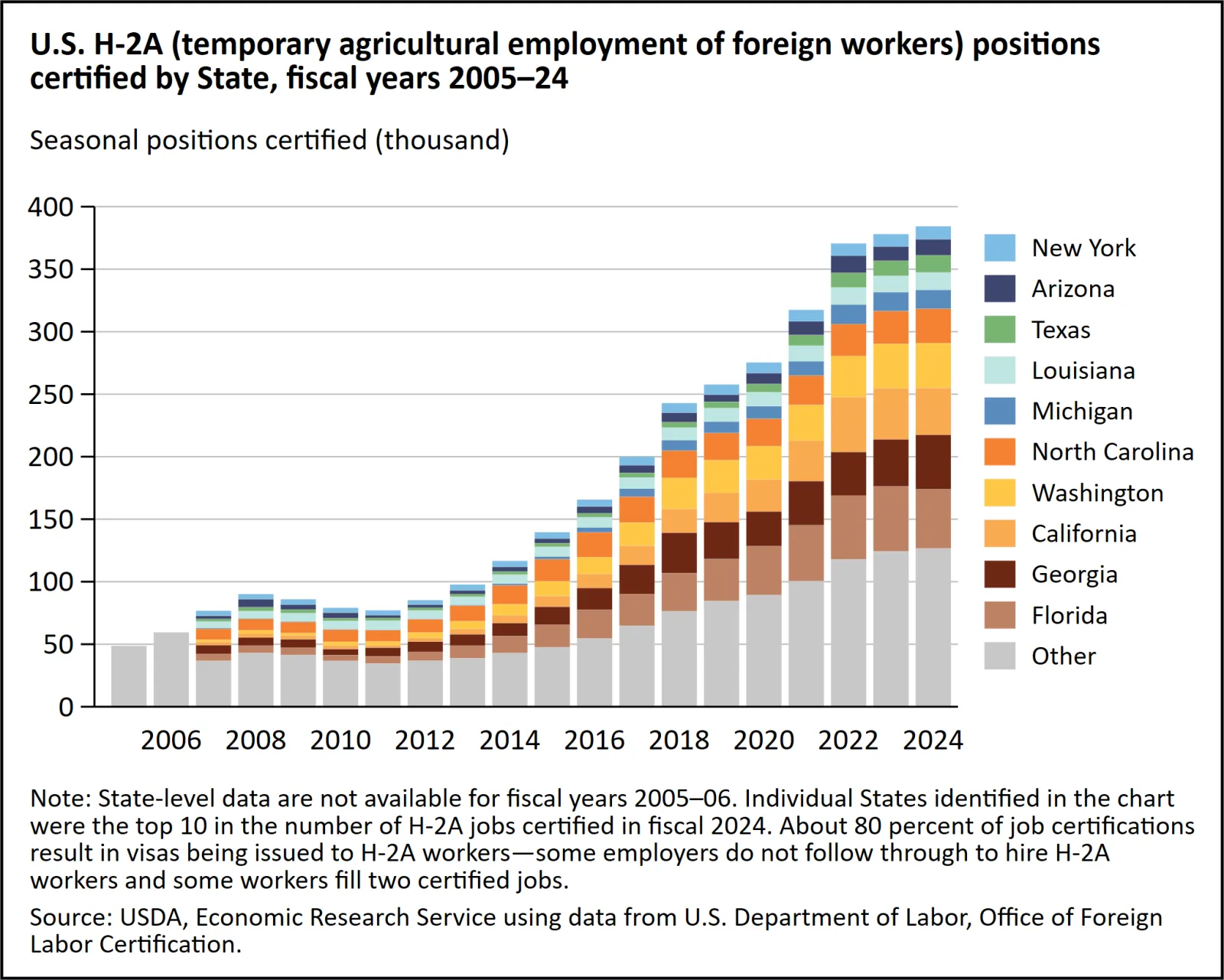
The H-2A temporary agricultural worker program has expanded rapidly in recent years, with the Labor Department certifying nearly 400,000 worker positions in Fiscal Year 2025, up from about 48,000 in 2005, according to Department of Labor data.
...
Representative Mike Simpson, an Idaho Republican, said dairy farmers and ranchers have faced a long-running labor crisis and called the bill a legislative fix for agricultural producers.
“Ask any farmer or rancher, especially in the dairy industry, and they will tell you about the labor crisis they face," he said in a press release. "After years of working to build consensus to address this critical issue, I'm confident that the Securing Agriculture's Workforce Act is the legislative fix we need."
The Idaho Dairymen’s Association and other farm groups also praised the measure, saying producers need a stable legal workforce.
Some Republicans have pushed for tougher immigration enforcement and have criticized visa programs that bring foreign workers into the United States. But many lawmakers from farm states say agriculture is different, arguing that farms need immigrant labor to operate and that Congress must provide a legal channel for employers and workers.
But support for the proposal is not universal. Jeremy Beck, co-president of NumbersUSA—which advocates lower immigration numbers to protect America’s workers, communities and natural landscapes, according to its website—told Newsweek in an emailed statement: "It's an amnesty for employers engaged in illegal hiring. And it allows hundreds of thousands of illegal workers to stay as long as they indenture themselves to the agricultural industry. Then the bill lowers workers' wages and deducts the cost of housing from their paychecks.
"It's an ugly look for America, but a profitable one that will lower labor costs and limit workers' opportunities to leave their employers. Cheap captive labor is a feature of large-scale guest worker programs. And if the bill passes, American agriculture will have even less incentive to mechanize. Other countries facing the same labor questions have modernized instead—we'd be choosing captivity over innovation."
The bill has been referred to the House Judiciary Committee. If enacted, its amendments will take effect one year after the law is signed.
Contact Newsweek editors on this story: Ben Kelly and Dave Siminoff.
View 0 Comments
Submit Correction
View Editorial & AI Guidelines