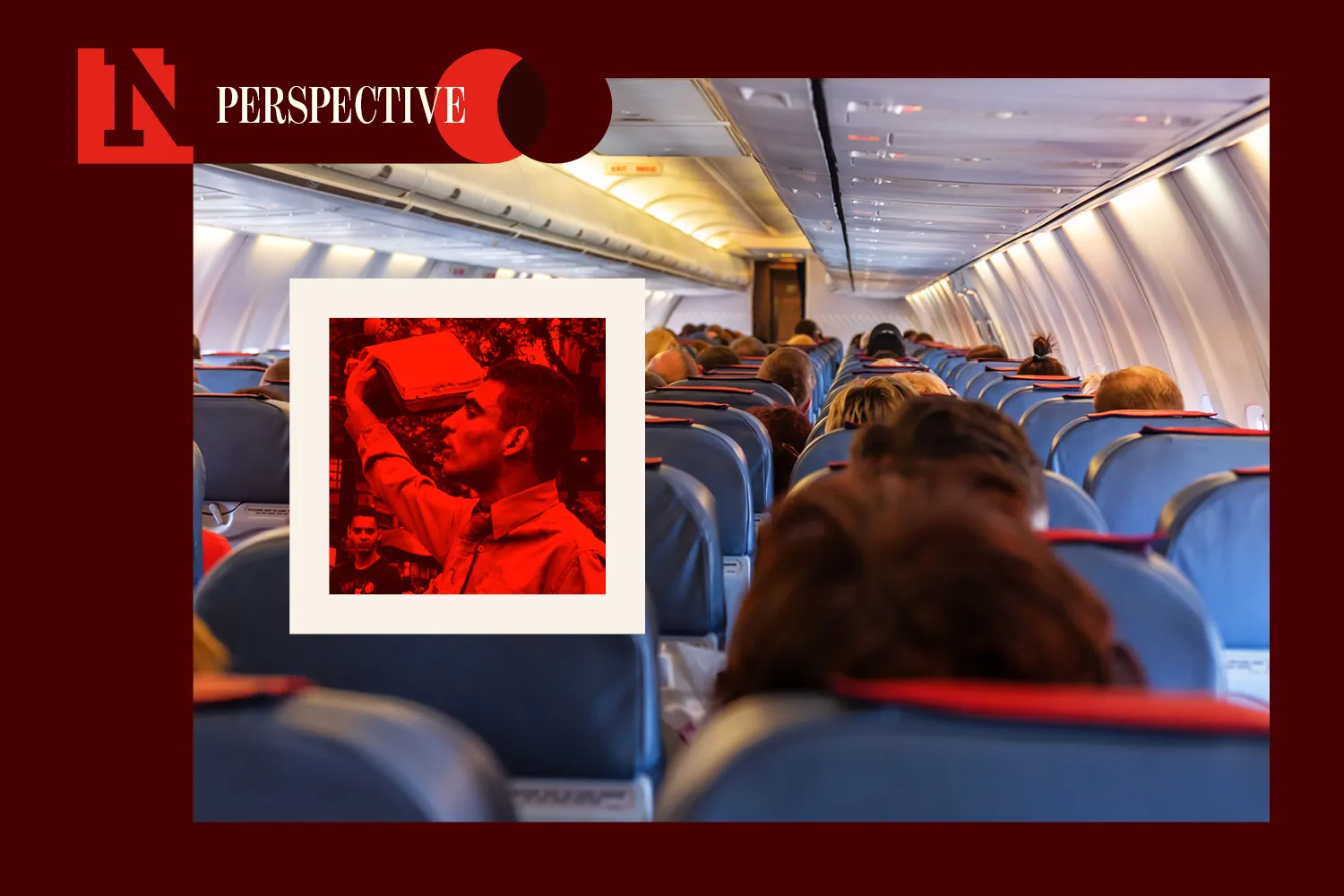
Preachers sermonizing on planes

By Anna Rahmanan
0
Share
Newsweek is a Trust Project member
See more of our trusted coverage when you search.Prefer Newsweek on Googleto see more of our trusted coverage when you search.
You are on the plane, which means you have already agreed to a small civic surrender. Your bag is wedged above row 23, your tomato juice is sweating on the tray table and you are scrolling through the in-flight movies with the low-grade desperation of someone trying to make two hours disappear. Then someone stands up.
In clips circulating online recently, what follows is pretty striking: a self-described evangelist turns the cabin into a temporary pulpit, speaking over rows of strangers about Jesus, salvation or hell. In other videos, worshippers break into song, sometimes accompanied by a guitar, while passengers clap, film, stare straight ahead, or quietly endure it. The reactions are almost as revealing as the performances themselves.
Deeper issues are clearly in play, and not just ones involving Christian versus secular beliefs, or public faith versus progressive intolerance. It isn't even really about free speech versus captive annoyance. The more interesting question is why an airplane cabin makes almost everyone sound like a hypocrite.
Read More on Analysis
Progressives who often defend disruptive public expression suddenly become guardians of bourgeois quiet, as anti-woke conservatives who ridicule "safe spaces" suddenly see the appeal of a room where strangers are not forced to absorb someone else's message. The cabin exposes a principle neither side likes to admit: Americans tend to support neutrality only after defining it in terms of their own comfort.
After all, a sidewalk sermon that you can walk away from—or ignore by pretending to be on the phone—is different from a sermon at 30,000 feet in air, when the seat belt sign is on, the aisle is blocked by the drinks cart and you are, literally, trapped in the sky.
The Preachers Know the Audience Is Captive
The 2026 clips are powerful precisely because the speakers understand their captive audience.
A June 2026 video by Presley Mae Foster from a delayed plane turns the aircraft’s stillness into a rationale: the plane is “not moving,” so passengers might as well talk about God. That logic makes sense from inside the evangelist’s frame. A delay becomes an opportunity and, in tandem, a captive audience becomes a mission field.
From the seat back perspective, the same facts produce the opposite reaction: The plane is not moving, so there is nowhere to go to escape whatever it is that’s happening that you don’t care to be a part of. The social contract was narrower: sit down, keep your elbows in, obey the crew, get there.
Everyone Wants Neutrality After They Define It
A March 2026 clip from a Cebu Pacific flight shows how quickly “respect” becomes the shared vocabulary. Commenters pointed out that faith is personal, public transport is shared and consent should matter even when it comes to "spontaneous" preaching.
Although that is a fair objection, it also happens to lean on the unstable. Consent is rarely demanded with equal force across every kind of public expression. Many people who object to plane preaching might tolerate political slogans, for example, or protest chants or activist disruptions in other shared spaces. Many people defending the preaching would likely object if the in-flight message came from a faith or ideology they disliked.
The airplane strips away the flattering story both sides tell about themselves. In this particular situation, the progressive is not always a free-expression absolutist and the conservative is not always a discomfort-is-good-for-you realist. Each side has a preferred public order that they call neutral but perhaps really isn’t.
The Strongest Defense Is Sincerity
The videos should probably be watched with a clear thought in mind: Evangelism is central to many forms of Christianity, and the clips show speakers who describe fear, conviction and obedience rather than prankishness. In her June upload, Foster writes that her plane broke down and that she felt the Holy Spirit telling her to share her faith.
But, a passenger wearing a Jesus hoodie is different from a passenger standing in the aisle loudly talking about the importance of faith. A sincere belief may explain why someone speaks, but doesn’t really settle whether everyone should have to listen.
Related Story

Big Tech Has a Bad Case of Cyclospora
The Next Fight Will Be Over the Line
Airlines already operate in a world where passenger behavior is regulated more tightly than ordinary public conduct, so, perhaps, there should be guidelines for these types of episodes as well. The Federal Aviation Administration says passengers who interfere with crew instructions or behave disruptively can face fines and other penalties, and it lists potential civil penalties of over $40,000 per violation in unruly-passenger cases. Congress is also moving on cabin quiet in another form: the Quiet Skies Act, introduced in July 2026, would require the FAA to finalize a ban on in-flight phone calls on commercial planes.
Those rules and proposals are not about religion and they show why planes are treated differently. At 30,000 feet, annoyance can become a crew-management issue. At the same time, a cabin is public enough to contain strangers and private enough that no one can exit.
If nothing changes, the next viral clip will probably bring the same split-screen outrage: one side praising bold faith, the other demanding basic manners.
As the duality of that potential reaction shows, the Mile High Club of religion is not exposing America’s hostility to faith but, rather, exposing the country’s selective love of restraint.
At 30,000 feet, everyone believes in freedom of expression…until someone else takes the pulpit.
View 0 Comments
Submit Correction
View Editorial & AI Guidelines