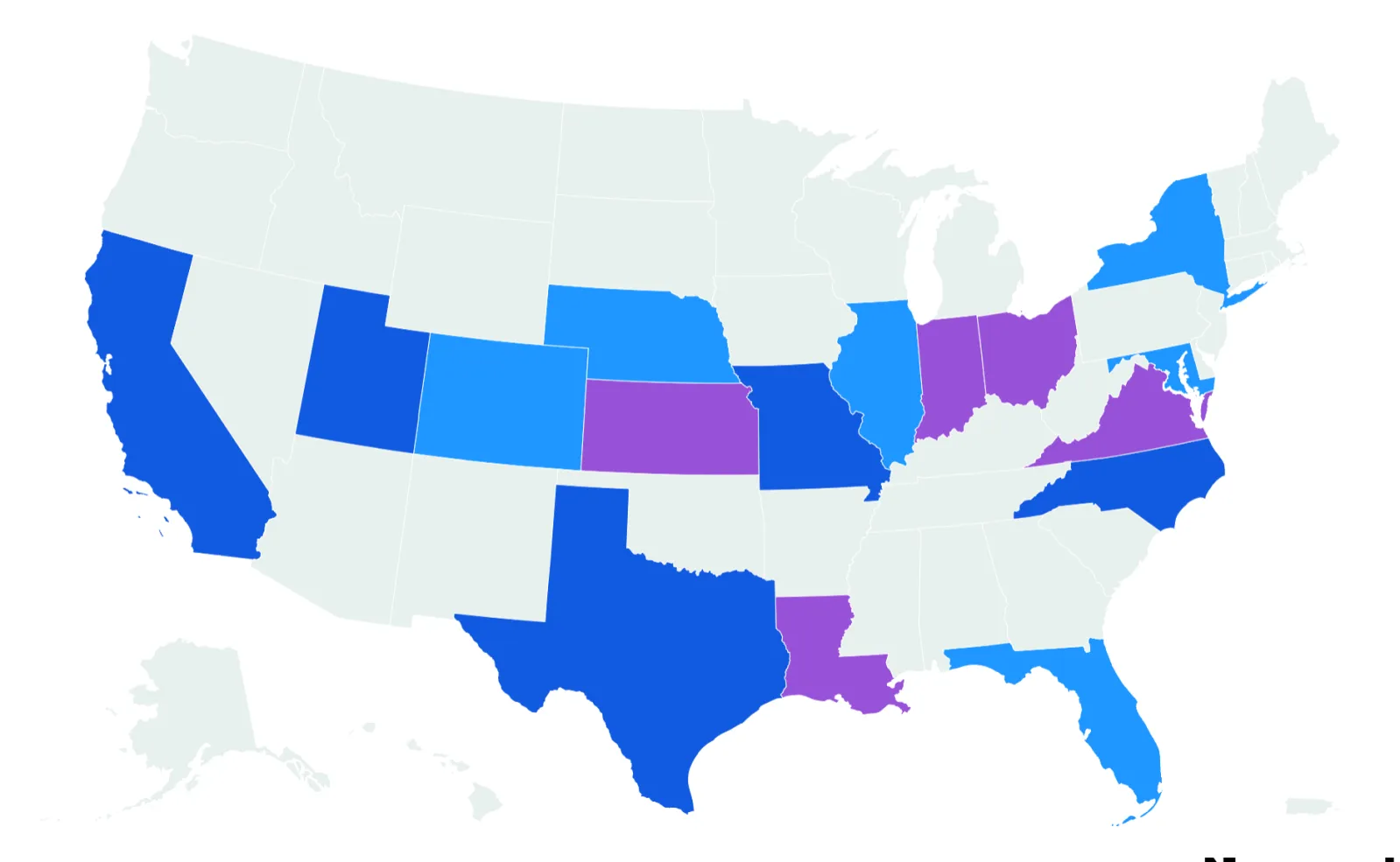
Map shows what states are doing about redistricting

By Khaleda Rahman
National Correspondent
0
Share
Newsweek is a Trust Project member
See more of our trusted coverage when you search.Prefer Newsweek on Googleto see more of our trusted coverage when you search.
A Newsweek map shows which U.S. states are gerrymandering congressional districts—or considering doing so—ahead of next year’s midterm elections.
Why It Matters
President Donald Trump’s call for Republican-led states to redraw their congressional boundaries ahead of the 2026 elections has triggered a redistricting arms race across the U.S.
Read More on News
Typically, states redraw boundaries of congressional districts every 10 years, after the census has concluded. But Trump is hoping to preserve the GOP’s slim majority in Congress through mid-decade redistricting, since the president’s party typically loses seats in midterm elections.
However, Democrats, who need to gain three seats to win back the House, are countering by redrawing boundaries in Democrat-led states. The efforts could determine which party wins control of the closely divided House, and whether Democrats will be able to impede Trump’s agenda in the second half of his term.
States That Have Passed New U.S. House Maps
Texas
At Trump’s request, Texas was the first U.S. state to take up redistricting.
The effort by the president and the state’s Republican-controlled Legislature prompted Texas Democrats to stage a two-week walkout, kicking off a wave of redistricting efforts across the country.
Republican Governor Greg Abbott signed a new U.S. House map—which could help Republicans win five additional seats in next year’s election—into law on August 29. Voting rights advocates have sued to overturn the map, saying it dilutes the power of Black voters and other minorities. Republicans currently hold 25 of the state’s 38 congressional seats.
California
California was the first Democratic-led state to counter Trump’s redistricting push.
The state Legislature passed a new U.S. House map that would temporarily set aside districts adopted by an independent citizens commission after the 2020 census and replace them with districts drafted by Democrats that could help their party win five additional seats.
That map will take effect only if voters approve Proposition 50, a ballot measure championed by Democratic Governor Gavin Newsom, in a November 4 election. Democrats currently hold 43 of 52 seats.
Missouri
Republican Governor Mike Kehoe signed a new U.S. House map into law in late September that could help Republicans win an additional seat.
Republicans currently hold six of Missouri’s eight U.S. House seats. The new map targets a seat held by Democratic Representative Emanuel Cleaver by shaving off parts of his district in Kansas City and stretching it into Republican-heavy rural areas.
Opponents are gathering signatures on a petition that could force a statewide referendum on the map and have also filed several lawsuits.
North Carolina
North Carolina’s Republican-led General Assembly gave final approval to a new map last week that could help Republicans win an additional seat.
The changes to the state’s congressional boundaries seek to prevent the reelection of Representative Don Davis, a Democrat who represents more than 20 counties in what’s been the state’s only swing seat.
Democratic Governor Josh Stein cannot veto redistricting maps under state law, so the GOP’s lines can be implemented unless anticipated legal challenges stop them.
Republicans currently hold 10 of the state’s 14 congressional seats.
Utah
The Republican-led Legislature approved a revised congressional map earlier in October after a judge struck down the districts adopted after the 2020 census because lawmakers had circumvented an independent redistricting commission established by voters.
The revised map, which still requires court approval, could make some seats more competitive for Democrats. Republicans currently hold all four of Utah’s House seats.
States Taking Steps Toward Congressional Redistricting
Indiana
Indiana’s Republican Governor Mike Braun has called for a special session to redraw congressional boundaries to begin on November 3. Indiana lawmakers have faced pressure to reshape maps from the Trump administration, with Trump and Vice President JD Vance meeting separately with Indiana Republicans, including Senate President Pro Tem Rodric Bray, in recent months.
Last week, a spokesperson for Bray said the Indiana Senate did not have the votes to pass a new congressional map. Since there are 10 Democrats in the 50-member Senate, that means at least a dozen Republicans oppose redistricting.
Republicans currently hold seven of Indiana’s nine congressional seats.
Virginia
The Democratic-led General Assembly is meeting in a special session in the first step in a plan to redraw U.S House districts.
Democrats currently hold six of 11 districts and view two of the GOP-held seats, those held by Representatives Jen Kiggans and Rob Wittman, as being potentially competitive in next year’s midterms.
Lawmakers would need to approve a proposed constitutional amendment in two separate sessions and then place it on the statewide ballot.
Louisiana
The state’s Republican-led Legislature is meeting in a special session to push back next year’s primary election by a month.
That change could give lawmakers more time to redraw U.S. House districts in the event that the Supreme Court overturns the state’s current congressional map. Republicans currently hold four of six seats.
Ohio
Officials in the Republican-led state are meeting to redraw House districts before next year’s election.
They are required to do so by the state constitution because Republicans adopted districts without sufficient bipartisan support after the 2020 census. Republicans currently hold 10 of 15 seats.
Kansas
Republican lawmakers are gathering petition signatures from colleagues to try to call themselves into a special session on congressional redistricting. Republicans currently hold three of four seats.
Despite having a GOP supermajority, Senate President Ty Masterson said the Legislature was still “working out the details,” but no formal moves had been made.
This is likely because the Kansas House of Representatives has not yet reached the required two-thirds threshold. While Republicans hold an 88–37 advantage in the Kansas House of Representatives, meaning they technically have the numbers, not all GOP members are on board. Some Republicans have publicly opposed mid-decade redistricting, with Representative Mark Schreiber saying that “redistricting by either party in midcycle should not be done.”
States Considering Mid-Decade Redistricting
Colorado
Democratic Attorney General Phil Weiser, who is running for governor, has said he would support a constitutional amendment to allow mid-decade redistricting in response to Republican efforts in other states.
The measure would need to go on a statewide ballot. Democrats and Republicans currently hold four U.S. House seats each.
Florida
Republican state House Speaker Daniel Perez has formed a special committee on congressional redistricting in Florida. “As many of you are aware, there are national conversations ongoing in other states related to midterm redistricting,” Perez said in a memo seen by Newsweek in August.
Republicans currently hold 20 of the state’s 28 seats.
Illinois
House Minority Leader Hakeem Jeffries has urged Democratic state lawmakers to redraw Illinois’ congressional districts.
“We are going to support efforts to make sure that there are fair maps all across the country in the face of what Republicans are endeavoring to do, which is to rig the midterm elections by gerrymandering congressional maps,” he told reporters last week.
Democrats currently hold 14 of 17 seats.
Maryland
Democratic state lawmakers have proposed congressional redistricting legislation for next year’s session.
Governor Wes Moore has not called a special session to take up redistricting, but he suggested last week that he was ready to do so.
“We need to make sure that next November, when the people vote, that they are voting on fair maps and they are voting where we have a chance to make sure that the people are selecting our elected officials and elected officials are not selecting their people,” he told 7News.
Democrats currently hold seven of the state’s eight congressional seats.
New York
Democratic state lawmakers have filed a proposed constitutional amendment to allow mid-decade redistricting.
The Legislature would need to approve the measure in two separate sessions and then place it on the statewide ballot. Democrats currently hold 19 of 26 seats.
Nebraska
Republican Governor Jim Pillen has said he is open to mid-decade redistricting.
Republicans already hold all three of Nebraska’s House seats, but the focus would be on the 2nd Congressional District—a competitive district that includes Omaha. Incumbent Representative Don Bacon, who eked out wins in the last two elections, is retiring in 2026, boosting Democrats’ hopes of a pickup.
This article includes reporting by the Associated Press.
View 0 Comments
Submit Correction
View Editorial & AI Guidelines