...

By Jordan King
Reporter
0
Share
Newsweek is a Trust Project member
See more of our trusted coverage when you search.Prefer Newsweek on Googleto see more of our trusted coverage when you search.
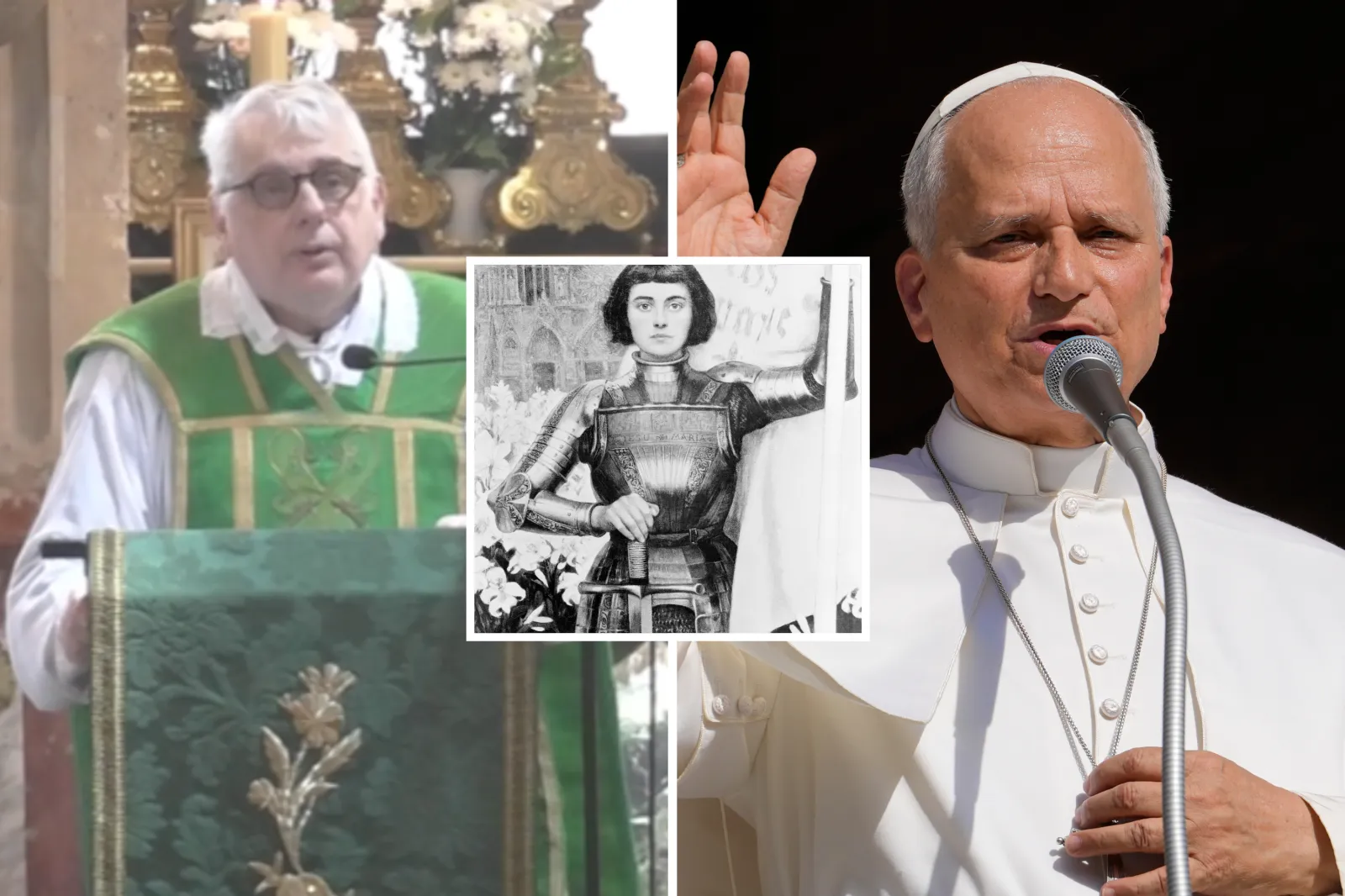
A priest from the breakaway rebel group the Society of Saint Pius X (SSPX), which is facing excommunication, compared the fraternity to Joan of Arc, the French military heroine and Catholic saint who was condemned for heresy before her conviction was overturned and she was later canonized.
The SSPX is planning to consecrate four new bishops without papal approval on July 1, a move that the Vatican has repeatedly warned could result in their excommunication.
Encouraging followers at the church of Saint-Nicolas-du-Chardonnet, in Paris, France, to “remain at peace”, SSPX Father Denis Puga invoked Joan of Arc.
Read More on News
“Saint Joan of Arc was judged by the Church, she was burned at the stake, and you know that in her final moments, she asked for a crucifix to be brought to her,” he said. “She gazed upon this crucifix, invoking the holy name of Jesus to come to her aid and help her in this terrible suffering. And on her head, she wore a mitre. On this mitre were written these words: ‘Witch, heretic, schismatic, excommunicated’.”
“And today? Today, the Church venerates Saint Joan of Arc not only as a saint, but also as the patron saint of France,” Father Puga said. “So, dear brothers, let us keep faith.”
...
Who was Joan of Arc?
Joan of Arc was a 15th-century French peasant who said she received visions from God instructing her to help Charles VII reclaim the French throne during the Hundred Years' War. She became a military leader whose victories helped turn the tide of the conflict, but was captured by English-allied forces, tried by an ecclesiastical court and burned at the stake for heresy in 1431.
Twenty-five years after her death, a Church-ordered retrial declared the original proceedings null and void, finding her condemnation had been tainted by procedural errors, according to Vatican documents. She was canonized as a saint by Pope Benedict XV in 1920 and is now one of France's patron saints.
For traditionalist Catholics, Joan's story has long carried symbolic weight because it is viewed as an example of Church authorities wrongly condemning someone later recognized as a saint.
SSPX Calls Excommunication Warning ‘Laughable’
Father Puga also took aim at the Vatican's head of discipline, Cardinal Víctor Manuel Fernández, who had warned the SSPX about excommunication in May, when he told them consecrating bishops without Pope Leo XIV’s approval would “constitute a schismatic act.”
Puga argued that Fernández was being hypocritical, saying the cardinal had previously written that the modern Church "no longer condemns or excludes" people, in contrast with the pre-Vatican II era.
“And this is the same man who, today, is raising the specter of excommunication and threatening schism,” Puga said. “It's laughable, if it weren't so serious, it would be laughable.” Puga did not identify the specific writings he was referring to.
The Decades-Long Divide Between Rome and the SSPX
The SSPX was founded in 1970 by French Archbishop Marcel Lefebvre to preserve the traditional Latin Mass and oppose reforms introduced by the Second Vatican Council, including changes to the liturgy and the Church's approach to ecumenism and religious liberty.
More recently, the society has objected to Fiducia Supplicans, a 2023 Vatican declaration that opened the door to nonliturgical blessings for same-sex couples and others in "irregular" relationships.
The group's relationship with Rome reached a breaking point in 1988, when Lefebvre consecrated four bishops without the permission of Pope John Paul II, resulting in their excommunication.
Pope Benedict XVI lifted the excommunications of the surviving bishops in 2009 as part of an effort to promote reconciliation, but stressed that the SSPX had no canonical status in the Catholic Church and that its ministers did not legitimately exercise ministry because doctrinal issues remained unresolved.
The current standoff was triggered by the SSPX's intention to proceed with episcopal consecrations without authorization from Pope Leo XIV.
SSPX superior general Father Davide Pagliarani has argued that the consecrations are necessary for the group's continued existence, which currently has only two remaining bishops.
In a letter to the pope last month, Pagliarani repeated the group’s position that, since the Second Vatican Council, the Vatican had repeatedly carried out modernist "errors that are destroying Catholic faith and morals.”
Two weeks ago, when Pope Leo XIV spoke out about the feud for the first time, he said: “Certainly, division among Christians is always a painful point. But they refuse to accept certain fundamental elements of the Church, starting with several points from the Second Vatican Council. If they make that choice, I am sorry, but we must move forward.”
Contact Newsweek editors on this story: Alabama Jackson and Gray R. Thomas
View 0 Comments
Submit Correction
View Editorial & AI Guidelines