...

By Gabe Whisnant
News Editor
0
Share
Newsweek is a Trust Project member
See more of our trusted coverage when you search.Prefer Newsweek on Googleto see more of our trusted coverage when you search.
Senator Rand Paul, a Republican from Kentucky, pressed Secretary of State Marco Rubio on Wednesday to acknowledge that the U.S. military operation to oust and capture Venezuelan President Nicolás Maduro could be considered an act of war.
During a hearing on U.S. actions in Venezuela, Paul asked Rubio whether similar actions by a foreign power — such as bombing U.S. defenses, removing the president and blockading the country — would be defined as an act of war. Rubio replied that he did not believe the operation “comes anywhere close to the constitutional definition” of war.
Read More on News
Paul pushed back, saying he thought it clearly would meet that standard.
“What I’m saying is that our arguments are empty ... the drug bust isn’t really an argument. It’s a ruse.”
The Kentucky Republican, who has long advocated for greater congressional oversight of military force, has frequently challenged unilateral presidential authority for foreign military actions.
Rubio defended the Trump administration’s January operation that led to Maduro’s capture, arguing it removed a major national security threat and was justified under existing legal frameworks. He also walked back earlier threats of further military action, telling senators that there were no current plans for additional operations in Venezuela.
Rubio Defends Trump’s Venezuela Operation
Secretary of State Marco Rubio on Wednesday mounted a robust defense of President Donald Trump’s military operation to oust and arrest Venezuelan President Nicolás Maduro, telling senators the intervention eliminated a major U.S. national security threat and left the United States safer.
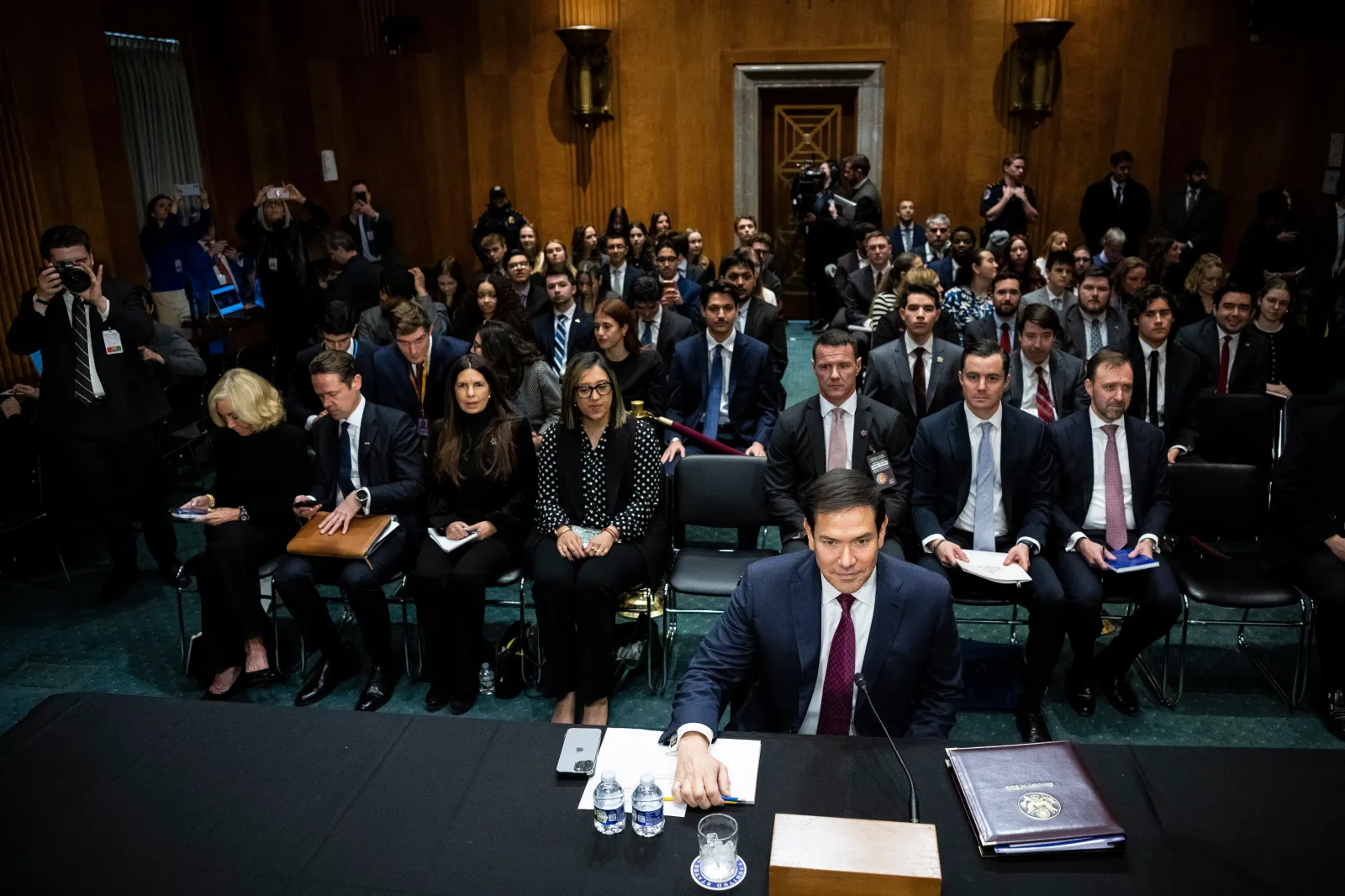
Testifying before the Senate Foreign Relations Committee in his first public appearance since the January 3 operation, Rubio said the Trump administration acted decisively to address instability in the Western Hemisphere and would now work with interim Venezuelan authorities to stabilize the country.
“We’re not going to have this thing turn around overnight,” Rubio said. “But we are certainly better off today in Venezuela than we were four weeks ago.”
No Plans for Further Military Action
Rubio said Venezuela’s current leaders are cooperating with Washington and would soon begin to see economic benefits. He emphasized, however, that the administration does not anticipate further military action.
“I can tell you with full certainty, we are not postured to nor do we intend or expect to have to take any military action in Venezuela at any time,” Rubio said, backing away from language in prepared remarks that suggested force could be used again if U.S. demands were not met.
Rubio said any future action would require an imminent threat, which he said the administration does not foresee.

...
Oil Sales and Economic Oversight
Rubio told lawmakers that Venezuela would soon be permitted to sell oil currently restricted under U.S. sanctions, with proceeds tightly controlled. He said revenue would be placed in a U.S. Treasury-managed account and released only after Washington approves monthly Venezuelan budgets.
The funds would be used for basic government services such as policing and health care, Rubio said, framing the move as a step toward restoring stability without empowering corrupt officials.
Democrats Raise Broader Global Concerns
While Republican senators largely praised the Venezuela operation, Democrats expressed skepticism, questioning whether Trump’s actions could embolden rivals such as China and Russia or strain relationships with U.S. allies.
Senators pressed Rubio on Trump’s repeated threats toward Greenland, a semiautonomous territory of NATO ally Denmark, and his criticism of the NATO alliance itself. Rubio downplayed the concerns, saying tensions within NATO were easing and discussions were underway.
“I think we’re going to get something positive done,” Rubio said, adding that Trump’s demands reflect longstanding U.S. frustrations over defense spending rather than hostility toward the alliance.
“NATO needs to be reimagined,” Rubio said. “This president just complains about it louder than others.”
Taiwan, Iran and China
Rubio rejected suggestions that the Venezuela operation could influence China’s posture toward Taiwan. He said Beijing’s stated goal of reunifying Taiwan with the mainland is a long-standing objective of Chinese President Xi Jinping, independent of events elsewhere.
“The situation on Taiwan is a legacy project,” Rubio said.
Asked about Iran, Rubio said the administration has no current plan to launch military action, despite Trump’s rhetoric. He cautioned that any effort to change Iran’s government would be far more complex than removing Maduro.
“That would require a lot of careful thinking,” Rubio said.
Details of the Caracas Raid
Committee Chairman Senator Jim Risch, a Republican from Idaho, offered new details about the Caracas operation, saying it involved about 200 U.S. troops and lasted less than 30 minutes.
“This military action was incredibly brief, targeted and successful,” Risch said, adding that international oversight may be needed to ensure future Venezuelan elections are free and fair.

...
Democrats Question the Outcome
Senator Jeanne Shaheen of New Hampshire, the committee’s top Democrat, questioned whether the intervention achieved its goals, noting that many of Maduro’s allies remain influential and economic conditions remain dire.
“We’ve traded one dictator for another,” Shaheen said, asking why the administration is focusing on Venezuela rather than domestic economic concerns.
“From Venezuela to Europe, the United States is spending more, risking more and achieving less,” she said.
Congress Weighs War Powers
Democrats have argued that Trump exceeded his authority by ordering the operation without congressional approval. A war powers resolution directing Trump to remove U.S. forces from Venezuela narrowly failed in the Republican-led House.
The administration maintains there are no U.S. troops stationed in Venezuela, despite a significant regional military presence.
Meanwhile, families of two Trinidadian nationals killed in U.S. strikes on suspected drug-smuggling boats have filed what is believed to be the first wrongful-death lawsuit tied to the campaign. Since September, at least 126 people have been killed in more than three dozen maritime strikes, according to human rights groups.
Steps Toward Normalizing Relations
Even as the administration continues to target what it calls narcotrafficking networks, officials are moving to normalize relations with Venezuela’s acting president, Delcy Rodríguez.
The administration’s demands include opening Venezuela’s energy sector to U.S. companies, ending subsidized oil shipments to Cuba and using oil revenue to purchase American goods.
Rodríguez, Maduro’s former vice president, said Tuesday that her government and Washington have established “respectful and courteous” communication channels. She has released some political prisoners and signaled cooperation with U.S. conditions.
In a significant step toward restoring diplomatic ties, the State Department notified Congress that it plans to send additional personnel to Caracas to prepare for reopening the U.S. Embassy, which closed in 2019. Fully restoring relations would require the U.S. to revoke its recognition of Venezuela’s 2015-elected parliament as the country’s legitimate government.
Rubio was scheduled to meet later Wednesday with Venezuelan opposition leader María Corina Machado.
Updates: 1/28/26, 1:43 p.m. ET: This article was updated with new information and remarks.
In a polarized era, the center is dismissed as bland. At Newsweek, ours is different: The Courageous Center—it's not "both sides," it's sharp, challenging and alive with ideas. We follow facts, not factions. If that sounds like the kind of journalism you want to see thrive, we need you.
When you become a Newsweek Member, you support a mission to keep the center strong and vibrant. Members enjoy: Ad-free browsing, exclusive content and editor conversations. Help keep the center courageous. Join today.


View 0 Comments
Submit Correction
View Editorial & AI Guidelines