
Photo Illustration by Newsweek/Getty

By Didi Kirsten Tatlow
Senior Correspondent, International Affairs
0
Share
Newsweek is a Trust Project member
See more of our trusted coverage when you search.Prefer Newsweek on Googleto see more of our trusted coverage when you search.
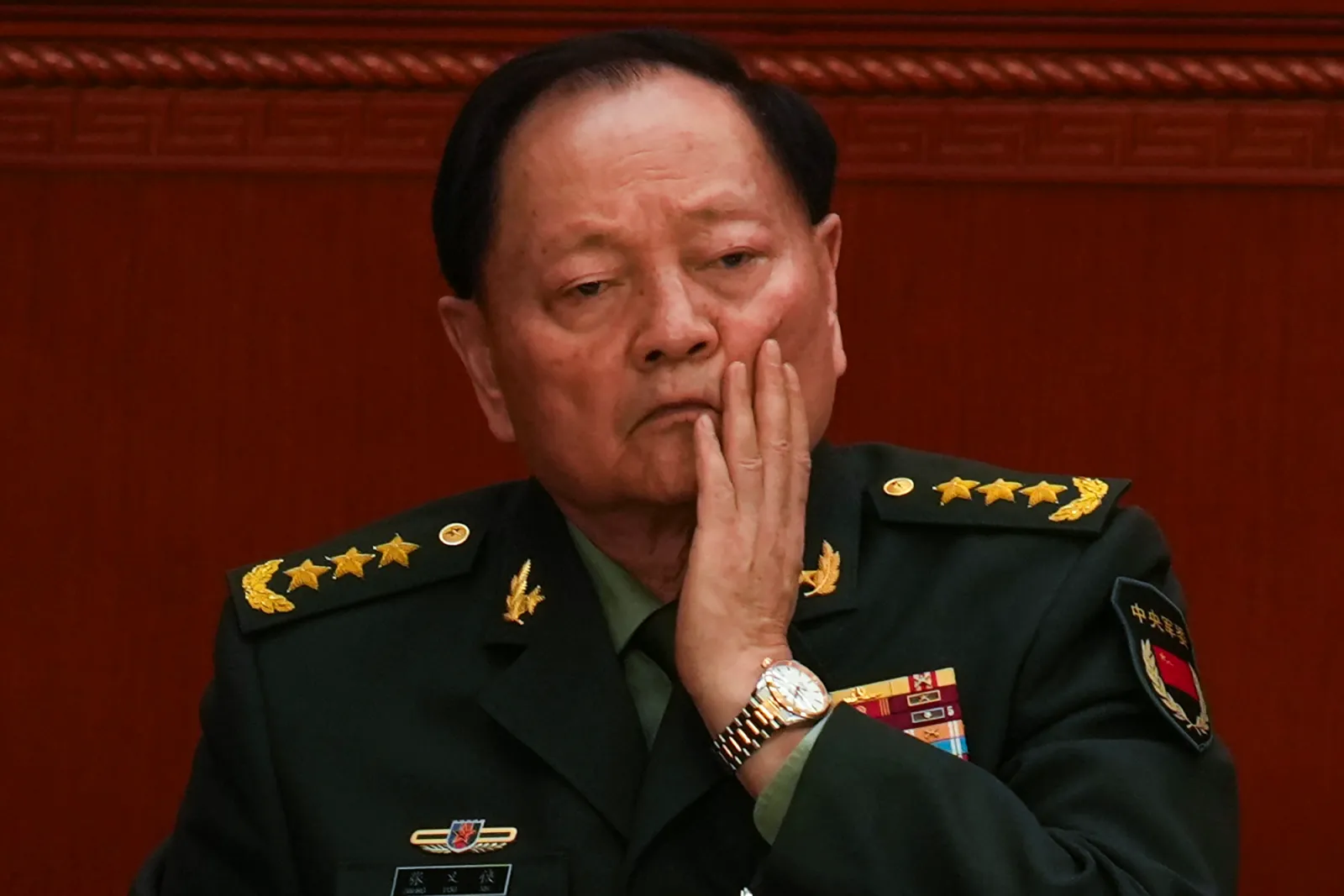
The announcement was a political earthquake in China, one that rocked locals and Beijing watchers globally. China’s Defense Ministry declared its most powerful general had been placed under investigation. Zhang Youxia would be sidelined while authorities probed him and another general on the country’s all-important Central Military Commission.
Was this a political coup by Chinese leader Xi Jinping against a powerful rival? Or was it another push to clear out corruption amid Xi’s decade-and-a-half anti-graft campaign; an effort to strengthen the People’s Liberation Army for when it may use force against Taiwan, as Xi has warned?
Since a purge last year which removed two other commanders, the CMC now has just two members—the Chinese president and his “enforcer,” General Zhang Shengmin, head of the PLA’s discipline unit. Such a low number at the apex of military authority indicates a massive concentration of power by Xi. Even the Chinese Communist Party’s late Chairman Mao Zedong had five people on his military commission. In China, the PLA is the party’s army, but traditionally it has also been given room to run its own affairs. The CMC is where they interface.
Read More on World
It’s also where the CCP asserts its political control. Xi is chairman of the CMC and Zhang Youxia was the first vice chairman, effectively No. 2. So, analysts are watching closely to work out what the abrupt shift at the top of China’s military really means.
Liu Pengyu, spokesperson for China’s embassy in Washington, D.C., told Newsweek: “The CPC Central Committee has decided to open disciplinary and supervisory investigations into Zhang Youxia and Liu Zhenli on suspicion of serious violations of discipline and law. This decision once again underscores that China maintains a full-coverage, zero-tolerance approach to combating corruption. The more resolutely the people’s armed forces fight corruption, the stronger, more united and capable they become.”
The Ministry of Defense in Beijing did not respond to a request for comment.
Was Xi Fending Off a Coup?
The Chinese Defense Ministry’s tersely worded statement on January 24—saying that Zhang Youxia and Liu Zhenli, the joint staff chief, were being probed for “serious disciplinary and legal violations”—was quickly followed by a longer editorial in the People’s Liberation Army Daily that accused them of “serious” corruption. The article, likely approved by Xi himself, also accused the pair of failures that suggested the problem may be deeply political.
They had “seriously trampled on and broken the CMC chairman responsibility system,” the newspaper said, a reference to power distribution at the top. They had “seriously attacked the political and ideological foundation for the unity and progress of all officers and soldiers throughout the military.” Probing them would “further rectify the political foundation and purge ideological toxins and evils.”
Speculation has been rife for years over whether Xi was under pressure as he conducted multiple purges of senior generals, including the former national defense minister, Li Shangfu, and political figures tied to China’s security system. The purges affected scores of officials. “The Chinese system is extremely rigid,” said Francesco Sisci, director of the Rome-based Appia Institute think tank who lived in China for 30 years. Because it’s so rigid, it has what Sisci likened to “grammar rules” that are easy to spot when broken.
“When you see such a sweeping purge that goes to scores of generals being demoted or put under investigation, it’s not something minor—it must be extremely serious. So, I surmised there had been an attempt at a coup, because of the size of it.”
That would make Xi’s action a kind of counter-coup. But that’s only one interpretation.
...
The Wall Street Journal reported that military officers in Beijing were briefed that Zhang Youxia had leaked technical data on China’s nuclear weapons to the United States.
But several experts cast doubt on that theory, questioning how, in a stovepiped bureaucracy such as China’s, Zhang Youxia could have accessed such detailed material, or why he would have done it. They suggest instead the allegation could be an effort by Xi to consolidate his control.
“Xi once told Trump, ‘There are a thousand reasons to improve Sino-US relations.’ Blaming Zhang for leaking state secrets to the U.S.: ‘There are a thousand reasons to frame Zhang,’” Henry Gao, a law professor at Singapore Management University, wrote on X. “Not a single one of those reasons has anything to do with actually leaking state secrets to the US,” Gao continued. “The most plausible explanation is that this was a case of high-level information warfare: feeding false intel to foreign media to generate pressure on Zhang’s allies, especially within the senior party leadership and the military.”
Sisci agreed. “His main fault is not espionage or passing secrets to the Americans—that is something that may or may not have happened—but that he organized a clique,” he told Newsweek, offering as evidence the state and party media allegations of systemic political damage wrought by Zhang. “Or at least that Xi Jinping thought that there was an attempted coup.”
Xi has angered many in China with his drive against corruption. China’s increasingly shaky economy has been affected by a severe property downturn and increasingly over-leveraged localities.
Why Zhang Posed a Threat To Xi
What is known is that the political relationship between Zhang Youxia and Xi was vital, said Peter Mattis, the president of the Washington, D.C.-based think tank The Jamestown Foundation.
Zhang Youxia is popular in the military for his combat experience, having participated in China’s 1979 invasion of Vietnam. And Xi has not been comfortable with anyone holding power that could rival his own—including someone from the military. “The Zhang-Xi relationship almost certainly was the most important single relationship inside the Chinese Communist Party,” Mattis told Newsweek. “Zhang represented the last overt vestige of non-Xi power in the PLA…. That’s the kind of independent power Xi has not tolerated.”
Mattis addressed the question of military performance, which is not helped now by the removal of so much of its top brass. “Xi also has repeatedly reminded the party of its original mission and national rejuvenation. His anti-corruption campaign focused on readying the party for struggle, both domestically and internationally. From the beginning, Xi seems to have his eyes set over the horizon, not simply on maintaining power,” he said.
“Why does he want power? Why does he want the party to be strong and disciplined? That naturally leads to performance issues. And the PLA has had more than a few problems on its way toward the 2027 benchmark of being able to fight and win a war over Taiwan.”
The power shift at the military apex is likely to have implications for China-U.S. relations. Just before the bombshell from Beijing, the U.S. Defense Department released its National Defense Strategy, with President Donald Trump tentatively due to visit China in April. The strategy said the U.S. sought to deter China “through strength, not confrontation,” and to seek “a decent peace” in the region. But it also said it would militarily “erect a strong denial defense” that would include Taiwan, which Xi has repeatedly said he may invade.
The events in Beijing—a geopolitical swirl that could have profound implications for peace or war—are challenging even the most seasoned China observers. “Is this about power or performance?” asked Mattis. “There is no reason the purge cannot be about both.”
View 0 Comments
Submit Correction
View Editorial & AI Guidelines