...

By Newsweek Editors
0
Share
Newsweek is a Trust Project member
See more of our trusted coverage when you search.Prefer Newsweek on Googleto see more of our trusted coverage when you search.
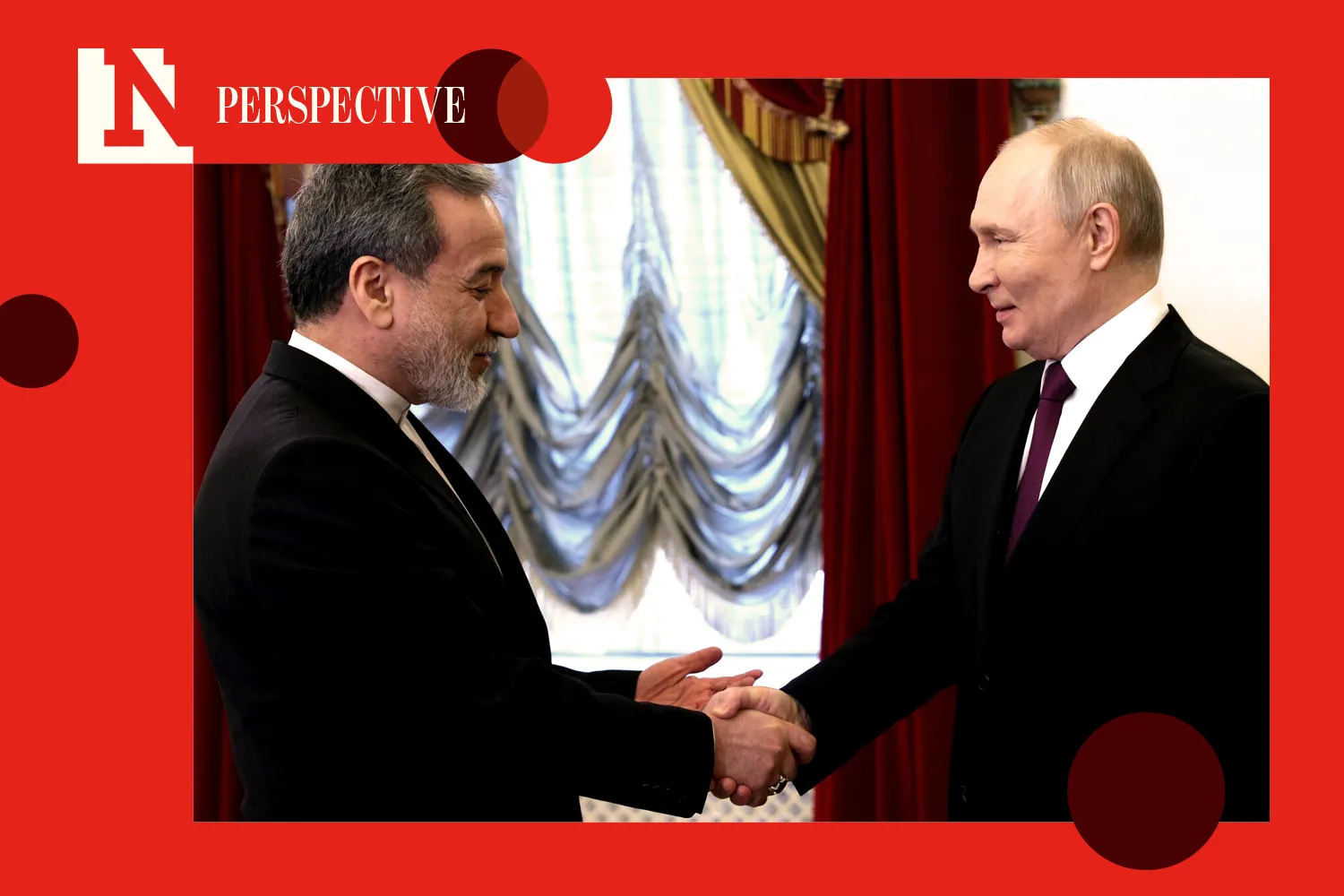
When Russian President Vladimir Putin shook hands in St. Petersburg with Iranian Foreign Minister Abbas Araghchi, it was a physical connection that symbolized a link between their two nations that has become increasingly clear in recent weeks.
Putin told Araghchi, “We see how courageously and heroically the Iranian people are fighting for their independence and sovereignty,” and presented Russia as a diplomatic broker in a war involving the U.S. and Israel.
The simple reading is to dismiss it as another anti-Western photo-op, all hollow smiles and dead eyes. The more complex one is that two wars Washington still tends to discuss in separate rooms are now inextricably connected.
Read More on Analysis
Put simply, Iran and Ukraine aren’t separate wars.
The Iran Crisis Is Not a Second File
The American habit of putting Iran and Ukraine in different foreign-policy folders now looks more like bureaucratic lag than strategic discipline.
The U.S. intelligence community said in March that “selective cooperation” among China, Russia, Iran and North Korea is helping those states balance U.S. action, while Iran’s military support has helped Moscow in Ukraine, largely via Shahed drones.
European allies have anonymously leaked to the media that they are telling American diplomats Russia is materially helping Iran more than Washington has publicly acknowledged. Those same allies see the Iran and Ukraine wars as intertwined.
Secretary of State Marco Rubio offered the cleanest counterargument when he said, “There is nothing Russia is doing for Iran that is in any way impeding or affecting our operation or the effectiveness of it.”
That may be true in a narrow operational sense, even if there are concerning reports about Russia offering Iran intelligence help to strike U.S. targets, but it misses the wider strategic balance sheet.
Putin’s meeting with Araghchi on Monday was, for him, less about Moscow rescuing Iran than the crisis helping Russia sustain and perhaps even increase its pressure on Ukraine in the stalled war he started next door.
In fact, Putin doesn’t have many incentives to save Tehran right now, even if he could: Iran’s pain is Russia’s gain.
Putin’s First Dividend
The first link between Tehran and the Donbas runs through oil revenue.
Chatham House, an international affairs think tank, argued this month that higher energy prices and temporary U.S. easing on Russian oil have boosted Moscow’s budget and export revenues at a moment when sanctions were squeezing Russia’s economy.
Moreover, Russia’s biggest single oil tax revenue was set to double to about $9 billion in April because of the oil and gas crisis triggered by the U.S. and Israeli attack on Iran, according to Reuters calculations.
And Chatham House noted that Russia’s oil and petroleum export revenue had fallen to $9.5 billion in February, its lowest level since the full-scale invasion began in 2022.
That sequence is the point: the Iran crisis did not make Russia strong, but it eased a pressure point Ukraine and its partners had worked hard to create through attacks on infrastructure and sanctions on trade.
The caveat is that a longer global shock could eventually reduce demand and hurt Russia, but the near-term effect is cash for a war economy that needs to keep its troops armed and paid while juggling high inflation and interest rates.
And the Trump administration has boosted the boost, as it were, by temporarily relaxing oil sanctions on Russia to cool the sharp rise in prices cooked up by its war in Iran.
For the first time in a long time, Putin’s in the black with the black stuff.
Patriot Scarcity
The second link is air defense, where arithmetic is harsher than rhetoric.
Israel, Gulf allies and Ukraine are all now seeking the same U.S.-made interceptors used against incoming missiles, and they are in shortening supply.
Ukraine’s concern is as live as those of Israel and the Gulf states. President Volodymyr Zelensky said Patriot systems are essential for intercepting Russian ballistic missiles but warned, “We have to recognize that we are not the priority for today.”
The U.S. Army awarded Lockheed Martin a $4.7 billion contract action this month to accelerate production of PAC-3 MSE interceptors. Lockheed says the plan is to raise annual capacity from about 600 to 2,000 over seven years.
That production plan may be necessary, but it is not a warehouse today. The strategic consequence is simple: Every additional regional missile crisis increases the competition for the same defensive systems Kyiv needs most.
The more effective Russia’s aerial attacks, the greater the political pressure on Zelensky to end the war sooner, and probably not on terms favorable to Kyiv.
Diplomatic Bandwidth
The third link is diplomatic attention, the scarcest commodity in any administration.
U.S.-brokered Ukraine-Russia talks have become uncertain as Trump concentrates on Iran. Zelensky said Ukraine’s partners’ “priority and focus” were currently on Iran. Meanwhile, Russia’s wartime economy is mobilized for long-term conflict.
This does not mean Iran can be ignored, because the Strait of Hormuz crisis is affecting shipping, energy prices, and U.S. security commitments. But it does mean that Putin benefits when Washington debates Iran as though Ukraine were paused.
Zelensky put the economic side plainly when he said, “Russia gets additional money because of this.” The diplomatic side is just as important: delay gives Moscow more time to test whether battlefield pressure can improve its bargaining position.
With Washington distracted in Iran, the White House's pressure on Moscow to end its war in Ukraine, already insufficiently intense in the view of Ukraine and its European allies, is even softer.
It gives Russia room to increase its aggression and build its advantages ahead of any future talks taking place.
Putin has few cards to play. But the hand he has is stronger because of Iran.
Interconnectedness of War
The lesson is that America’s rivals increasingly exploit connections between theaters of conflict that Washington is slower to price in.
This interconnectedness is a point repeatedly emphasized by NATO’s Secretary General Mark Rutte, who has, for example, argued that Russia keeping the U.S. and Europe busy in Ukraine creates a strategic opening for China to act on Taiwan.
A sober Ukraine policy now has to account for Iran’s effect on oil markets, missile inventories and negotiating calendars. If Washington wants to keep Ukraine from being decided by exhaustion, it cannot treat the Middle East as a separate tab.
Putin’s Iran play reveals the larger point: the war in Ukraine may come to a head not only on the front line, but in the second-order consequences of a crisis 1,500 miles away.
Hey gang, Carlo Versano here. I hope you enjoyed this article. As Newsweek's Director of Politics and Culture and editor of the 1600 newsletter, I'm keen to hear what you think. Now, Newsweek is offering a new service to allow you to communicate directly with me in the form of a text message chat. You can sign up and get a direct line to me, as well as the reporters who work for me. You can shape our coverage.
As a Newsweek member, we're offering this service to you for free. You can sign up below, or read more about how it works here. Let's talk!
View 0 Comments
Submit Correction
View Editorial & AI Guidelines