AccuWeather

By Joe Edwards
Reporter
0
Share
Newsweek is a Trust Project member
See more of our trusted coverage when you search.Prefer Newsweek on Googleto see more of our trusted coverage when you search.
A weakened polar vortex is allowing frigid air to spill into portions of the U.S. this week, forecasters say.
The National Weather Service Weather Prediction Center (WPC) warned in a Thursday update that the “significant arctic outbreak” will usher in “frigid temperatures and dangerously cold wind chills” across the Northeast and Mid-Atlantic—with the coldest wind chills “in the minus 30s” expected across the Interior Northeast and New England.
Strong winds on Saturday—with gusts that could top 50 miles per hour—will make the already dangerous subzero wind chills even worse and may lead to scattered power outages and tree damage, especially across the southern and central Appalachians, the Mid‑Atlantic, and the interior Northeast, it added.
Read More on News
In a media advisory shared with Newsweek on Thursday, AccuWeather meteorologists explained that the polar vortex is a broad circulation of cold air over the Arctic. When this weakens or is disrupted, frigid air can push into the mid-latitudes.
When the vortex is strong, the coldest air is usually contained closer to the Arctic. But occasionally it can weaken, bringing a surge of cold air southward.
...
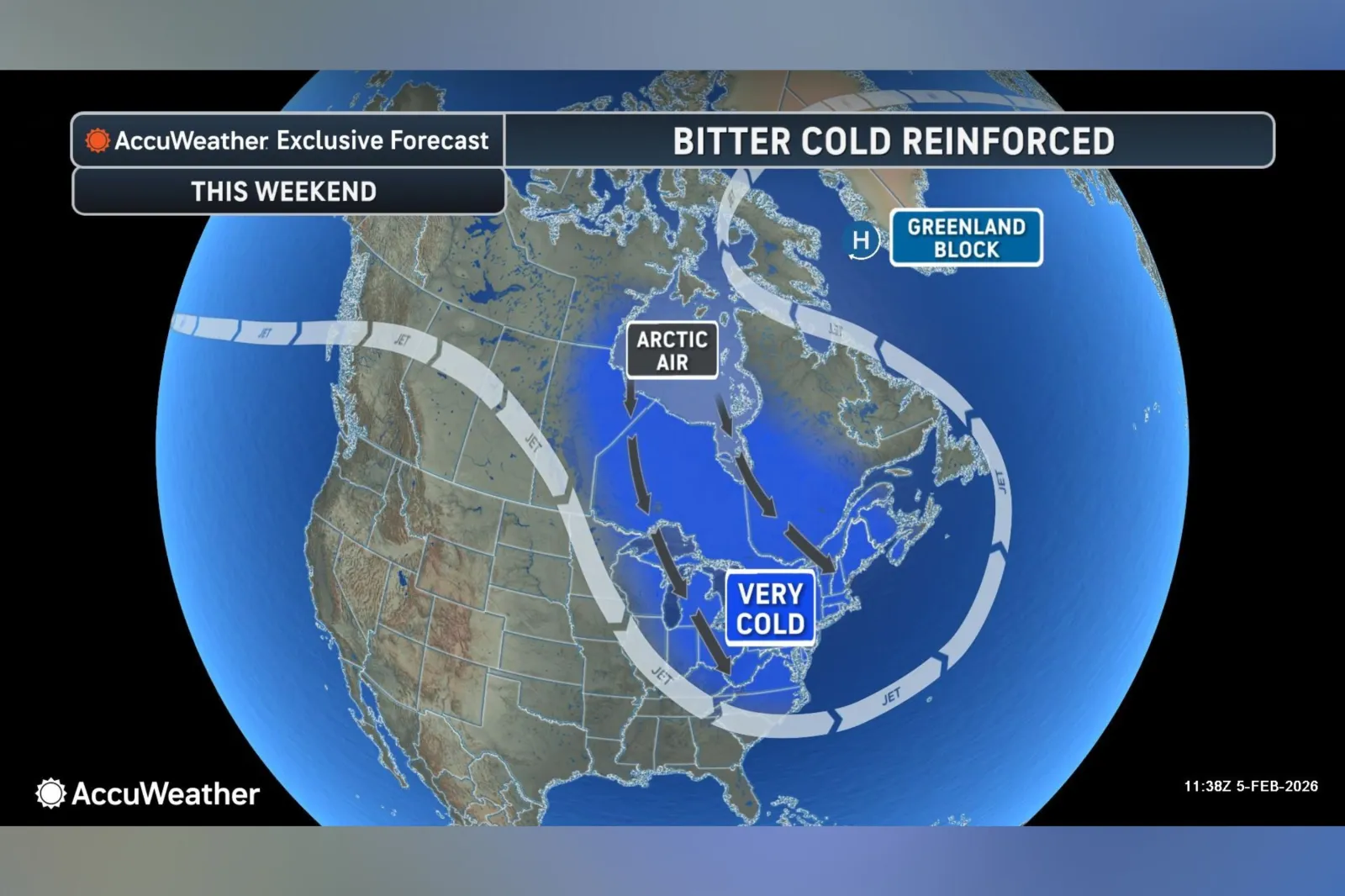
A forecast map from the outlet provided to Newsweek showed that the Mid-Atlantic and Northeast are the primary regions expected to be gripped by very cold Arctic air this weekend.
The WPC warned that the wind chills expected this weekend posed a “life-threatening” risk of hypothermia and advised travelers to carry a cold weather survival kit, limit time outdoors, and to cover exposed skin if outside.
“As the polar vortex strengthens next week, the jet stream will become strong, but in a general west-to-east setup over the U.S. and southern Canada,” AccuWeather senior meteorologist Brett Anderson said.
“As this happens, Pacific air will tend to flow across the U.S., and the air will end up being much less cold than recent weeks in the Central and Eastern states.”
AccuWeather said that the severe cold should moderate in many areas next week, giving snow and ice a chance to thaw in regions that have endured weeks of freezing temperatures.
"The forecast temperatures for next week will lead to some natural melting of the snow and ice cover, especially when combined with the strengthening February sun," Anderson said. "On a sunny day, it may feel pretty warm riding around in the car. However, temperatures will dip back below 32 degrees at night in many locations, and that will lead to wet areas freezing up.”
View 0 Comments
Submit Correction
View Editorial & AI Guidelines