...

By Soo Kim
Reporter
0
Share
Newsweek is a Trust Project member
See more of our trusted coverage when you search.Prefer Newsweek on Googleto see more of our trusted coverage when you search.
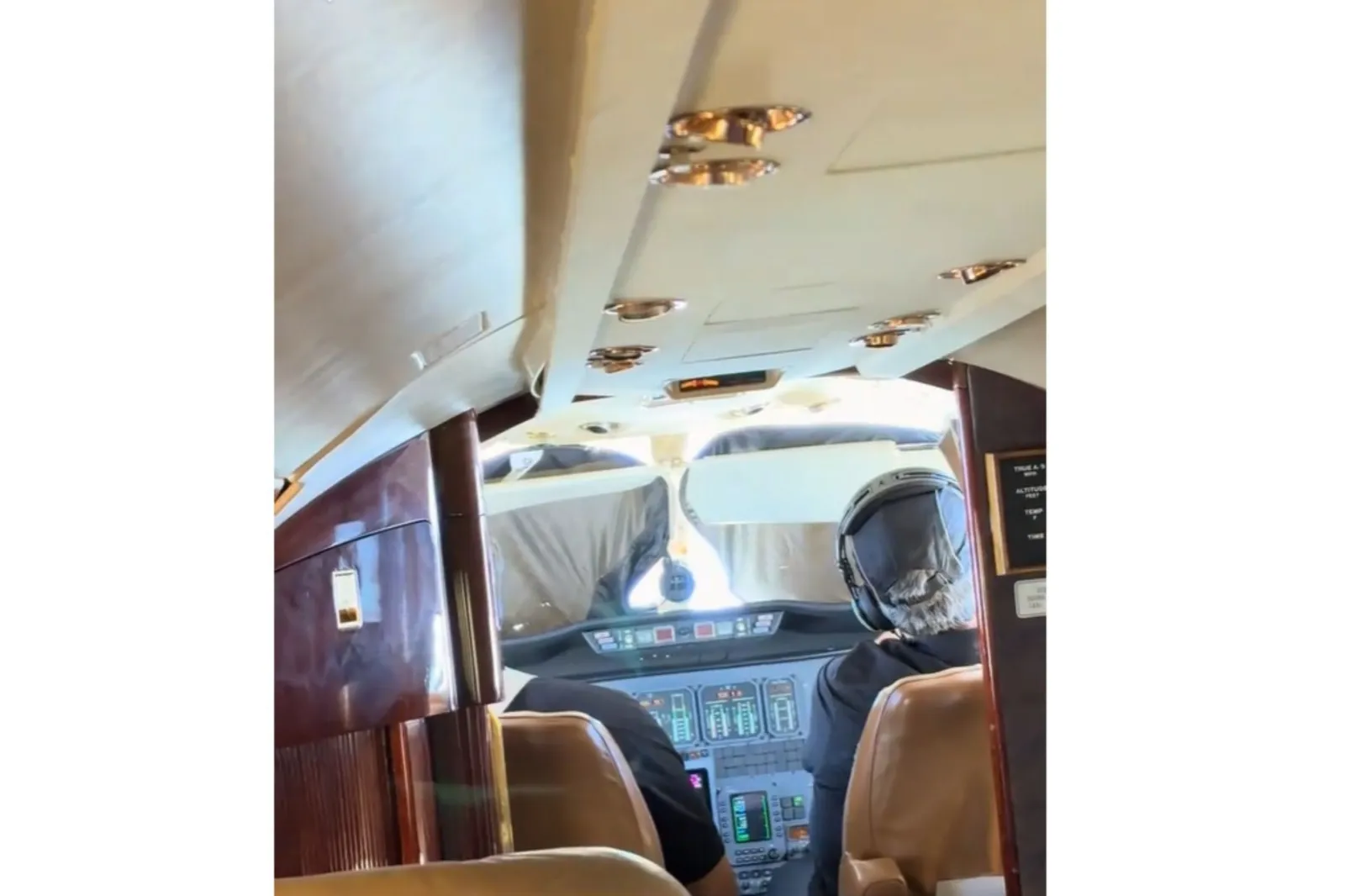
A video showing two pilots operating an aircraft with the cockpit’s front window almost entirely covered has gone viral on social media.
The TikTok clip, posted by user @angel_3o5, shows a view of the cockpit from the passenger side of the aircraft while it is in flight. Sheets appear to be covering the front cockpit window, obscuring what would normally be the pilots’ forward view. Despite the covering, both are seated at the controls as the aircraft continues its journey.
Text overlaid on the video, which has amassed over 22.5 million views since it was shared on March 13, reads: "The sun blocker is covering the pilot’s whole view…so how do they actually see?"
Read More on Travel
The unusual setup prompted concern from the TikTok poster, but modern commercial flight operations rely heavily on instruments and air traffic control, particularly at higher altitudes, according to an aviation expert.
Former airline pilot Dan Bubb, who is a historian and professor at the University of Nevada, told Newsweek that what viewers are seeing reflects a balance pilots must sometimes strike between visibility and other in-flight risks. "There is a bit of a dichotomy here between flight safety, and exposure to higher levels of radiation," Bubb said*.*
Bubb added that aircraft flying at high speeds and altitudes operate in what is known as class A, or positive, airspace. In this environment, pilots are in constant communication with air traffic control and rely on advanced systems onboard the aircraft. "Because this is an advanced, high-performance aircraft that flies at very fast speeds and high altitudes, the pilots are talking to air traffic control since they are flying in what we call class A or positive airspace," he said.
Bubb noted that aircraft are also equipped with a Traffic Collision Avoidance System, or TCAS, which displays the positions and altitudes of other nearby planes. "The chance of a collision with another aircraft is very low. The air traffic controller would advise the pilots that there are other aircraft in their vicinity at different altitudes," he said.
Another factor raised by Bubb is radiation exposure. At higher cruising altitudes, pilots are exposed to increased levels of cosmic radiation, which can accumulate over time. "The higher the altitudes pilots fly, the greater their exposure to radiation. That is why some pilots will wear sunscreen to help combat their exposure to radiation," Bubb said*.*
While windshield screens can help reduce sunlight and radiation exposure, Bubb said flying with obstructed windows is not ideal. "Ideally, the pilots in this video should fly without the windshield screens," he said. However, he added that the pilots would likely be fully aware of surrounding aircraft and remain in close contact with air traffic controllers while attempting to reduce their radiation exposure.
Concerns about flight safety are often heightened when unusual in-flight scenarios circulate online, but industry data shows that most serious aviation accidents do not occur during cruise phases at altitude.
A statistical analysis of commercial aviation accidents conducted by Airbus found that, covering the period from 1958 through 2024, "the approach and landing phases of flight have recorded the largest proportion of fatal accidents over the last 20 years."
The Airbus report found that, in 2024, there was an increase in the overall accident rate due to four fatal accidents, three of which were hull losses, alongside nine additional hull-loss accidents with no fatalities. The company said the rise could "be partially attributed to the growth in air traffic and the challenges that poses for the industry."
Data from the report shows that most of the hull-loss accidents without fatalities in 2024 occurred during the most-demanding segments of flight. "Of the nine hull loss accidents without fatalities recorded in 2024, seven occurred at landing and two occurred during takeoff," the report said.
Airbus highlighted that the approach and landing phases place particularly heavy demands on flight crews. "Approach and landing are highly complex flight phases, which place significant demands on the crew in terms of navigation, aircraft configuration changes, communication with Air Traffic Control, congested airspace, and degraded weather conditions," the report explained.
It added that this combination of high workload and unexpected events can create "a complex interplay of contributing factors, which may lead to an accident."
Newsweek has contacted the original poster for comment via TikTok. This video has not been independently verified.
Do you have a travel-related video or story to share? Let us know via life@newsweek.com, and your story could be featured on Newsweek.
...
View 0 Comments
Submit Correction
View Editorial & AI Guidelines