...

By Gabe Whisnant
News Editor
0
Share
Newsweek is a Trust Project member
See more of our trusted coverage when you search.Prefer Newsweek on Googleto see more of our trusted coverage when you search.
The business jet that crashed while departing during a snowstorm at a Maine airport—killing at least six people—is a model that has previously been involved in wrecks linked to ice buildup on its wings, aviation experts told the Associated Press.
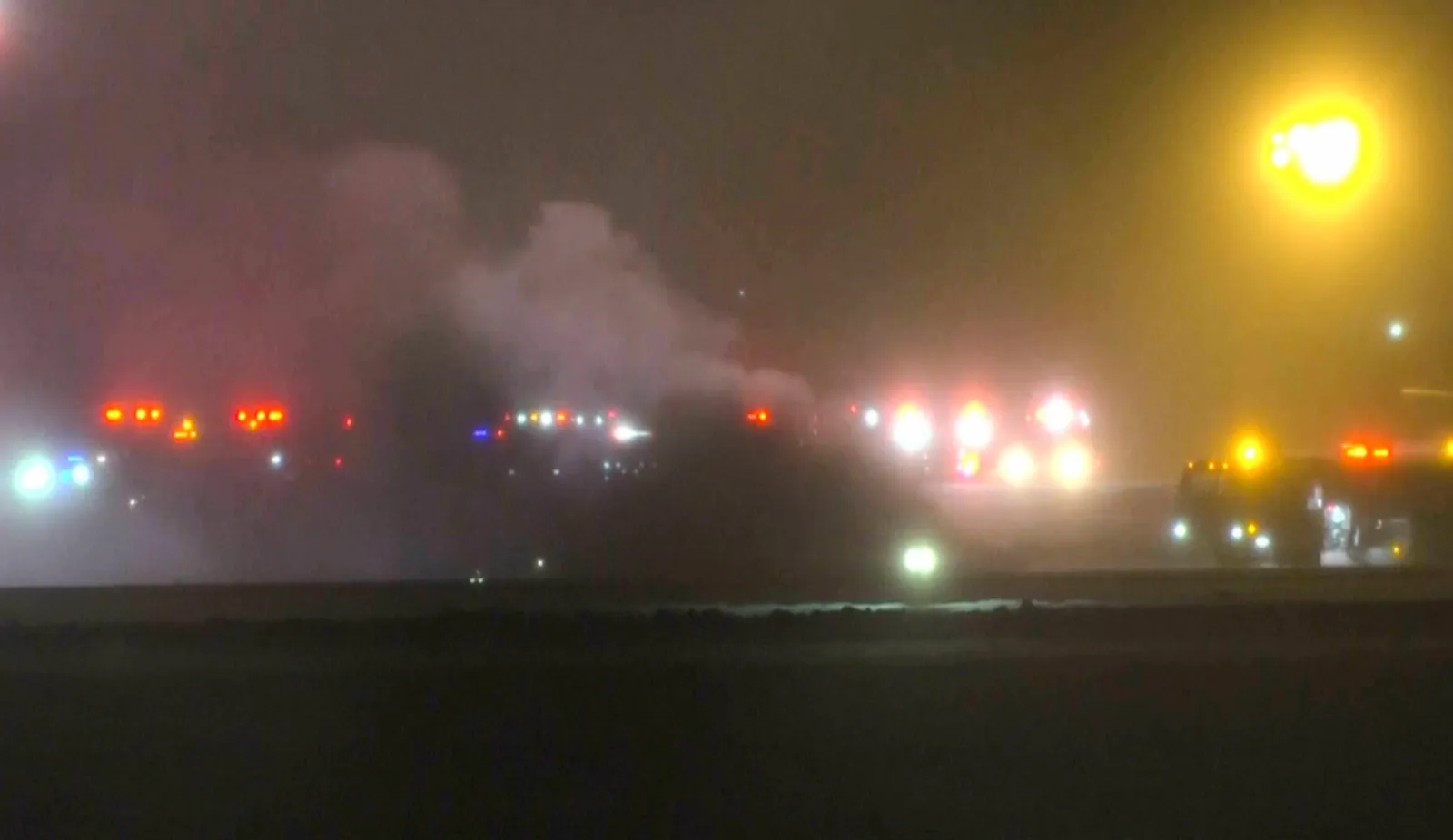
The Bombardier Challenger 600 overturned and caught fire shortly after beginning its takeoff roll at Bangor International Airport around 7:45 p.m. Sunday, as a major winter storm system was starting to reach New England.
Airport officials said Monday afternoon that six people were listed on the flight manifest and all were presumed dead. Earlier, the Federal Aviation Administration (FAA) said seven people were killed and one crew member survived with serious injuries, but an agency spokesman said those figures were preliminary and subject to change. No one was transported to a hospital, the airport said.
Read More on News
In a statement provided to Newsweek via email Monday, Bangor International added: "When an accident such as this occurs, there are numerous agencies and assets, both state and federal, that must coordinate their respective portions of the investigation. With the large number of stakeholders involved, it is important that we don’t release any information until all parties have completed their work and can confirm the information being released."
Officials have not released the identities of those on board, saying names will be withheld until positive identification is completed.
...
What Caused the Crash?
Snowfall was heavy in many parts of the country at the time of the crash, but accumulation had only begun in Bangor, where other aircraft were landing and departing safely around the same time.
The Challenger 600 “has a history of problems with icing on takeoff” that has contributed to previous crashes, said Jeff Guzzetti, aviation safety consultant and former federal crash investigator. Even small amounts of ice on a plane’s wings can significantly reduce lift and lead to loss of control, he said.
“That airplane absolutely would have needed to be deiced before takeoff if there was any freezing precipitation,” Guzzetti said, adding that it remains unclear whether or when that was done.
Flight tracking data from FlightRadar24 shows the aircraft had arrived in Bangor from Houston at 6:09 p.m., meaning it likely sat outside in snowy conditions for more than an hour before attempting to depart. Ice can begin forming quickly on aircraft surfaces under such conditions, particularly if cold jet fuel is added to wing tanks, a factor cited by the National Transportation Safety Board (NTSB) in previous icing-related crashes.
Airport officials said aircraft were being deiced at Bangor at the time of the crash, but it was not immediately known whether this particular plane received treatment.
“Given the weather conditions and the known history of wing contamination issues with this aircraft type, that’s going to be an immediate focus of the investigation,” Guzzetti said. “If there was any freezing precipitation at all, those wings would have needed to be completely clean before departure.”
Plane Registered to Texas Law Firm Crashes in Maine: What We Know
Public records show the jet was registered to a corporation that shares a Houston address with personal-injury law firm Arnold and Itkin Trial Lawyers. One of the firm’s founding partners is listed as the registered agent for the company that owns the aircraft.
Bangor International, about 200 miles north of Boston, is among the closest U.S. airports to Europe and is frequently used as a refueling stop for private and chartered transatlantic flights. It was closed after the crash and expected to remain so until at least Wednesday while investigators examine and remove the wreckage.
The NTSB and FAA are investigating. The safety board said preliminary information indicates the plane crashed during departure and was followed by a post-crash fire, adding that it will not release additional details until investigators arrive at the scene, a process that typically takes one to two days. Full investigations often take more than a year.
Audio from air-traffic control communications posted on LiveATC.net captured a controller saying, “Aircraft upside down. We have a passenger aircraft upside down,” about 45 seconds after the jet was cleared for takeoff. Airport Director Jose Saavedra said first responders arrived at the scene in less than a minute.
The crash occurred as an intense winter storm roared across the eastern United States, bringing snow, sleet and freezing rain while disrupting air and road travel nationwide.
Bangor’s airport, which operates under a longstanding joint-use agreement with the Maine Air National Guard, touts its ability to handle winter conditions.
“Runways are ready rain or shine — or snow,” the airport’s website says under the slogan, “A Little Snow Doesn’t Scare Us.”
The National Weather Service (NWS) office in Caribou, Maine, said the airport ultimately received nearly 10 inches of snow, but only light, steady snowfall had begun at the time of the crash. About one-tenth of an inch accumulated from midnight to 7 p.m. Sunday, the agency said. Winds were about 10 mph, which forecasters described as typical.
Other aircraft were taking off and landing at the airport around the time of the crash, Saavedra said.
“We have crews on site that respond to weather storms on a regular basis,” he said. “This is normal for us to respond to weather events.”
What Is a Bombardier Challenger 600?
The Bombardier Challenger 600 is a wide-body business jet typically configured to carry nine to 11 passengers. Introduced in 1980, it was the first private jet designed with a stand-up, walk-through cabin and remains widely used for charter operations, according to Air Charter Service.
Following earlier crashes involving the Challenger 600 and similar models, Bombardier and the FAA issued revised procedures and guidance aimed at preventing ice contamination during takeoff. Guzzetti said those changes have significantly reduced icing-related accidents in recent years.
Still, investigators will closely examine weather conditions, ground handling, deicing procedures and the aircraft’s systems as they work to determine what caused Sunday’s crash.
Update: 1/26/25, 3:10 p.m. ET: This article was updated with new information and remarks. The headline was renewed with the latest death toll.
This article includes reporting by the Associated Press.
In a polarized era, the center is dismissed as bland. At Newsweek, ours is different: The Courageous Center—it's not "both sides," it's sharp, challenging and alive with ideas. We follow facts, not factions. If that sounds like the kind of journalism you want to see thrive, we need you.
When you become a Newsweek Member, you support a mission to keep the center strong and vibrant. Members enjoy: Ad-free browsing, exclusive content and editor conversations. Help keep the center courageous. Join today.


View 0 Comments
Submit Correction
View Editorial & AI Guidelines