...

By Lucy Notarantonio
Senior Reporter
0
Share
Newsweek is a Trust Project member
See more of our trusted coverage when you search.Prefer Newsweek on Googleto see more of our trusted coverage when you search.
Pets are increasingly treated like children, and a viral video showing a dog and cat being disciplined in a very human way has left internet viewers in hysterics.
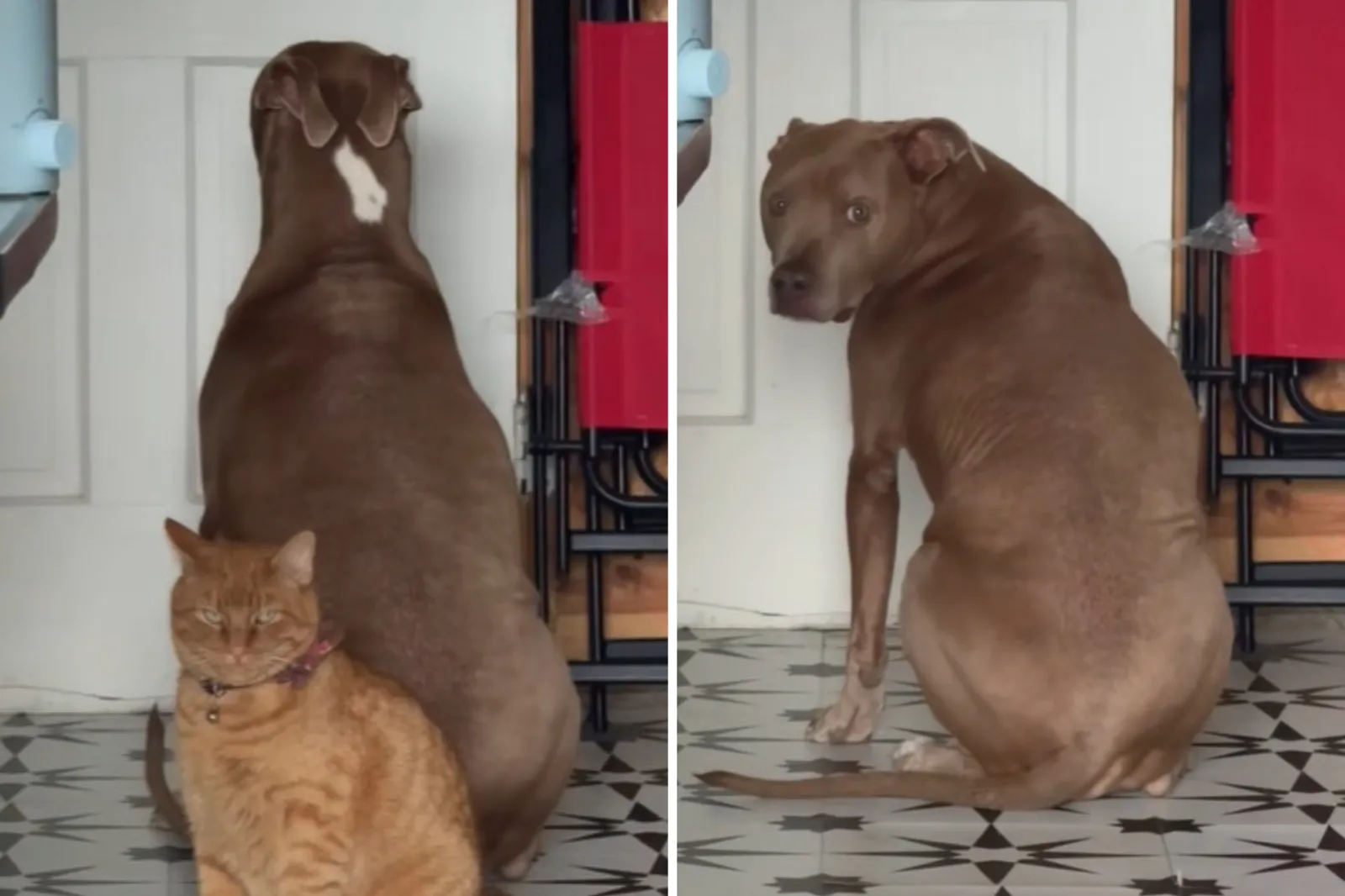
The clip, shared to @shyoma801, has racked up almost 8 million views, shows a pit bull and an orange cat being put into "time out"—a discipline strategy commonly used with children that involves temporarily removing attention and stimulation after misbehavior.
In the footage, the pit bull, named Lucious, appears to take the punishment seriously. He sits facing the wall while his owner films from behind the camera and says: "This is what happens when you are a bad boy."
Read More on Pets
The cat named Garfield, however, has a very different reaction.
...
Not long after the time out begins, Garfield casually walks off, completely ignoring the punishment. The moment has since earned around 1.6 million likes on its own, with viewers finding the contrast between the two pets’ reactions especially amusing.
As Garfield disappears out of frame, the owner turns their attention back to the dog, telling Lucious, "Thank you for staying there," while the cat is already long gone—clearly uninterested in participating.
The moment sparked a flood of comments comparing dogs and cats, with one viral remark earning more than 141,000 likes.
It said: "Dogs are smart [because] they can follow commands. Cats are smarter [because] they know they don’t have to."
Another joked: "Garfield is like…Girl I do what I want. this my house."
"Why do cats always get away with everything!" a third commenter added.
The video has also prompted a bigger question among viewers: do pets actually know when they’ve done something wrong?
Do Pets Understand Right From Wrong?
According to VCA Animal Hospitals, pets don’t have a moral sense of "right" and "wrong" in the same way humans do. Instead, animals learn rules through experience—repeating behaviors that lead to rewards and avoiding those that result in unpleasant consequences. What counts as acceptable behavior also depends on the household, since every home has its own expectations.
How Pets Learn Household Rules
When a pet enters a new home, it doesn’t automatically understand human rules. Its focus is on meeting basic needs such as food, comfort, and play. Over time, consistent training helps pets learn which behaviors their owners approve of and which they don’t. When a pet breaks a rule, it usually means the training hasn’t been fully reinforced in every situation.
Why Pets Don’t Feel Guilt
When pets steal food or damage household items, they aren’t weighing whether the action is right or wrong. They are focused on the immediate reward. By the time an owner notices the behavior, the pet has often already forgotten making the choice, which is why punishment after the fact is ineffective.
Why Scolding Doesn’t Help
Scolding a pet—whether moments or hours later—doesn’t work and can even be harmful. Punishment is only effective if it happens immediately, and even verbal reprimands can cause fear and damage trust. Rather than learning what not to do, pets may simply become afraid in certain situations or around specific objects.
Newsweek reached out to @shyoma801 for comment via TikTok. We could not verify the details of the case.
View 0 Comments
Submit Correction
View Editorial & AI Guidelines