...

By Ryan Chan
China News Reporter
0
Share
Newsweek is a Trust Project member
See more of our trusted coverage when you search.Prefer Newsweek on Googleto see more of our trusted coverage when you search.
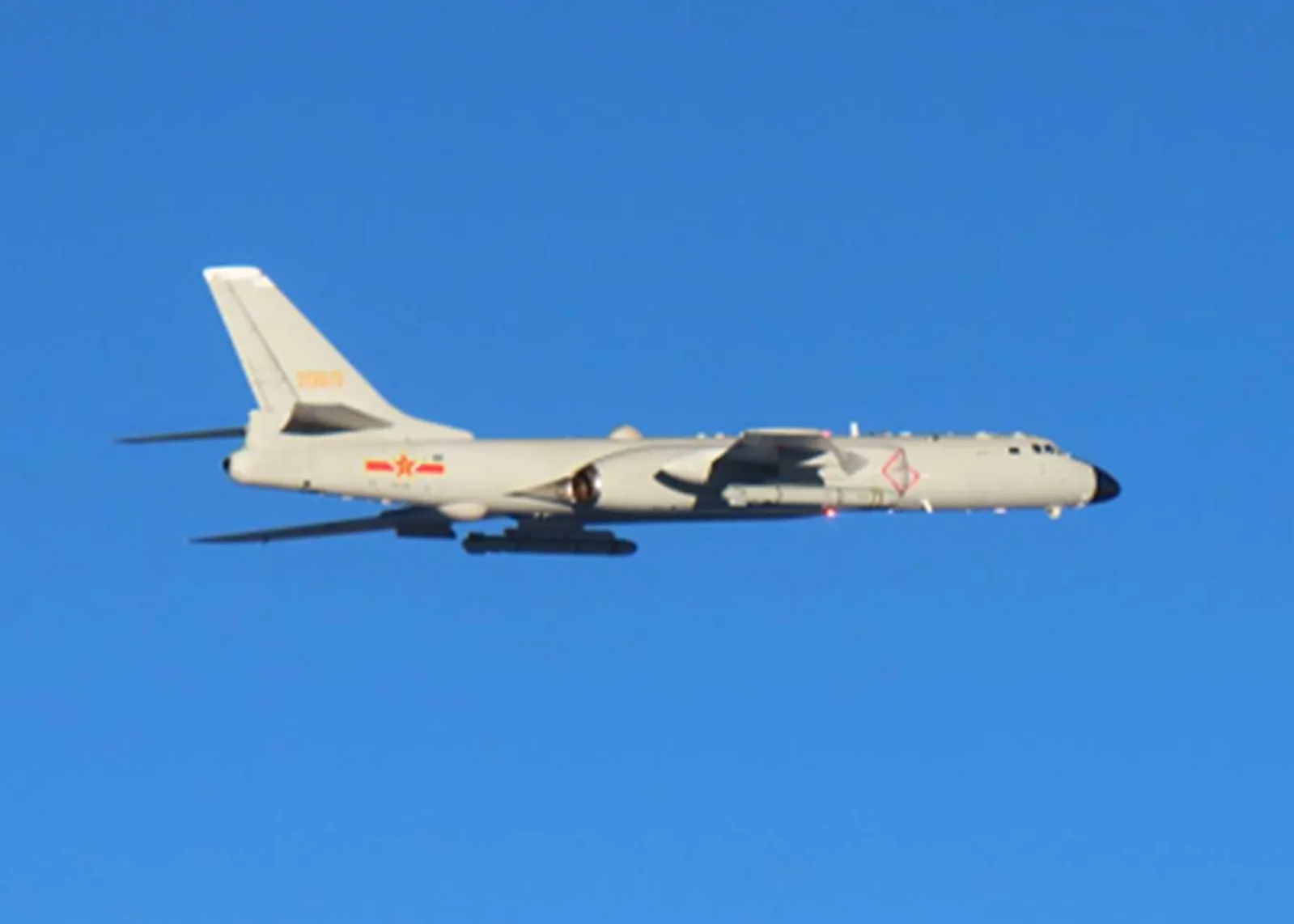
Japan has said it intercepted a group of Chinese military aircraft, led by bombers, last month near its outlying southwestern islands during Beijing's large-scale war games around Taiwan.
The interception took place on December 29, the Japanese Defense Ministry said on Monday, coinciding with China's Justice Mission 2025 exercise, which was organized in response to the United States' approval of more than $11 billion in arms sales to Taiwan.
The Chinese Foreign Ministry did not immediately respond to a request for comment.
Read More on World
Why It Matters
Japan and Taiwan, along with the Philippines, are key security partners under a north-south defensive line known as the First Island Chain, a U.S. strategy aimed at deterring and defending against potential Chinese aggression by projecting joint military power.
The most recent Chinese military exercise also came amid ongoing tensions between Beijing and Tokyo, following remarks by Japanese Prime Minister Sanae Takaichi about military intervention should China move against Taiwan, a self-governing island.
Meanwhile, China has recently stepped up its military presence in waters east of the First Island Chain, including a bomber patrol with Russia and the deployment of an aircraft carrier, as part of efforts to demonstrate its rapidly growing military strength.
What To Know
The Joint Staff Office of Japan's Defense Ministry said a total of eight Chinese military aircraft, including two H-6 bombers, four fighter jets and two intelligence-collection planes, flew from the East China Sea to the Philippine Sea via the Miyako Strait.
The First Island Chain waterway lies between Japan's Miyako and Okinawa islands and serves as a major gateway for China's military deployments to the broader western Pacific.
Imagery released by Tokyo shows that at least one H-6 bomber and one J-16 fighter jet were carrying missiles as they transited Japan's air defense identification zone (ADIZ), which lies beyond the country's sovereign airspace, according to a Newsweek map.
...
Japanese fighter aircraft assigned to the Air Self-Defense Force's southwestern unit were scrambled on both December 29 and 30 over what the Joint Staff Office called "the possibility of airspace violations" in the East China Sea and the Pacific Ocean.
Flight tracks provided by the Joint Staff Office indicate that two H-6 bombers and one Y-9 intelligence-collection plane flew farther southeast over the Philippine Sea than the rest of the formation before returning to China's mainland through the Miyako Strait.
Collin Koh, a senior fellow at Singapore's Institute of Defense and Strategic Studies, described the Chinese aircraft formation as a simulated long-range air strike package that "ostensibly targeted" Guam, the westernmost American territory, and beyond.
Under the Island Chain Strategy, Guam is a centerpiece of the Second Island Chain, which runs from Japan to the island of New Guinea. It is a key outpost for projecting U.S. forces in the western Pacific, hosting Air Force, Marine Corps and Navy bases.
Japan's military also tracked three Chinese naval vessels transiting the Miyako Strait between December 27 and 30. Based on their hull numbers, the ships were identified as the frigates CNS Zhoushan and CNS Yiyang and the destroyer CNS Changchun.
What People Are Saying
The Joint Staff Office of Japan's Defense Ministry said: "The Ministry of Defense and the Self-Defense Forces will continue to ensure complete readiness, 24 hours a day, 365 days a year, to protect our country's territory and the peaceful lives of all citizens."
Zhang Xiaogang, a spokesperson for China's Ministry of National Defense, said: "We urge relevant countries to abandon the illusion of using Taiwan to contain China, and to refrain from challenging China's resolve in safeguarding its core interests."
What Happens Next
China is expected to maintain its military presence along the First Island Chain. It remains to be seen how the U.S. will help its allies and partners bolster defenses as its national security strategy calls for building the capability to deny aggression in the region.
View 0 Comments
Submit Correction
View Editorial & AI Guidelines