10
Loading video...

By Gabe Whisnant
News Editor
0
Share
Newsweek is a Trust Project member
See more of our trusted coverage when you search.Prefer Newsweek on Googleto see more of our trusted coverage when you search.
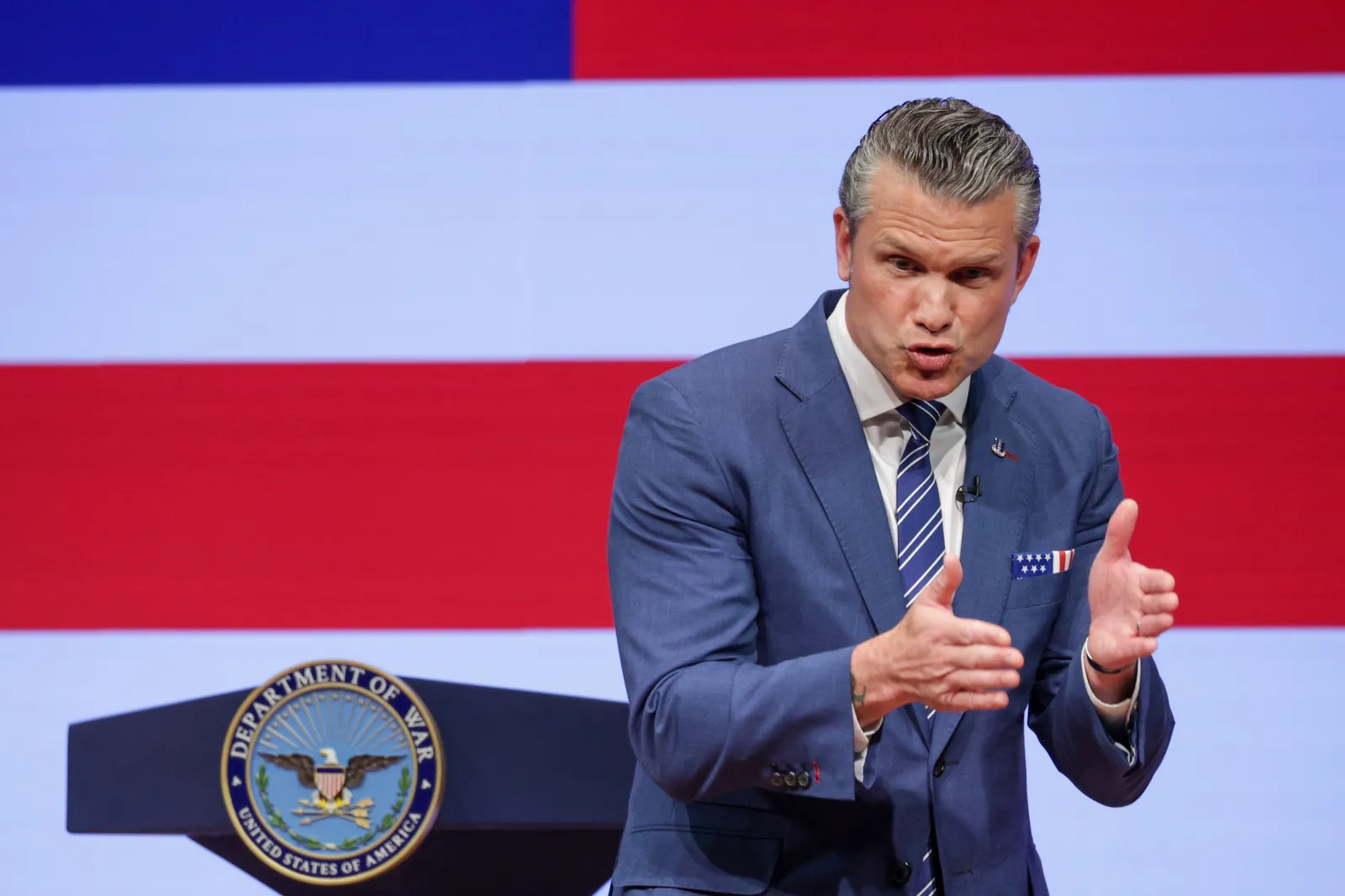
Secretary of Defense Pete Hegseth was interrupted four times in roughly five minutes by anti-war protesters Wednesday during an autonomous warfare panel at the U.S. Army’s 2026 Annual Meeting and Exposition in Washington, D.C.
“Children in Gaza are starving! He is a war criminal!” one protester shouted during the panel at the Walter E. Washington Convention Center. Another yelled, “You’re not a warrior, you’re a coward!”
After one interruption, Hegseth quipped, “She thinks highly of me.”
Read More on U.S.
Six protesters separately interrupted the morning panel over the course of roughly 20 minutes, shouting and holding up signs inside a ballroom at the Washington convention center. All six were removed from the event.
Pentagon press secretary Kingsley Wilson dismissed the protesters as “performative, left-wing activists” in an email response to Newsweek, and said Hegseth was not deterred by the disruptions. She called the U.S. military “the greatest fighting force the world has ever known” and said that under Trump and Hegseth it had carried out “numerous successful operations with excellence and professionalism.”

...
Anti-War Groups Claim Responsibility for Hegseth Protest
CodePink and the National Iranian American Council (NIAC) have claimed responsibility for a protest that repeatedly interrupted Defense Secretary Pete Hegseth and other military leaders during a U.S. Army conference in Washington, D.C., on Wednesday.
NIAC said in a social media post that protesters, including the group’s communications manager Isabella Javidan, “confronted” Hegseth at what it described as a gathering of military officials and defense contractors. The Iranian American advocacy group has been a vocal opponent of the war with Iran.
Javidan said that CodePink, a feminist anti-war organization whose activism dates back to the run-up to the 2003 U.S. invasion of Iraq, organized the protest.
Iran War Faces Growing Opposition at Home
The disruptions come amid continued opposition to U.S. military policy in the Middle East. The Trump administration has faced criticism over its support for Israel and its approach to the war in Gaza, while Hegseth has also played a leading role in the administration’s expanded military campaign against Iran in 2026.
U.S. and Israeli forces launched strikes against Iran earlier this year, with Hegseth and President Donald Trump saying the ongoing campaign is intended to eliminate threats posed by Iran’s nuclear program, missiles, navy and other military capabilities.
The conflict has also faced broad public opposition in the United States. A Pew Research Center poll released October 8 found 65 percent of Americans disapproved of Trump’s handling of the conflict, compared with 33 percent who approved.
The war has also carried economic consequences for Americans, according to Mark Zandi, chief economist at Moody’s Analytics. Nearly eight months into the conflict, Zandi estimated that the average American household is nearly $2,000 worse off because of the war, amounting to $265 billion nationwide.
“Nearly $2,000. By my calculation, that is what the Iran war has cost the average American household since the war began nearly eight months ago. Nationwide, that adds up to $265 billion,” Zandi wrote on social media this week.
The estimate captures a different measure than the federal government’s direct spending on the conflict. Hegseth told Congress that the war had cost the U.S. government [amount] between February 28, when the U.S. and Israel launched joint strikes on Iran, and late July.
Related Story
Why Pete Hegseth Needs Wimps and Weirdos
Pentagon Expands Focus on Autonomous Warfare
Wednesday's panel, titled “Project Agincourt: Autonomous Warfare,” focused on the Pentagon’s push to expand the military’s use of unmanned and autonomous systems and prepare them for a larger role in future conflicts. Hegseth appeared alongside senior leaders from the Army, Navy and Air Force, as well as Derrick Anderson, the assistant secretary for special operations and low-intensity conflict.
Project Agincourt is an initiative directed by Hegseth to establish a new four-star Autonomous Warfare Command that would lead the military’s approach to unmanned and autonomous warfare. Under a September 30 Pentagon memorandum, the proposed command would have dedicated personnel, budget and acquisition authority, with a target establishment date of October 1, 2027. The initiative also calls for changes to how the military develops and purchases autonomous systems, with an emphasis on more rapidly adapting technology for battlefield use.
The Army is separately moving to establish its own Futures and Autonomous Systems Command. An October 1 directive also calls for a centralized acquisition office for priority autonomous systems and directs the service to prioritize systems including drones, robotics, reconnaissance platforms, combat vehicles and autonomous systems for artillery, rockets and missiles.
Contact Newsweek editors on this story: Samantha Beech and Sam Wilson.
View 0 Comments
Submit Correction
View Editorial & AI Guidelines