
By Jon Jackson
News Editor
0
Share
Newsweek is a Trust Project member
See more of our trusted coverage when you search.Prefer Newsweek on Googleto see more of our trusted coverage when you search.
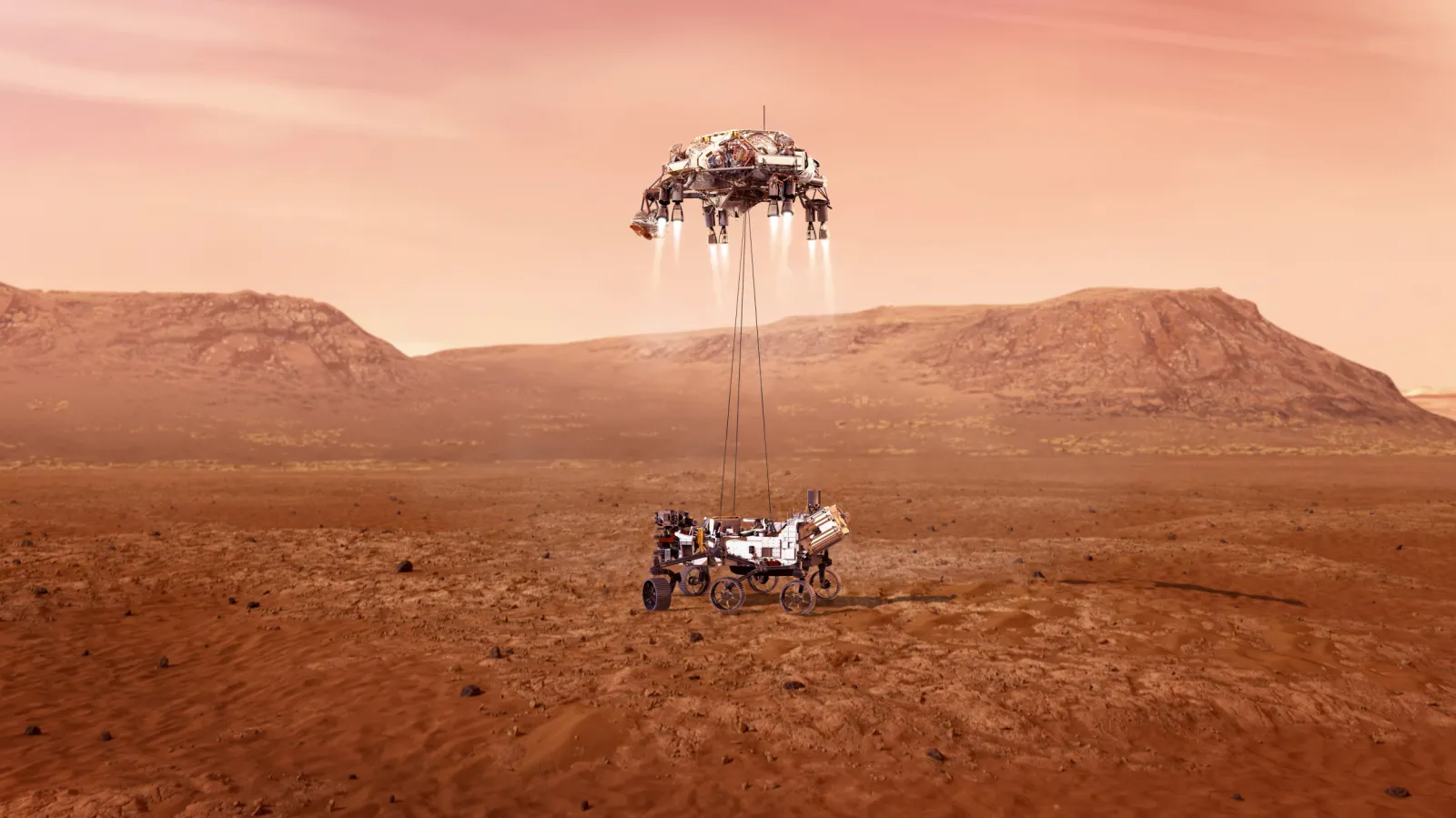
NASA's Perseverance rover successfully landed today at its scheduled time of 3:55 p.m. EST, and the crew gathered in NASA's control room could be seen and heard celebrating via the agency's official YouTube live stream of the event. The first image of the surface of Mars was shown moments later, eliciting another round of applause from the NASA crew.
...
The spacecraft successfully survived a challenging landing that NASA referred to as the "seven minutes of terror." This period is called such due to communication from Earth not being able to reach the rover for roughly seven minutes and thus not being able to make any adjustments to its course toward the surface of Mars. Fortunately, no such adjustments were necessary as the spacecraft's parachute successfully deployed and its protective heat shield was detached to allow its cameras to navigate to the designated landing spot destination. Rocket engines slowed the descent more to allow Perseverance to quickly decelerate to a full stop and land after traveling at a speed of more than 12,000 miles per hour. This abrupt ending came following a seven-month journey through space to the rover's destination 125 million miles from Earth.
Read More
Ancient Mars Had Warm Weather and Rainstorms Before the Planet Turned Icy, Scientists Say7 min read

NASA’s Curiosity Sends Back Desolate View of Mars Landscape as It Makes Its Lonely Ascent of Mount Sharp3 min read

Mars Rover Perseverance Offers the Best Chance Yet of Finding Signs of Life on Red Planet3 min read

Now, Perseverance begins the real work of its mission in the Jezero Crater, where scientists believe they may find signs of life from a lake that existed billions of years ago. The rover will explore the crater's dunes, cliffs and rock formations.
The rover is actually the third visitor to the red planet this month. A robotic probe from the United Arab Emirates began orbiting Mars on February 9, before another from China did the same a day later.
With Perseverance successfully on the surface of Mars, the rover will set about collecting rock samples. These samples will be sealed in tubes for a later sample-return mission. Perseverance will also launch a helicopter drone to test whether unmanned, targeted probe tasks are possible on the planet. All this will occur will the rover broadcasts information back to Earth via high-definition 4K.
In 2026, NASA plans on launching a lander to retrieve the samples Perseverance collects, but this craft will take a longer, two-year route. This lander will also feature a 9-foot-tall rocket that will bring back the samples from the Mars. NASA's plan is for these samples to reach Earth sometime in 2031.
In all, the craft and all the high-tech tools on Perseverance added up to a total cost of $2.7 billion. If signs of ancient water are found, and the mission helps to the other eventual goal of allowing human exploration on Mars someday, the cost will likely be seen as a worthwhile investment for NASA.
Perseverance's official Twitter account also acknowledged it had arrived safely to its destination.
View 0 Comments
Submit Correction
View Editorial & AI Guidelines