...


By Amira El-Fekki and Shane Croucher
0
Share
Newsweek is a Trust Project member
See more of our trusted coverage when you search.Prefer Newsweek on Googleto see more of our trusted coverage when you search.
Pakistan's President Muhammad Shehbaz Sharif accused India of backing the Afghan Islamist groups that he said conducted a suicide bombing at a courthouse in Islamabad on Tuesday and a deadly attack on a cadet college in Wana.
"The time has come for the world to condemn such nefarious conspiracies by India," Sherif said in a statement shared by the Pakistani government, originally in Urdu. "Both attacks are the worst examples of Indian state terrorism in the region."
India rejected the allegations. Separately, there was a deadly car bombing in the Indian capital, New Delhi, a day before the Islamabad attack. Indian authorities suspect Islamist groups based in Kashmir.
Read More on News
Newsweek has contacted the foreign ministries of Pakistan and Afghanistan for comment.
Why It Matters
The comments could renew tensions between the two nuclear-armed countries. India and Pakistan fought a brief war in 2025 after a massacre of Indian tourists in Pahalgam, in Indian-controlled Jammu and Kashmir. U.S. President Donald Trump later claimed credit for mediating a ceasefire agreement reached in March, following weeks of cross-border artillery exchanges and airstrikes.
The Pakistani government often accuses India of being behind acts of terror in the country. India also accuses Pakistan of plotting terror attacks there. Both sides deny the accusations. The remarks also come as Pakistan faces renewed clashes with Taliban-ruled Afghanistan along their shared border, where Islamabad accuses Kabul of harboring militants involved in attacks inside Pakistan.
...
What To Know
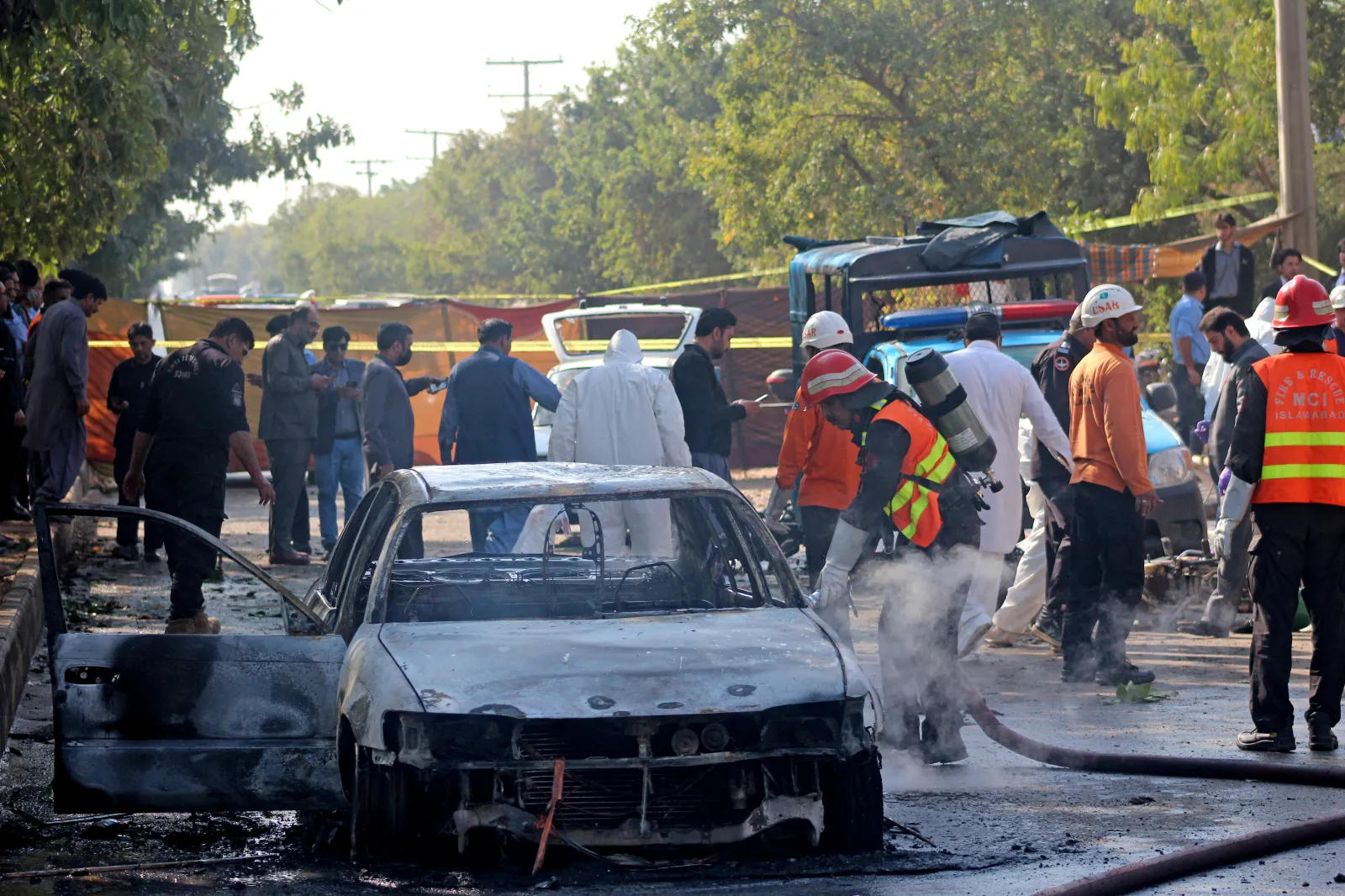
At least 12 people were killed and 27 others wounded when a suicide bomber struck outside the gates of a district court in Islamabad on Tuesday, detonating explosives next to a police car. The attack was later claimed by Jamaat‑ul‑Ahrar, a splinter faction of the Pakistani Taliban, according to the Associated Press.
Overnight, militants also launched an attempted attack in Wana, Khyber Pakhtunkhwa, targeting an army-run college and leaving several people dead and wounded. Sharif blamed groups allegedly acting in collusion with India for both attacks.
Pakistan and Afghanistan agreed to an immediate ceasefire, brokered in Doha, Qatar, announced on October 18. However, subsequent negotiations in Istanbul mediated by Turkey have reportedly stalled without a breakthrough. Pakistan’s defense minister had warned that if the talks fail to deliver a durable arrangement, Islamabad may consider "open war" with Kabul.
Meanwhile in India, a car explosion near the historic Red Fort in New Delhi Monday killed at least eight people and wounded over a dozen others. Indian officials have not publicly blamed Pakistan at this stage, though the blast is being investigated under India’s anti‑terror law, police officials told the Associated Press.
What People Are Saying
Shri Randhir Jaiswal, a spokesperson for the Indian Foreign Ministry, said in a public statement on Tuesday in response to media queries: "India unequivocally rejects the baseless and unfounded allegations being made by an obviously delirious Pakistani leadership. It is a predictable tactic by Pakistan to concoct false narratives against India in order to deflect the attention of its own public from the ongoing military-inspired constitutional subversion and power-grab unfolding within the country. The international community is well aware of the reality and will not be misled by Pakistan’s desperate diversionary ploys."
Pakistan's defense minister, Khawaja Mohammad Asif wrote Tuesday on X, in Urdu: "We are in a state of war. Anyone who thinks the Pakistan Army is only fighting this war in the Afghan-Pakistan border areas or in the remote regions of Balochistan should take today’s suicide attack at the Islamabad District Court as a wake-up call—this is a war for all of Pakistan, in which the Army is making daily sacrifices and giving the people a sense of security."
India's Prime Minister Narendra Modi said in a statement on X on Tuesday, condemning the New Delhi attack, translated from Hindi: "I assure everyone that our investigative agencies will get to the bottom of this conspiracy. Whoever is responsible for this will not be spared at any cost."
Afghanistan’s government spokesman, Zabiullah Mujahid was quoted as saying by the Associated Press on Sunday: "Afghanistan [does] not want insecurity in the region, and entering into war is not our first choice," but he noted that "if war breaks out, we have the right to defend ourselves."
What Happens Next
Rising tensions between Pakistan, Afghanistan, and India risk triggering a cycle of attacks and retaliation.
Update 11/12/25, 3:26 a.m. ET: This story was updated with a comment from the Indian Foreign Ministry.
View 0 Comments
Submit Correction
View Editorial & AI Guidelines