...

By Jordan King
Reporter
0
Share
Newsweek is a Trust Project member
See more of our trusted coverage when you search.Prefer Newsweek on Googleto see more of our trusted coverage when you search.
Californian authorities have scaled back the evacuation zone for the Garden Grove chemical tank emergency in Orange County after determining the risk of a "catastrophic" explosion had passed, though a significant blast or fire is still possible.
As of 6 p.m. local time on Monday, evacuation orders were scaled back from roughly 50,000 residents to about 16,000, after the Orange County Fire Authority (OCFA) confirmed that the most dangerous scenario—a boiling liquid expanding vapor explosion, or BLEVE—had been averted.
Earlier in the crisis, OCFA interim Fire Chief TJ McGovern had described a BLEVE as "the worst-case catastrophic event."
Read More on News
On Monday evening, OCFA released an updated evacuation map on X, urging residents to continue following official instructions, "We ask that you continue listening to law enforcement and do NOT enter the newly evacuated area."
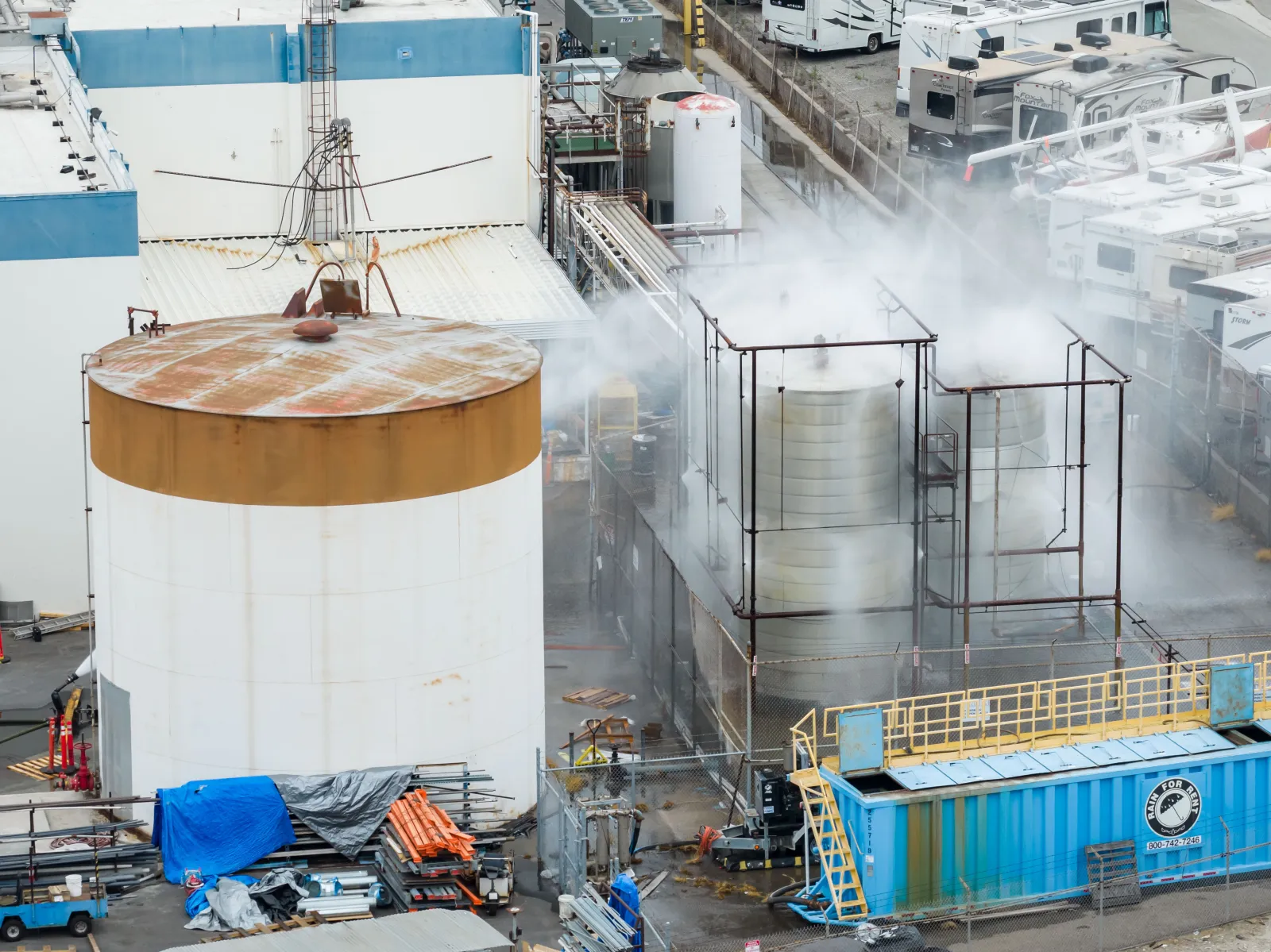
Emergency crews have been working to cool and stabilize a chemical tank at GKN Aerospace in Garden Grove, which holds thousands of gallons of methyl methacrylate, a highly flammable substance commonly used in plastics and aerospace production.
The tank's internal temperature had risen to at least 100 degrees—the maximum reading on the thermometer—heightening concerns about a potential "thermal runaway" reaction that could lead to an explosion.
About 50,000 people had been told to leave their homes by the end of last weekend, according to the Associated Press.
Threat of Catastrophic Explosion Ends
The OCFA said on Monday that the tank was beginning to cool, eliminating the threat of a catastrophic explosion. The tank's interior had cooled to 93 degrees Fahrenheit as of Monday, and the fire authority called it "incredibly positive news."
But there is still a chance of a smaller blast or a fire, OCFA Division Chief Craig Covey said during a news conference.
"It's not over yet. We still have work to do," Covey said. "We still have to mitigate a fire and very small explosion concern, and also a spill potential."
At the same news conference, Orange County Health Director Regina Chinsio-Kwong assured people returning home that they were safe to do so.
"There was no contamination. There were no fumes. There were not vapors that came from this incident," she said. "There was not a leak. So it should be, you should feel comfortable going home even if you're across the street from that new zone line."
...
Environmental Danger Not Over
Covey said at Monday's news conference that there was still a risk of a smaller blast or fire.
Andrew Whelton, an engineering professor at Purdue University who has studied environmental contamination, also warned about the ongoing risk, telling the Associated Press that the chemical inside the tank would remain hot and reactive even though it had begun cooling, meaning there could still be an explosion.
He said temperatures must fall to between 60 and 70 degrees Fahrenheit before things could be considered fully safe.
Presidential Emergency Declaration Announced
California Governor Gavin Newsom announced on Monday that his office had secured a presidential emergency declaration, meaning federal resources and funding could now be used to support Orange County's response to the chemical tank emergency.
"Working closely with local responders, the state has moved aggressively to protect residents in the impacted area," Newsom wrote on X.
"This morning, Orange County Fire Authority announced that the risk of a massive explosion has been mitigated. This new federal assistance will further bolster our resources to help resolve this situation," he continued.
What Happens Next
County health officials said people returning home may be able to smell the chemical, even if they are in an area that poses no risk.
The South Coast Air Quality Management District will continue monitoring air quality for several months, Orange County Supervisor Janet Nguyen said, while the Environmental Protection Agency will test sewer and storm drains.
Evacuated residents who flocked to shelters over the weekend will be waiting to hear when they are able to safely return home.
The American Red Cross, which opened seven evacuation shelters for the emergency, said capacity would be reevaluated on Tuesday.
GKN said in a statement that it was working with emergency services, telling residents, "We are acutely aware of the uncertainty this incident is causing and sincerely apologize for the ongoing disruption to the local community."

...
View 0 Comments
Submit Correction
View Editorial & AI Guidelines