Almanac.com/Frost-2026

By Joe Edwards
Reporter
0
Share
Newsweek is a Trust Project member
See more of our trusted coverage when you search.Prefer Newsweek on Googleto see more of our trusted coverage when you search.
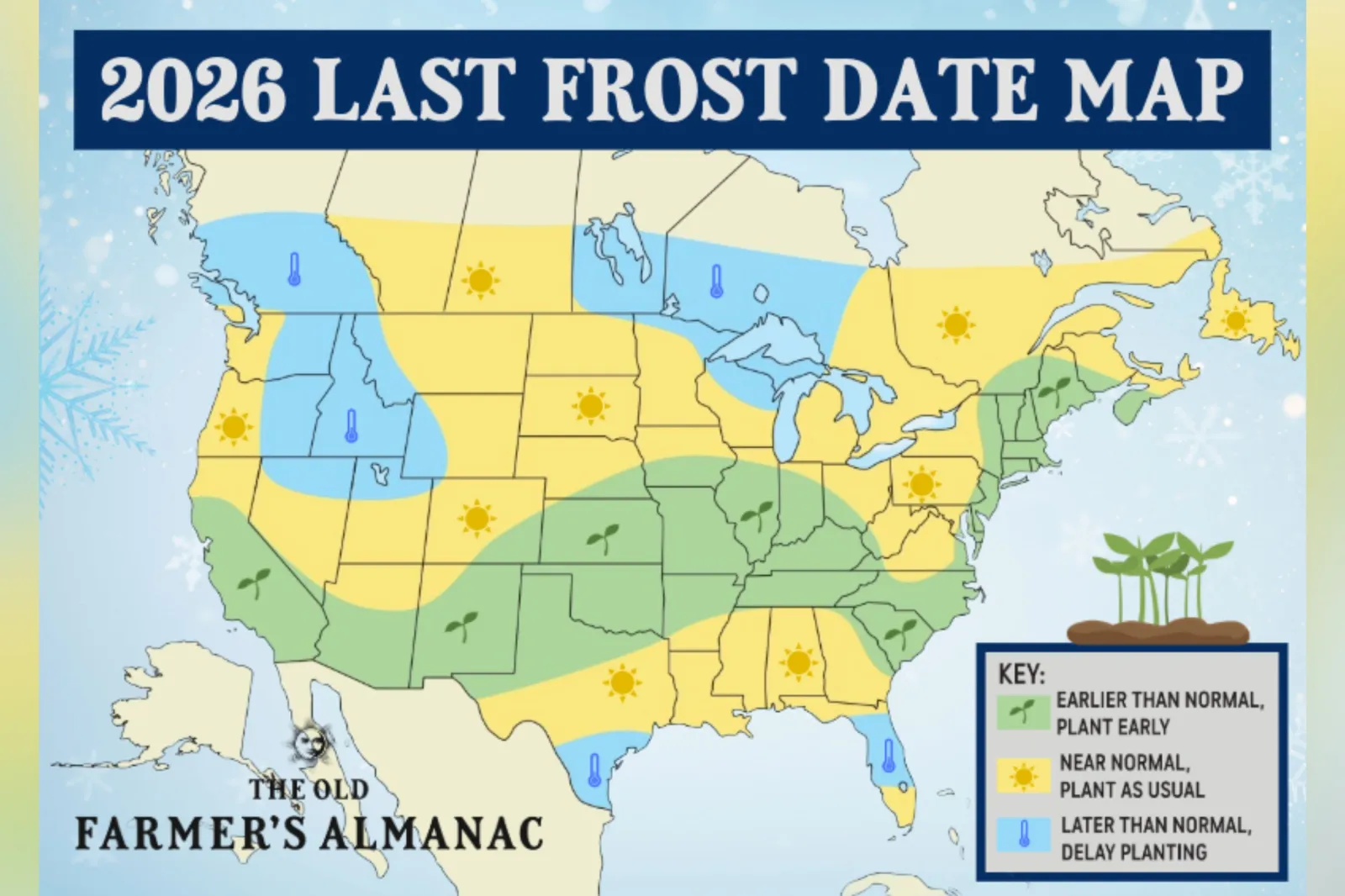
Historic publication The Old Farmer’s Almanac has released a 2026 Last Frost Date Map predicting when spring frost will end across the U.S., guiding early planting plans.
Why It Matters
The Almanac’s new map aims to help gardeners fine-tune early-season decisions for frost-tolerant crops by indicating whether the last spring frost in 2026 will arrive earlier than average, near normal or later than average.
Read More on News
The tool builds on historical averages by incorporating predictive outlooks, offering more situational guidance during an erratic weather year without replacing traditional frost-date benchmarks, the publication said.
What To Know
The map classifies regions in three colors: green for an earlier-than-normal last frost by about one to two weeks, yellow for near the long-term average within roughly a week, and blue for a later-than-normal last frost by about one to two weeks.
The Old Farmer’s Almanac noted that the map is intended to guide early plantings of frost-tolerant, cool-season crops, not warm-season plants like tomatoes, peppers, cucumbers, squash, beans or basil, which require frost-free nights and consistently warm soil to thrive.
...
The publication broke the predictions down by region as follows:
Northeast: Green, earlier-than-normal outlook across Boston and much of New England, signaling a potentially earlier window for cool-season planting.
Atlantic Corridor: Green across New Jersey, New York City and Philadelphia, indicating earlier final frosts relative to averages.
Southeast: Green across the Carolinas and eastern Georgia, pointing to a longer spring planting window.
Florida: Central areas near Orlando are blue for later-than-normal frost timing, with yellow near-normal conditions around Jacksonville and in the southern tip of the state.
Appalachians: Yellow near-normal timing across the region, suggesting planning close to historical averages.
Ohio Valley: Green across Kentucky and much of Indiana, with yellow, near-normal conditions in much of Ohio and West Virginia, indicating a mixed but generally favorable early-season start.
Deep South: Yellow overall near-normal last frost timing, supporting standard planting schedules for the region’s early crops.
Upper Midwest: Yellow overall with blue, later-than-normal conditions at the northern tips of the region.
Lower Lakes: Yellow, near-normal across Michigan and major Great Lakes cities, including Chicago, favoring typical schedules.
Heartland: Green, earlier-than-normal conditions, including St. Louis and Kansas City, with yellow, near-normal timing in northern Iowa.
Texas-Oklahoma: Green, earlier-than-normal in the north near Oklahoma City, with yellow, near-normal in central zones, and blue, later-than-normal in the south near San Antonio, suggesting a north-south contrast for spring timing.
High Plains: Yellow, near-normal across Nebraska and northern Colorado, as well as across the Dakotas, supporting typical early planting plans where soils cooperate.
Intermountain: Blue later-than-normal across Idaho, eastern Oregon and Washington, northern Utah and Nevada, and far northwest Colorado, indicating caution and potential delays for outdoor starts.
Mountain West: Blue, later-than-normal in northern Montana with yellow near-normal elsewhere across the region.
Pacific Northwest: Yellow, near-normal across Seattle, Portland and coastal areas.
Pacific Southwest: Green, earlier-than-normal across California and desert areas, including Los Angeles, Phoenix and Las Vegas.
What People Are Saying
The Old Farmer’s Almanac: “We created this new map because gardeners today want more than averages—they want insight into this year’s conditions. The weather has become more erratic, and while the traditional frost dates remain a trusted foundation, we saw an opportunity to provide another layer of guidance.”
What Happens Next
The Old Farmer’s Almanac also released its long-range forecast for spring 2026.
"We are forecasting a warmer than normal spring for most of the U.S., however, parts of Washington, Oregon, Idaho, Montana, and Colorado are expected to see temperatures closer to or below seasonal averages," Sarah Perreault, managing editor of The Old Farmer's Almanac, previously told Newsweek.
In a polarized era, the center is dismissed as bland. At Newsweek, ours is different: The Courageous Center—it's not "both sides," it's sharp, challenging and alive with ideas. We follow facts, not factions. If that sounds like the kind of journalism you want to see thrive, we need you.
When you become a Newsweek Member, you support a mission to keep the center strong and vibrant. Members enjoy: Ad-free browsing, exclusive content and editor conversations. Help keep the center courageous. Join today.


View 0 Comments
Submit Correction
View Editorial & AI Guidelines