...

By Amanda Greenwood
Associate News Editor
0
Share
Newsweek is a Trust Project member
See more of our trusted coverage when you search.Prefer Newsweek on Googleto see more of our trusted coverage when you search.
The long‑running Old Farmer's Almanac—known for its weather forecasts and planting guidance—has released a "Last Frost Date Map" for spring 2026, outlining when the last frost is likely to happen and how this timing may affect the planting of flowers, shrubs, crops and other garden plants.
Why It Matters
For gardeners and farmers across the United States, the timing of the last spring frost is a crucial marker that determines when planting can safely begin.
Read More on News
The Old Farmer's Almanac pairs long‑established climate averages with predictive weather forecasting to estimate when that final frost is most likely to occur. This type of guidance has become increasingly more valuable as the weather continues to become more erratic.
Mistiming a planting, whether it's by sowing seeds too early and risking frost damage or by missing the optimal window, can result in lost crops and wasted effort.
...
How To Read the Old Farmer's Almanac 'Last Frost Date' Map
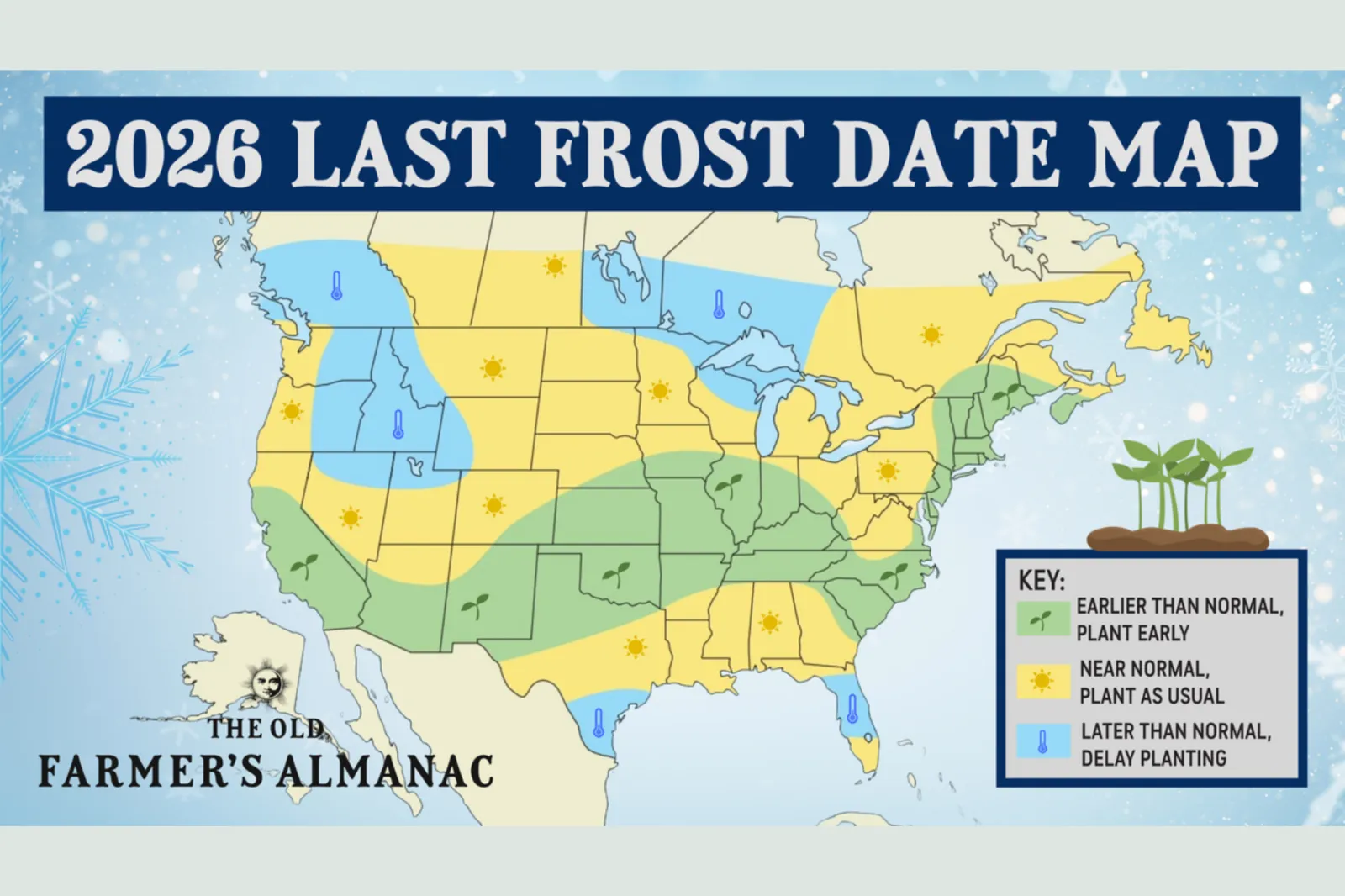
The Old Farmer's Almanac's 2026 Last Frost Date Map offers region‑specific predictions for when the final frost of the spring season is likely to occur.
The map categorizes regions across the U.S. into three color-coded outlooks:
- Green areas indicate an earlier‑than‑normal last frost, with freezing temperatures expected to end one to two weeks ahead of historical averages.
This includes cities and regions such as Boston, much of New England, the Atlantic corridor, the Carolinas and California. - Yellow areas reflect near‑normal last frost timing, aligning closely with three‑decade climate averages.
These zones cover much of the Deep South, the lower Great Lakes, the Pacific Northwest and portions of the Midwest. - Blue areas show a later‑than‑normal last frost, with freezing temperatures lingering one to two weeks beyond the expected time frame.
Regions affected include northern Montana, Idaho, northern Nevada and Utah, and central Florida.
The 2026 Last Frost Date Map is intended to guide the planting of cool‑season, frost‑tolerant crops—such as peas, lettuce and spinach—rather than warm-season crops, such as tomatoes or peppers, that need fully frost-free conditions and consistently warm soil.
For the best planting results, The Old Farmer's Almanac advises farmers and gardeners to use the 2026 Last Frost Date Map in combination with local weather forecasts and regular soil temperature checks. It cautions that the map isn't a direct replacement for traditional seasonal averages, but it does provide another way for growers to adapt more confidently to the increasingly variable spring weather.
According to The Old Farmer's Almanac, "Whether your area is blue, green, or yellow, the advice is the same: watch the weather, trust your soil, and protect tender plants. Gardening has always been about patience and adaptation; this map helps you begin your gardening season with a clearer picture and to plant with confidence."
View 0 Comments
Submit Correction
View Editorial & AI Guidelines