10
Loading video...

By Andrew Stanton
Reporter
0
Share
Newsweek is a Trust Project member
See more of our trusted coverage when you search.Prefer Newsweek on Googleto see more of our trusted coverage when you search.
Kroger’s announcement that it will lay off thousands of corporate workers comes as economic concerns have emerged as the defining issue in Ohio's midterm elections.
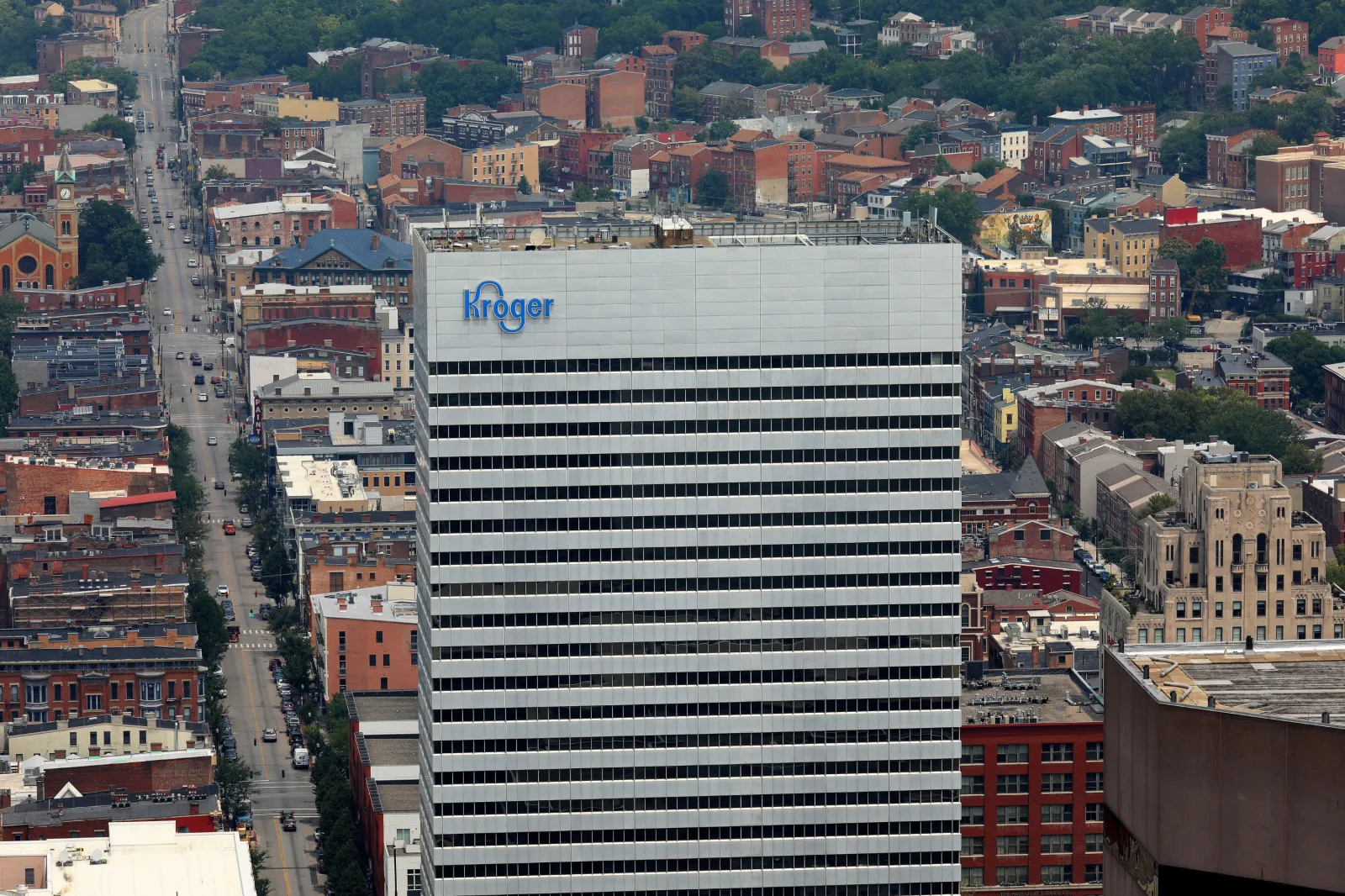
The Cincinnati-based supermarket giant will lay off about 3,000 people over the next three years, according to an internal memo seen by outlets including Reuters and Bloomberg. That’s equivalent to about 37 percent of its 8,200 corporate employees.
The Buckeye State has become a critical battleground in this year’s elections. The city’s corporate office could be hit hard by the layoffs, though cuts will not be limited to Cincinnati, the Cincinnati Business Courier reported*.* Kroger is the largest company in Greater Cincinnati, reporting $148 billion in revenue in 2025, according to the report.
Read More on Politics
The memo also outlined CEO Greg Foran’s desire to further integrate artificial intelligence into Kroger’s operations.
While Kroger has not said how many positions will be eliminated in Ohio, the cuts come as voters in the state consistently rank the economy among their top concerns. The shake-up arrives amid broader anxiety about the economy and job market, especially as AI introduces new uncertainty for many Americans.
Democrats and Republicans are both running on themes of affordability and lowering prices to reach undecided voters in the final weeks of the campaign.
...
Robert Alexander, a political science professor at Bowling Green State University, told Newsweek the news is “certainly at odds with any messaging that the economy is getting stronger.”
“I think most observers of Ohio politics expect close races for governor, senate, along with several high-profile congressional races. Differences at the margins will likely determine whether Democrats or Republicans ultimately come out on top,” Alexander said. “This news is not good for Republicans given the economic anxiety many Ohioans have conveyed in public opinion polls conducted throughout the last few months.”
There is already “a lot of unease about the economy, inflation, and tariffs,” Alexander said.
“If you are someone who has been on the fence about the strength of the economy in the state, this is the kind of news that will create more doubt about the future,” he said.
Ohio’s statewide races have become sharply competitive, despite the state’s rightward drift over the past decades. Democrat Amy Acton, former director of the Ohio Department of Health, and businessman Vivek Ramaswamy are in a toss-up race for governor, while Republican Senator Jon Husted is facing a challenge from Democratic former Senator Sherrod Brown.
Newsweek reached out to each of the candidates' campaigns via email for comment.
Why Ohio Matters for the Midterms
Ohio once was a premier swing state, backing former President Barack Obama in 2008 and 2012 before supporting President Donald Trump in 2016, 2020 and 2024, including by a double-digit margin in the most recent election. But Democrats believe the state can be competitive this year, as Trump’s low nationwide approval rating fuels a more favorable national environment for Democrats.
The Senate race holds implications for control of the upper chamber, as it's among a handful of toss-ups that could determine the balance of power. Republicans hold a 53-47 majority that is seen as increasingly at risk. Democrats must flip four seats to win a majority, as Vance would serve as the tiebreaker in a 50-50 Senate.
Democrats need to flip two seats in states Trump won by double digits in 2024 to secure a majority, and Ohio is one of their best opportunities.
Related Story

Trump Says Husted, Ramaswamy Are Now Ahead After Rally: What Polls Show
Economy Becomes Top Campaign Issue
For many Ohio voters, the economy matters most this year. Nationwide, issues like the cost of living, tariffs and high gas prices amid the Iran war have defined the midterms.
But over the past few decades, Ohio has undergone an economic transformation. For much of the 20th century, it was a major center of American industry, playing a key role in sectors like steel, iron, manufacturing and automotive equipment. But factory closures, automation and deindustrialization have hit the state hard.
Many Ohioans “feel like they have been left behind and they are really uncertain about what the future holds,” Alexander said.
“The rise of technology and changing global markets likely have many Ohioans feeling like the ground is moving underneath them and they just don't know how to steady themselves,” he said.
Manufacturing remains an important segment of the economy, but the shift has fueled economic anxiety in the state over recent decades.
Only 31 percent of Ohio voters said the state’s economy is either good or excellent in a recent New York Times and Siena University poll of 616 voters, conducted from September 22 to October 1. Forty-four percent rated the economy as “fair,” while 25 percent described conditions as poor. The analysis had a margin of error of plus or minus 4.5 percentage points.
Meanwhile, only 17 percent of Ohioans said their economic situation has improved, a Bowling Green State University and YouGov poll found. Thirty-nine percent said their situation has stayed the same, while 44 percent said it has worsened, the poll of 1,000 likely voters found.
The poll also found that 17 percent believe the national economic situation has improved, compared with 65 percent who believe it has worsened. The survey was conducted from September 1 to September 10 and had a margin of error of plus or minus 4 percentage points.
Ohio Senate Race Polls Three Weeks to Midterm
Recent polling points to a very close race in Ohio. Brown led Husted by 6 points in a new CNN poll of 760 likely voters from September 29 to October 5. The Democrat’s support stood at 49 percent, while 43 percent backed the incumbent Republican.
However, a co/efficient poll of 925 likely voters found Husted with a slight lead, 44 percent to 43 percent, on October 5 and October 6. It had a margin of error of plus or minus 3.49 percentage points.
Brown held a 3-point lead in the recent poll from the Times.
Before his appointment, Husted served as Ohio's lieutenant governor, and earlier as secretary of state. Brown represented Ohio in the Senate from 2007 to 2025.
Ohio Governor’s Race Polls Three Weeks to Midterm
Polls have also shown a close race between Acton and Ramaswamy. The CNN poll gave Acton an 8-point lead, 50 percent to 42 percent, while the co-efficient poll showed Ramaswamy up by 2 points, 45 percent to 43 percent.
Acton also led the Times poll by 4 points, 49 percent to 45 percent.
The Democrat served as director of the Ohio Department of Health from February 2019 to June 2020, while Ramaswamy is an entrepreneur who rose to national prominence during his 2024 presidential campaign. Neither candidate has ever held elected office.
What Happens Next
It is unclear whether the layoff announcement will affect voters' views on the economy ahead of the midterm, or how the shake-up will impact the Cincinnati area. The layoffs won't happen all at once.
As for the midterms, early voting is already underway, according to the Ohio secretary of state’s office. Forecasters like the Cook Political Report and Sabato’s Crystal Ball rate the Senate and gubernatorial races as toss-ups.
Newsweek’s reporters and editors used Martyn, our AI assistant, to produce this story. Learn more about Martyn here.
Contact Newsweek editors on this story: Jason Lemon, Edward T. Cummins, Sam Wilson.
View 0 Comments
Submit Correction
View Editorial & AI Guidelines