
By Adam Mills
AI Editor
0
Share
Newsweek is a Trust Project member
See more of our trusted coverage when you search.Prefer Newsweek on Googleto see more of our trusted coverage when you search.
Register for this webinar, for free, today.
Companies across industries are adopting artificial intelligence in increasingly visible ways, particularly in areas where implementation feels low risk.
Many organizations have begun deploying generative AI in internal workflows, back-office functions and narrow use cases. More transformative applications—those that touch customers directly or influence high-stakes decisions—often remain harder to roll out. While the technology itself is advancing rapidly, many companies are still grappling with how to govern its use at scale.
Read More on Newsweek.AI
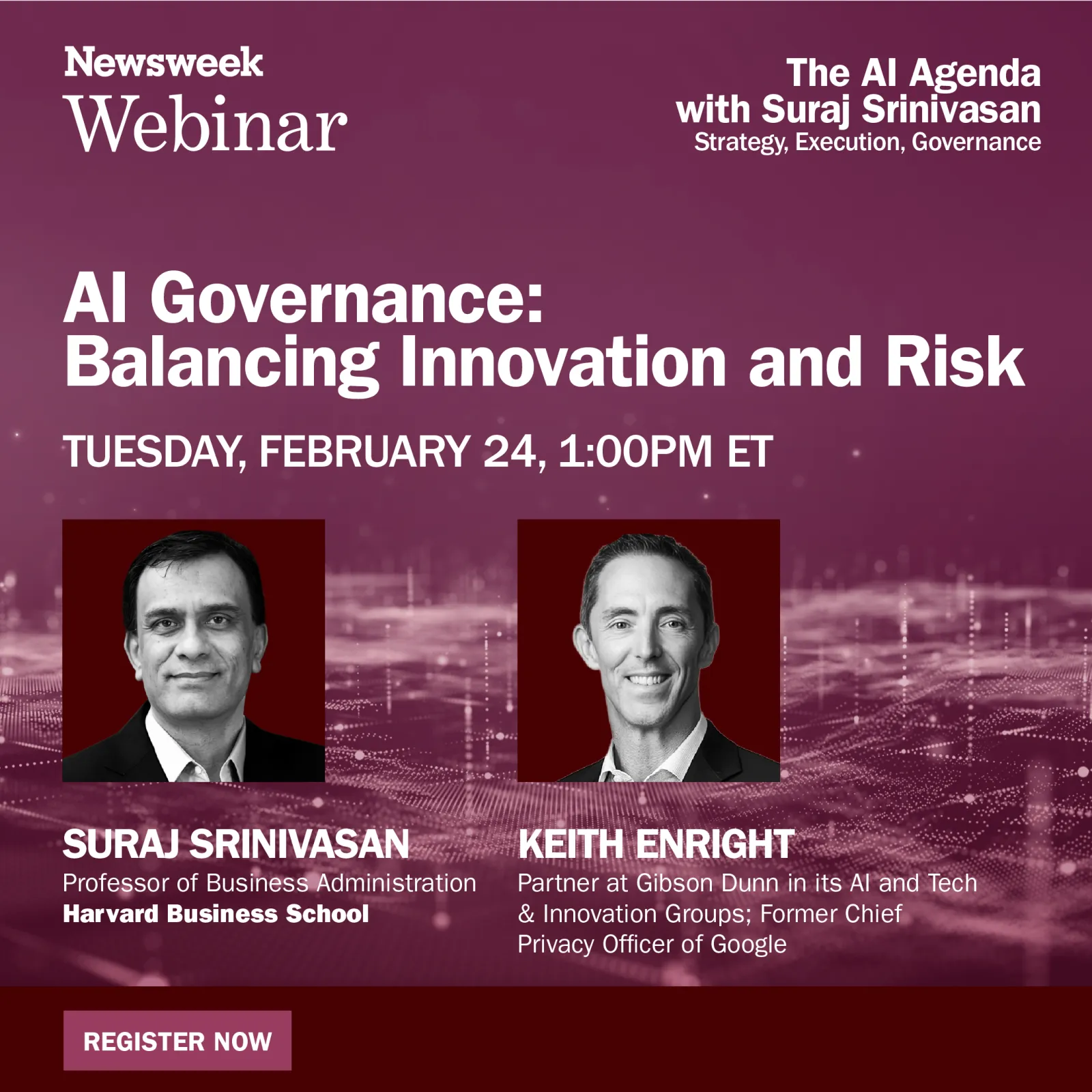
That tension sits at the heart of Newsweek’s upcoming webinar, "AI Governance: Balancing Innovation and Risk," scheduled for Feb. 24 at 1 p.m. ET, which brings together leaders from academia, law and risk management.
...
Suraj Srinivasan, professor at Harvard Business School, and Keith Enright—partner at Gibson Dunn, co-chair of the firm’s Tech and Innovation Industry Group and Artificial Intelligence Practice Group, and former chief privacy officer at Google—will explore how organizations can move faster with AI without losing control.
For Srinivasan, the challenge is not a lack of interest in AI adoption, but the hesitation organizations face when risk, oversight and accountability remain unresolved.
“Organizations are quite rightfully concerned about risk and safety—privacy, customer harm, mistakes,” Srinivasan told Newsweek. “But that means they can’t get the most value from what the technology is capable of doing.”
As a result, AI deployments often cluster around areas where the perceived downside is limited. While those implementations may feel safer, they can leave a gap between what AI systems can do and what organizations are willing to deploy.
“The engine is powerful,” Srinivasan said. “But we are deliberately unable to use the maximum potential of the engine because we are still behind in figuring out the risk, safety and governance aspects of it.”
To illustrate the challenge, Srinivasan points to an analogy that underscores how governance and speed are often misunderstood.
“If you take the fastest cars—Formula One cars—they have the best brakes,” he said. “If you can’t create good brakes, you can’t put in powerful engines.”
“The idea of the brakes is not to go slow,” Srinivasan added. “The idea of the brakes is to help you steer—and actually go fast.”
In that framing, governance is not about slowing adoption, but about creating the conditions necessary to scale AI responsibly. Without clear controls and shared accountability, organizations may struggle to move beyond experimentation.
That dynamic is increasingly visible to privacy and governance leaders working in various industries. “Thinking of responsible oversight existing in balance with innovation is problematic,” J. Trevor Hughes, CEO and president of IAPP, told Newsweek. “Trust and safety, building responsible products and services, are enablers of the adoption of innovative technologies.”
Hughes added that governance failures can directly undermine adoption, regardless of technical capability. “Consumers will not touch new technology if they cannot trust it,” he said, emphasizing that risk management, privacy and oversight must be integrated early rather than treated as afterthoughts.
That challenge is also playing out at the enterprise level, as organizations race to deploy AI tools across business units.
“There is genuine excitement about the possibilities that AI solutions can deliver and, as such, business area leaders sometimes rush to implement solutions before fully understanding the impacts,” Manny Padilla, board president of the Risk and Insurance Management Society and vice president of risk management and insurance at MacAndrews & Forbes, told Newsweek.
“Developing governance and policies that outline the necessary steps those leaders must take before implementing AI can prevent negative outcomes.”
As AI systems become more embedded in business operations, leaders are also confronting new categories of risk. Some can be addressed through familiar frameworks, while others require entirely new approaches, particularly as organizations weigh the impact of AI on customers, employees and decision-making processes.
Those pressures are increasingly visible across the risk profession itself.
“Artificial intelligence is rapidly reshaping the risk landscape, and the risk certification sector must evolve just as quickly,” Justin McCarthy, chief executive of the Professional Risk Managers’ International Association, told Newsweek via email.
McCarthy said risk professionals are seeking clarity around how AI affects real-world decisions and oversight, particularly as adoption moves from experimentation to core operations.
“Ultimately, AI will not replace risk professionals,” he said. “But it will redefine what good risk management looks like.”
Those themes—accountability, governance and the balance between opportunity and risk—will be central to Newsweek's upcoming discussion, as Srinivasan and Enright examine how boards, executives and risk leaders can build frameworks that allow AI adoption to accelerate without introducing unmanaged exposure.
As organizations push to capture AI’s potential, Srinivasan argues that progress will depend less on experimentation alone and more on how quickly governance structures mature alongside the technology.
“Companies want to put the pedal on the opportunity accelerator,” he said. “But as soon as they do, they realize there’s a lot of scaffolding they have to put around risk, governance, privacy, ethics and security.”
The webinar will explore how leaders can begin building that scaffolding—and why doing so may determine whether AI’s promise translates into lasting impact.
Updated 2/10/26 at 3:01 p.m. ET: This article was updated with comments from Manny Padilla, board president of the Risk and Insurance Management Society and vice president of risk management and insurance at MacAndrews & Forbes.
View 0 Comments
Submit Correction
View Editorial & AI Guidelines