

By Adam Mills and Gabriel Snyder
0
Share
Newsweek is a Trust Project member
See more of our trusted coverage when you search.Prefer Newsweek on Googleto see more of our trusted coverage when you search.

Newsweek
Editor's note: This is AI Impact, Newsweek's weekly newsletter where each week, we will explore how business leaders are unlocking real value through artificial intelligence.
Tap or click here to get this newsletter delivered to your inbox.
Read More on Newsweek.AI
Inference Layer
Is OpenClaw an iPhone Moment—or Just Gopher?
By Gabriel Snyder
I watched thousands of people discover this week that the future of AI isn't a product—it's a utility bill.
The viral ascent of OpenClaw, plus spinoffs like the AI-only social network Moltbook, feels like a glimpsed future. But the ultimate picture is still cloudy: These tools remain inaccessible to non-technical users, carry genuine security risks that developers keep flagging and offer no coherent picture of what an agentic future actually looks like. If anything, we're in the pre-HTML web era (remember Gopher, anyone?) where the infrastructure exists but the accessible interface doesn't.
Still, three lessons crystallize:
The personalization paradox is unavoidable. ChatGPT knows everything about the world and nothing about you. Turning AI into genuinely useful consumer experiences requires solving this asymmetry, which means AI needs access to your information and accounts. This is why OpenClaw raises security concerns—useful agency requires permission, and permission requires trust we haven't established protocols for yet.
AI literacy now means cost literacy. ChatGPT was the moment the wider world learned about LLM capabilities. OpenClaw is when they're learning about LLM economics. Users reporting $75 API bills just to check the current time has transformed everyone who installs OpenClaw into eagle-eyed token counters. The magic isn't free, and the costs scale in ways that feel arbitrary and punitive to anyone not tracking context windows and inference pricing.
"Selfware" is emerging as a category distinct from professional software. Non-coders can now build tools to solve their own idiosyncratic problems with roughly the same friction as publishing a web page in the early HTTP era—which is to say, still technically daunting but no longer requiring formal training. This isn't displacing professional software development. It's creating a parallel tier of personal automation that professional products were never designed to address but will nevertheless need to compete with.
The hype cycle wants this to be an iPhone moment. It's more like Mosaic—undeniably transformative for those who can use it but still awaiting the design paradigms that will make it inevitable.
Upcoming Webinar
AI Governance: Balancing Innovation and Risk
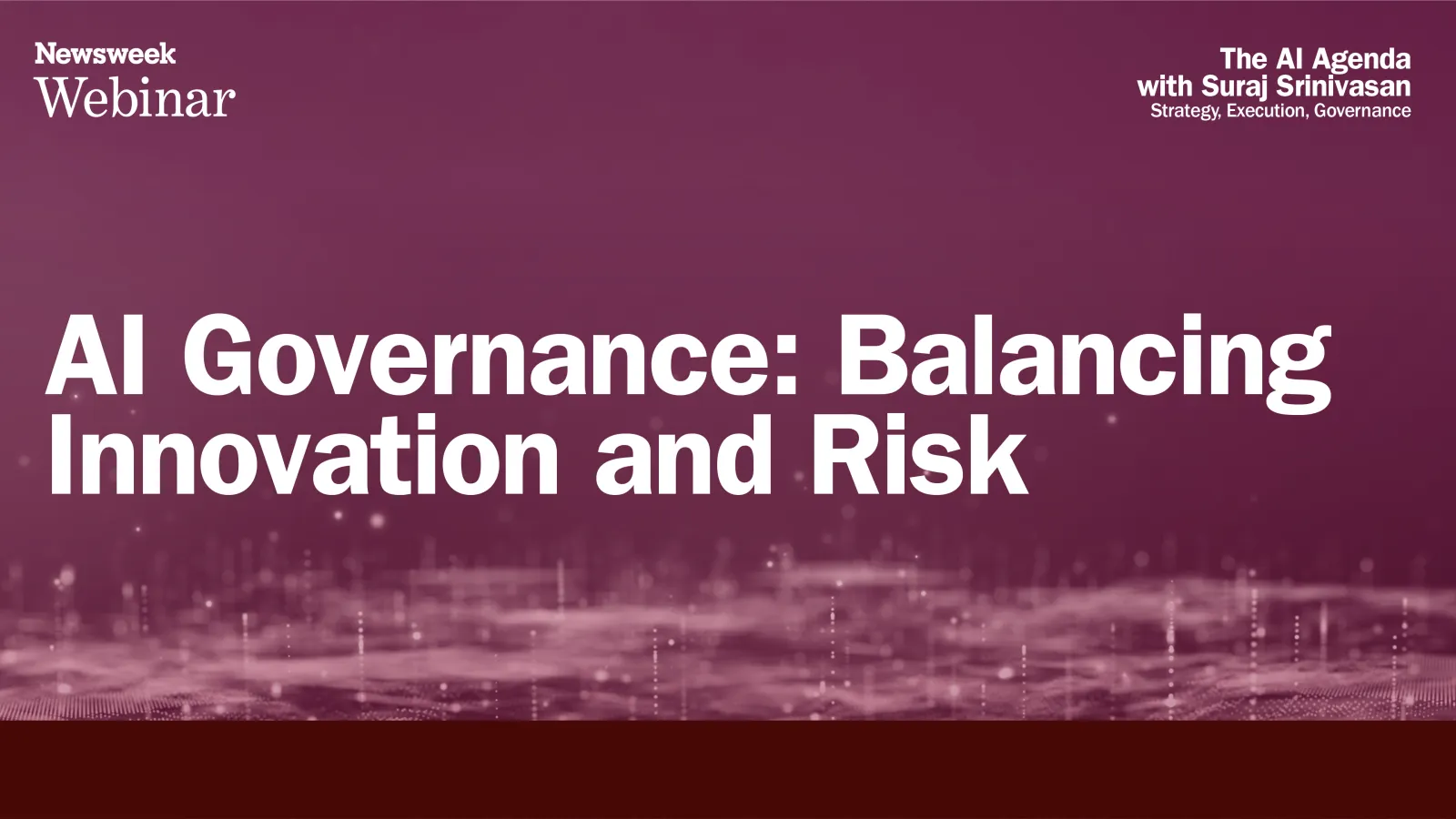
Join Prof. Suraj Srinivasan of the Harvard Business School and Keith Enright, partner at Gibson Dunn, co-chair of both the firm's Tech and Innovation Industry Group and the Artificial Intelligence Practice Group, and the former chief privacy officer at Google, for an essential webinar exploring the high-stakes intersection of AI innovation and risk.
The live webinar, “AI Governance: Balancing Innovation and Risk,” will take place on Tuesday, February 24, at 1 p.m. Eastern.
Register, for free, right now.
Core Intelligence
When Intelligence Becomes Luxury

...
Mercedes-Benz is making a deliberate bet that artificial intelligence will define the next era of automotive luxury. In a recent conversation with Eileen Falkenberg-Hull, Newsweek’s senior editor for autos, Magnus Östberg, chief software officer at Mercedes-Benz, described how the company is rethinking luxury around intelligence, software and experience rather than traditional feature checklists.
“Luxury is no longer just about materials or performance,” Östberg said. “It’s about how intuitive, personal and seamless the experience feels over time.”
That framing reflects a broader shift underway across premium industries. As products become increasingly software-defined, value is moving away from static specifications and toward systems that adapt continuously to the user. At Mercedes-Benz, this means embedding AI deeply into the vehicle’s operating system so it can personalize interactions, reduce friction and evolve through software updates rather than hardware cycles.
Crucially, this is not a story about automation for its own sake. The emphasis is on augmentation—using intelligence to make complex systems feel simpler and more human, not more opaque. Luxury, in this view, is measured less by novelty and more by coherence: how naturally the technology fades into the background while still delivering tangible benefits.
The implications extend well beyond the auto industry. In any sector where AI is becoming foundational, differentiation increasingly depends on whether intelligence is integrated thoughtfully across the entire experience. Companies that treat AI as a layer on top of existing products risk fragmentation. Those that build it into the core can redefine what “premium” means in their category.
The deeper signal from Mercedes-Benz is that luxury itself is being rewritten. In an AI-driven world, the brands that stand out will not simply be the ones with the most advanced models, but the ones that use intelligence with intent—shaping systems that genuinely enhance how people interact with technology.
You can watch the interview and read the full article here: Mercedes-Benz Aims to Prove AI Equals Luxury.
AI Impact Awards & Summit
The Newsweek AI Impact Awards seek to identify and recognize uniquely innovative AI solutions that solve critical business problems in different industry segments, or significantly advance capabilities. Recognition comes not from ideas, but from measurable IMPACT on business operations.
Prompt Injection

...
“The speed and magnitude with which AI has transformed search and discovery is forcing companies to be clear about who they are, who they serve and why they matter. Answer engines pull information from multiple sources at once, analyzing and consolidating them into statements rather than a menu of further research options. Want clicks? Be clear. Want customers? Be compelling. Want true brand loyalty? Don’t just tell me why you matter, tell me why you matter to me. If a company can’t show up this clearly everywhere, it won’t show up anywhere at all."
Have your own lesson to share? Email us at: ai.newsletter@newsweek.com
Run Log
By Adam Mills
At Parrish Law, growth exposed a familiar operational problem. The firm had outgrown basic email marketing, but its tools hadn’t kept pace. Campaigns were largely one-size-fits-all, reporting required manual spreadsheet work and there was little ability to test, segment or personalize outreach at scale. Open rates hovered in the high teens, sometimes dipping below 10 percent, and each monthly report cost hours of manual effort.
As the firm expanded, those gaps became harder to ignore. With more leads to nurture, former clients to stay connected with and community initiatives to support, marketing had become a bottleneck. For founder Jim Parrish, the challenge wasn’t creativity or effort, but feedback. Parrish Law lacked a fast, reliable way to understand what was working, why it was working and how to adjust without adding headcount.
That changed when the firm adopted AI-driven marketing automation through ActiveCampaign. Instead of pulling data manually or relying on static dashboards, the marketing director could interact with campaign performance through a conversational AI interface—asking which subject lines performed best, which campaigns drove engagement and where audiences were responding. Those insights directly informed segmentation, subject-line testing and content refinement, turning marketing from a reactive task into a continuous optimization loop.
The impact was immediate and measurable. Email open rates climbed from under 20 percent to a consistent 35–40 percent. Reporting time dropped from hours to seconds. The firm’s contact database grew rapidly, reaching 5,000 contacts within months. Just as importantly, marketing decisions became clearer and more confident.
For Parrish Law, the experience reinforced a broader lesson about AI in professional services. Growth doesn’t require bigger teams or more complexity. When AI is used to automate feedback loops and surface insights inside everyday workflows, it multiplies what small teams can accomplish.
The result isn’t just better metrics—it’s a marketing system that scales with the business, rather than slowing it down.
Have an AI use case to share with us? Email us at: ai.newsletter@newsweek.com
Context Window
■ As autonomous AI systems mature, industry and regulators are shifting focus from generating data to proving real-world safety, with experts arguing that while AI can run endless simulations, the hardest challenges lie in demonstrating that systems can reliably handle rare, high-risk scenarios and meet defensible evaluation standards. [Newsweek]
■ South Korea enacted what it calls the world’s first comprehensive AI law, the AI Basic Act, requiring watermarking of AI-generated content and risk assessments for high-impact systems but drawing pushback from startups over compliance costs and enforcement gaps. [The Guardian]
■ The U.K.’s Competition and Markets Authority proposed new rules to let publishers opt out of Google’s AI-generated summaries and demand clearer content attribution in search, aiming to curb Google’s dominance and boost competition as regulators tighten oversight of AI search features. [Financial Times]
■ The Pentagon reports that five of six military branches are now using the GenAI.mil platform as their primary enterprise AI tool, tracking more than a million users and signaling accelerating AI adoption across U.S. defense operations and intelligence workflows. [Defense Scoop]
■ Cloud data platform Snowflake agreed to a $200 million multi-year partnership with OpenAI to integrate advanced AI models directly into its infrastructure, enabling enterprises to run generative AI workloads across major clouds and extract insights from large data stores while jointly developing enterprise-grade AI tools. [Reuters]
■ The U.K. has named Barnsley its first government-backed “Tech Town,” a pilot to put AI to work in public services, education, health care and local business, with bespoke government support and industry partners helping train residents and build a model for broader adoption. [U.K. Department for Science, Innovation and Technology]
Transfer Protocol
Wei Manfredi, most recently a senior technology and architecture leader at Capital One, has been named senior vice president of AI and architecture at IHG Hotels & Resorts, where she will guide enterprise AI strategy, strengthen technical and data architecture and foster strategic technology partnerships.
Nancy Wang, most recently general manager and director of product and engineering at AWS Data Protection, has been named chief technology officer at 1Password, where she will lead global engineering and the company’s AI strategy to advance secure, AI-enabled identity solutions.
Kevin Murphy, who has served as NASA’s chief data science officer, has been named acting chief artificial intelligence officer and acting chief data officer at the National Aeronautics and Space Administration, where he will coordinate agencywide AI and data strategy supporting the agency’s science, engineering and mission operations.
Ovie Doro, formerly senior global director of data science and machine learning engineering at AB InBev, has been named senior vice president of data, analytics and AI at Scientific Games, where he will lead the expansion of the enterprise analytics practice and support AI-driven insights.
Dr. Jai Singh, who has held senior leadership roles in investment management and global financial services, including at Morgan Stanley, has been named chief pricing and analytics officer at Offerpad Solutions Inc., where he will lead AI-driven pricing, portfolio management and analytics initiatives as the company scales its multi-solution real estate platform.
Know someone on the move in AI? Send job change info to ai.newsletter@newsweek.com
Magic Moment

...
“I recently had an 'AI magic moment' in the back of an Uber. My driver talked about how he's training models on his home rig and debated the nuances of Compute Unified Device Architecture (CUDA) with me. It hit me then: The barrier to entry for coding is gone. Now that AI agents are everywhere, the challenge becomes orchestration. At Talkdesk, we have built a Customer Experience Automation platform which orchestrates 'teams' of autonomous AI agents and human agents. Together they not only complete complex tasks, but deliver outcomes across entire systems of engagement and across channels of communication. AI agents excel at scale, execution and speed; human agents augment with judgment and empathy. This is the future of the hybrid workforce.”
Experience some AI magic? Tell us about it at ai.newsletter@newsweek.com
Tap or click here to get this newsletter delivered to your inbox.
Updated 2/6/26 at 3:58 p.m. ET: This article was updated for clarity.
View 0 Comments
Submit Correction
View Editorial & AI Guidelines