
By Adam Mills
AI Editor
0
Share
Newsweek is a Trust Project member
See more of our trusted coverage when you search.Prefer Newsweek on Googleto see more of our trusted coverage when you search.

Newsweek
Editor's note: This is AI Impact, Newsweek's weekly newsletter where each week, we will explore how business leaders are unlocking real value through artificial intelligence.
Tap or click here to get this newsletter delivered to your inbox.
Read More on Newsweek.AI
Core Intelligence
Are Your Teams Quietly Replacing SaaS?
...
Inside many enterprises, the build-versus-buy debate isn’t really a debate anymore. It’s happening quietly, workflow by workflow.
A recent survey of 817 Retool customers and builders found that 35 percent have already replaced functionality of at least one SaaS tool with something they built themselves. Seventy-eight percent expect to build more in 2026. And 60 percent reported creating tools outside of IT oversight in the past year.
At first glance, this looks like a cost story. “The cost of building custom software has collapsed,” said Retool CEO David Hsu. What used to take weeks of engineering time and six-figure budgets can now, in some cases, be prototyped in days. When the math changes that dramatically, behavior changes with it. The default question shifts from “What should we buy?” to “Can we build this?”
But companies aren’t ripping out core systems. They’re targeting the parts that never quite fit—approval flows, dashboards, admin panels. The narrow, frustrating workflows that live between bigger platforms. One replacement doesn’t seem disruptive. A dozen changes how work actually gets done.
That’s where the real tension shows up. Much of that building is happening outside IT oversight. Hsu called “shadow IT at this scale” a demand signal. Teams are building because they can—and because there are real needs. The issue isn’t whether they should experiment. It’s what happens when those experiments turn into production systems without proper oversight.
That gap between capability and readiness echoes what Suraj Srinivasan, professor at Harvard Business School and host of Newsweek’s The AI Agenda webinar series, has described in enterprise AI more broadly. Organizations are understandably cautious about privacy, customer harm and safety risks. But, as he noted, an overabundance of caution means that “you cannot get the most value from the technology.” The same pattern is emerging here. Building is getting easier. Oversight and measurement are still catching up.
The risk isn’t one internal tool. It’s accumulation. Dozens of unsanctioned applications connected to production data create complexity, unclear ownership and expanding security exposure. Trying to block internal building may push it out of view. Letting it grow without guardrails invites fragmentation.
“The most important decision isn't whether to build—your people are already building,” Hsu said. “The decision is whether that building happens in a governed environment or in the shadows.”
Enterprises that treat governance as a core capability—not an afterthought—are more likely to turn this shift into an advantage. Those that don’t may find that the bigger risk wasn’t replacing SaaS. It was losing visibility into what replaced it.
You can read the full article here: Enterprises Are Replacing SaaS Faster Than You Think.
Upcoming Webinars
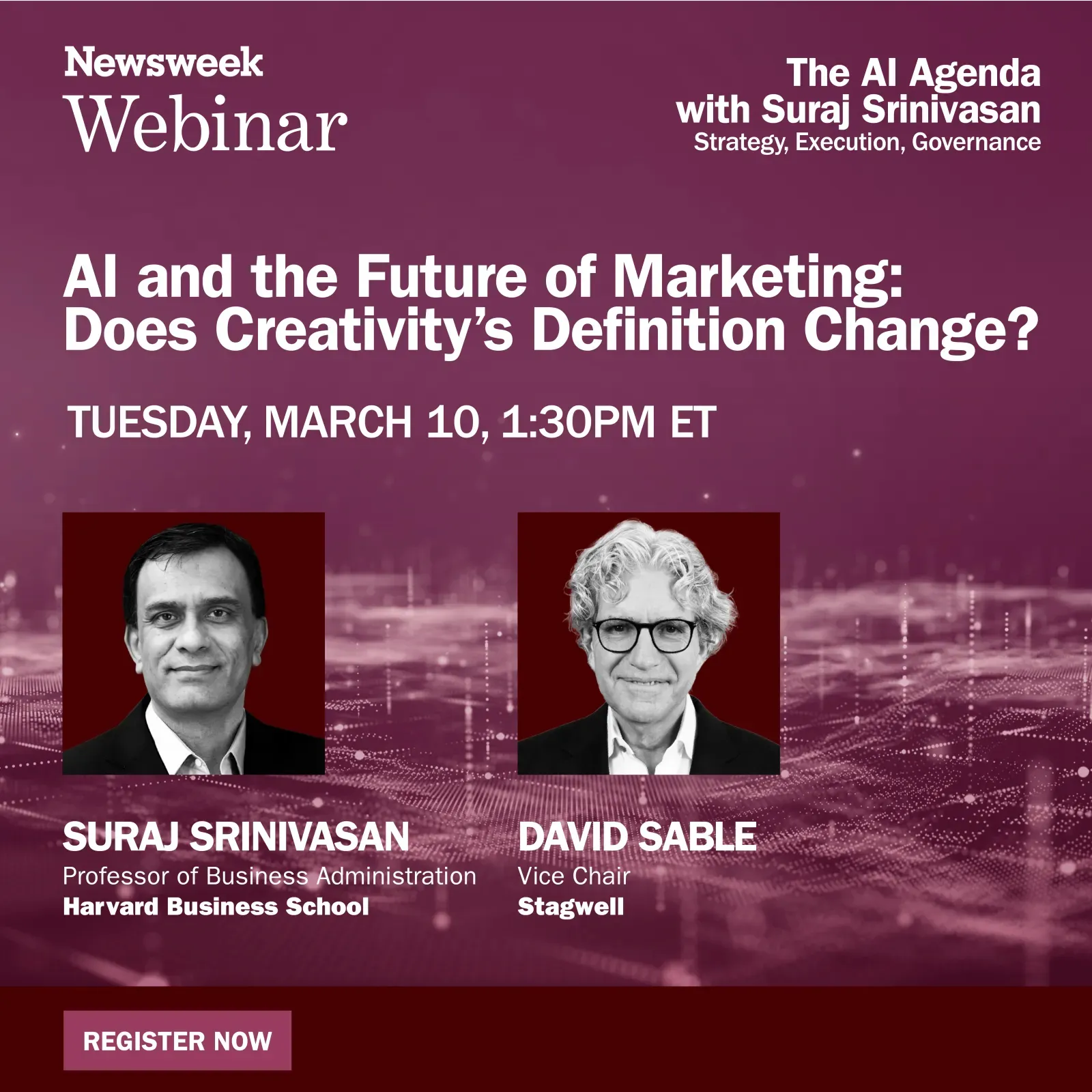
AI and the Future of Marketing: Does Creativity’s Definition Change?
...
Join Prof. Suraj Srinivasan of Harvard Business School and David Sable, vice chairman of Stagwell, for a discussion examining how generative AI is reshaping creativity in marketing and advertising—and what that means for brands seeking to move people, not just reach them.
This live webinar, “AI and the Future of Marketing: Does Creativity’s Definition Change?,” will take place on Tuesday, March 10, at 1:30 p.m. Eastern.
Register, for free, right now.
AI Impact Forum

...
Join Dr. Ranjit Tinaikar, host of Newsweek’s AI Impact Forum series, and Frank D'Souza, co-founder and managing partner of Recognize, for a strategic conversation examining how artificial intelligence is reshaping the IT services industry—and what recent market shifts signal about growth, competitiveness and the future operating model of the sector.
This live webinar will take place on Thursday, March 26.
Register, for free, right now.
AI Impact Awards & Summit

The Newsweek AI Impact Awards seek to identify and recognize uniquely innovative AI solutions that solve critical business problems in different industry segments, or significantly advance capabilities. Recognition comes not from ideas, but from measurable IMPACT on business operations.
Prompt Injection
What’s one recent insight you’ve learned about AI?

...
“What's become clear to me is how profoundly AI is changing where decisions get made, moving from distant data centers to the devices and systems right in front of us. In physical security, for example, advancements in edge processing now enable organizations of all sizes to use AI-powered analytics capabilities, generating actionable insights before the data even leaves the device. That means it isn’t just large, well-resourced organizations enjoying the benefits of AI. As the technology becomes increasingly democratized, it’s delivering real, impactful results across nearly every industry.
At the same time, I’ve been reminded how essential human context, governance, and responsibility remain. AI’s impact depends on how carefully and intentionally it is designed and deployed. Transparency, explainability, and respect for privacy must be built from the start if we want people to trust the technology and see lasting value from it. That realization continues to shape the way we build and deploy AI, using the technology as a tool that augments human decision-making to strengthen safety and efficiency while addressing ethical concerns from the earliest possible stage.”
Have your own lesson to share? Email us at: ai.newsletter@newsweek.com
Run Log
By Adam Mills
For many mid-market businesses, the challenge isn’t collecting data—it’s using it. Valuable operational information sits inside enterprise resource planning (ERP) systems, but without the technical expertise or resources to deploy and manage AI, much of that data remains underleveraged. At Acumatica, the question was how to turn that latent data into everyday decision support without adding complexity.
To close that gap, the company built a way to embed AI directly inside the workflows business users already rely on. Through Acumatica AI Studio, a no-code environment, users can configure AI-driven actions using natural language prompts—without developers or data scientists. Support teams can automatically generate structured closure notes as cases are resolved, finance teams can flag anomalies or summarize transactions and operations teams can update records or generate insights as part of routine processes. Because AI Studio integrates with large language models from providers such as OpenAI and Anthropic, businesses can align deployments with their governance and model preferences.
The focus was not on experimentation, but on simplifying everyday work. Tasks that once took minutes or required multiple handoffs can now be completed by one person in seconds. “Mid-market businesses don’t need experimental AI projects,” said Miten Mehta, chief engineering officer at Acumatica. “They need tools that solve real problems immediately, without disrupting existing processes.”
According to the company, customers have eliminated time-consuming manual work, enabling faster case resolution, fewer manual updates and errors in finance workflows and quicker access to actionable insights. Acumatica says the result is higher productivity, better data quality and faster decision-making.
In the mid-market, resources are finite and experimentation is expensive. Embedding no-code AI inside core systems shifts the equation. Instead of layering on a separate initiative, intelligence becomes a built-in capability, one that allows smaller organizations to operate with a level of efficiency traditionally reserved for much larger enterprises.
Have an AI use case to share with us? Email us at: ai.newsletter@newsweek.com
Context Window
■ A study by a strategy professor at King’s College London pitting leading AI models against one another in simulated war games found that in nearly all scenarios they escalated toward using tactical nuclear weapons, with many models treating nuclear options as a routine escalation step rather than a last resort, highlighting risks if AI were ever integrated into strategic decision support. [Newsweek]
■ OpenAI has amended its defense contract with the U.S. Department of War after backlash over a rushed deal, with CEO Sam Altman saying new terms clarify that the company’s AI services will not be used for domestic surveillance or without human oversight. [The Guardian]
■ Meta Platforms is launching a new Applied AI Engineering organization aimed at accelerating its AI research and model performance, focusing teams on real-world data, feedback and reinforcement learning workflows. [The Wall Street Journal]
■ Cox Automotive is steering an “AI-first” transformation across its dealer services and software platforms, embedding agentic AI into workflows to improve sales insights, pricing recommendations and customer engagement tools. [CIO]
■ Cyber security firm CyberCX flags a surge in generative AI being used by threat actors to create custom scripts and malware payloads, reducing the time between vulnerability discovery and weaponization in cyberattacks. [ARN]
■ The Cleveland Plain Dealer has begun using generative AI to draft routine local news articles, with human editors reviewing outputs—a move intended to boost newsroom productivity but raising concerns about editorial quality and workforce impacts. [The Washington Post]
Transfer Protocol
Tracking executive moves across the AI landscape
Phoebe Wang, who previously served on the board of directors at Nuvini Group Limited, has been appointed chief artificial intelligence officer. She will lead enterprise-wide AI strategy, investment and deployment across the company’s portfolio of B2B SaaS businesses as Nuvini deepens its commitment to AI-driven growth.
Ahmad Moradi, a technology and media executive who has led public and private companies, has been appointed chief executive officer of AI Era Corp. He will lead the company’s expansion of its creator AI ecosystem, scaling generative technologies such as UFilm.ai and growing global distribution through its licensed platform Uflix.ai.
Ryan Biren, who joined THOR Industries in February 2024 as vice president of corporate development, has been promoted to chief information officer and executive officer. He will lead North American IT, data, analytics and digital platform strategy while advancing the company’s broader enterprise data and AI agenda.
Jack Wood, most recently senior vice president and head of engineering at Symetra, has been named chief technology officer at ECI Software Solutions. He will drive the company’s scalable and practical AI development strategy while leading its technical vision and architectural standards for secure, cloud-based systems.
Chad Reese, a channel executive with more than 25 years of experience building global partner organizations, has been appointed senior vice president and global channel chief at Vectra AI. He will lead the company’s worldwide partner strategy, scaling its ecosystem to accelerate channel-led growth around the Vectra AI Platform.
Magic Moment
What’s the most fun or unexpected way you’ve used AI lately?

...
“I’ve actually written a ton of stuff over the last year using AI… I’ve written a bunch of software tools that enable us to model out scenarios with our customers. That was something I basically wrote on nights and weekends, because I could. In the pre-AI era, that would have been a few months of a software project—here it was a few weekends.”
Experience some AI magic? Tell us about it at ai.newsletter@newsweek.com
Tap or click here to get this newsletter delivered to your inbox.
View 0 Comments
Submit Correction
View Editorial & AI Guidelines