
...

By Martha McHardy
US News Reporter
0
Share
Newsweek is a Trust Project member
See more of our trusted coverage when you search.Prefer Newsweek on Googleto see more of our trusted coverage when you search.
Millions of people around the U.S. have been treated to the rare spectacle of the northern lights over the past two weeks as a result of a huge solar storm.
The aurora has been visible at some point from almost every state in the U.S. since May 10, including as far south as Florida, and the Space Weather Prediction Center predicted that the northern lights would be visible from Montana, North Dakota and Minnesota, and possibly parts of Idaho and Washington yesterday.
They have also been visible across the U.K., Germany and Italy, and even northern India this month, with millions of people around the world snapping pictures of the pink and green lights on their phones.
Read More on U.S.
...
While the latest solar cycle is ongoing, this month's display of the aurora has now likely come to an end for the U.S.
However, experts think we may have another good chance to see the northern lights at some point over the next few years as the solar cycle reaches its peak.
Best dates to see the northern lights in the U.S.
The solar storms that cause the northern lights are hard to predict, according to the Space Weather Prediction Center, but experts believe that they may be visible again in the U.S. at some point between November 2024 and March 2026, when the latest solar cycle peaks.
Space weather modeling shows this will probably be some time in July 2025. However, this is not exact and it could happen months sooner or later.
This latest solar cycle began in December 2019.
Best U.S. states to see northern lights
Alaska and Maine, the most northern points in the U.S., are generally the best places to see the spectacle.
In Alaska, you are most likely to catch a glimpse of the aurora between mid August and mid April, when it is dark enough to see the lights. In Maine, October through April have proven to be the best months.

...
Stargazers in other northern US sates such as Washington, Montana, Minnesota and North Dakota may also be able to see the northern lights during the winter.
The Space Weather Prediction Center says the best time to view the aurora borealis is just after sunset or just before sunrise. The aurora is not visible during daylight hours.
"The aurora does not need to be directly overhead but can be observed from as far as 1,000 km (621 miles) away when the aurora is bright and if conditions are right," it added.
The Space Weather Prediction Center also advises that to have a better chance of seeing the phenomenon, people should get away from city lights into a "dark, rural surrounding" and look north.
Northern lights 'strongest in 500 years'
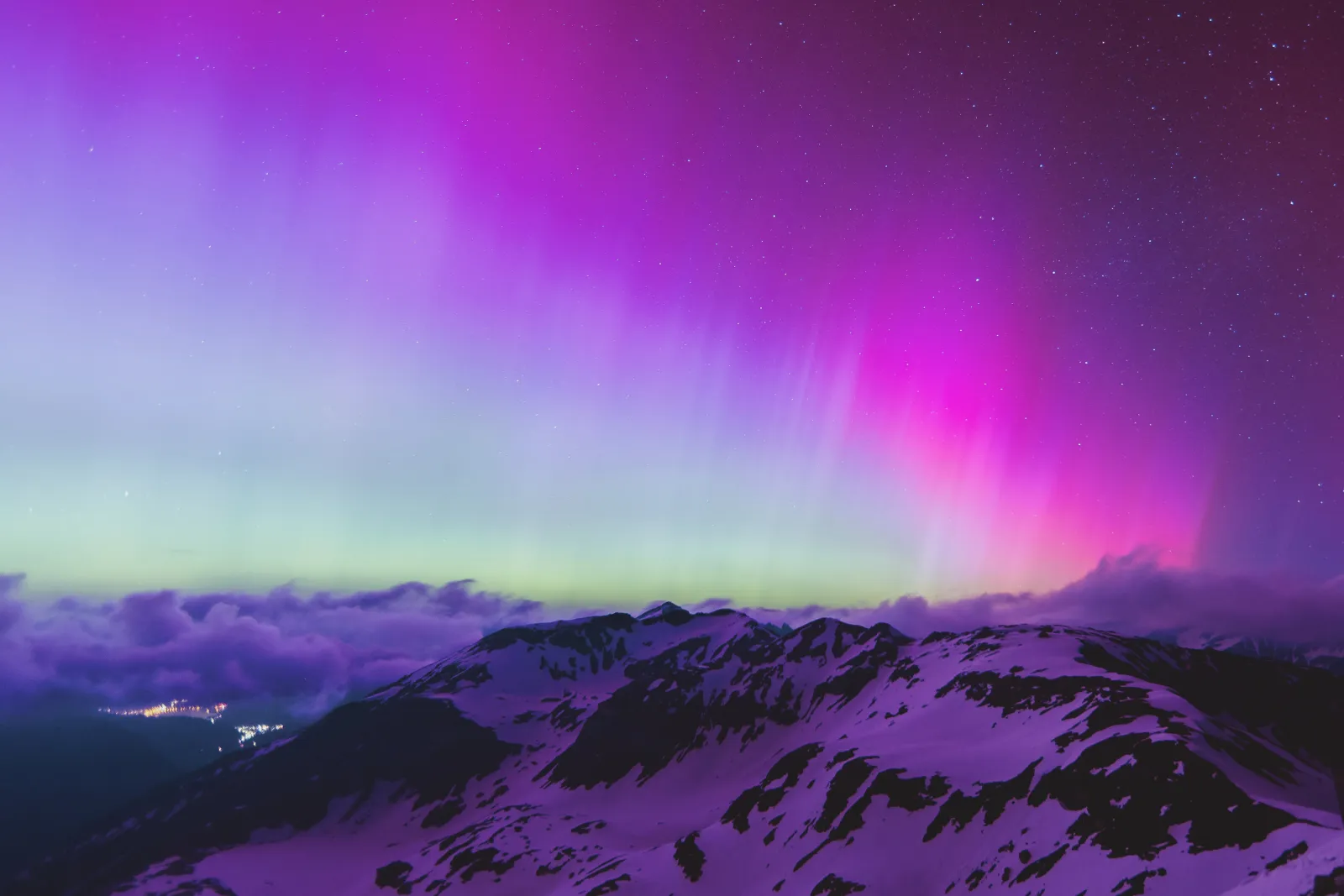
This month's northern lights display may have been strongest in 500 years, according to NASA.
"With reports of auroras visible to as low as 26 degrees magnetic latitude, this recent storm may compete with some of the lowest latitude aurora sightings on record over the past five centuries," the American space agency said in a blog post, adding that "scientists are still assessing this ranking."
...
The northern and southern lights can be triggered by geomagnetic storms, which are disruptions to the Earth's magnetic field caused by coronal mass ejections (CMEs) of solar plasma from the sun.
Every 11 years, the sun's magnetic field reaches solar maximum, and this is when the CMEs interact with the Earth's magnetosphere, a protective magnetic field that surrounds our planet, sparking a geomagnetic storm.
Geomagnetic storms vary in strength depending on the CME's speed and magnetic field and are classed on a scale of G1 (minor) to G5 (extreme). The stronger the geomagnetic storm, the further south the northern lights are visible.
This month's display was a G5 storm. It was the strongest solar storm to hit the planet since 2003 when millions of people across the globe witnessed another G5 that sparked power outages in Sweden.
The main region on the sun responsible for the recent stormy space weather is now turning away from the Earth, but data captured so far from this month's solar events could help astronomers for years, NASA said.
"We'll be studying this event for years. It will help us test the limits of our models and understanding of solar storms," Teresa Nieves-Chinchilla, acting director of NASA's Moon to Mars Space Weather Analysis Office said.
Clinton Wallace, Director of NOAA's Space Weather Prediction Center, described this year's G5 storm as an "unusual and potentially historic event."
View 0 Comments
Submit Correction
View Editorial & AI Guidelines