Space Weather Prediction Center

By Joe Edwards
Reporter
0
Share
Newsweek is a Trust Project member
See more of our trusted coverage when you search.Prefer Newsweek on Googleto see more of our trusted coverage when you search.
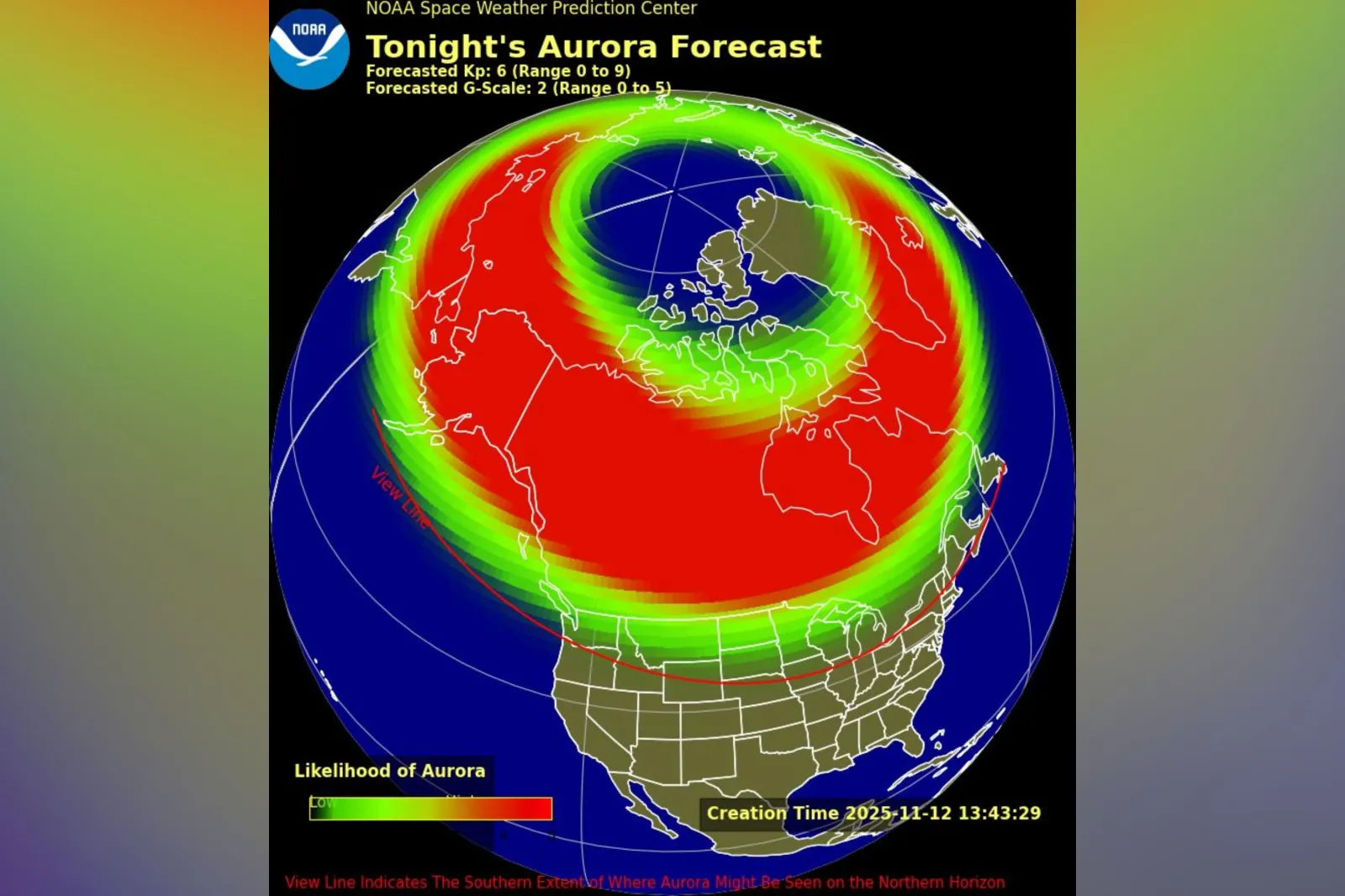
Americans across numerous states stand a chance of witnessing the northern lights on Wednesday night, according to a forecast from the National Oceanic and Atmospheric Administration's (NOAA) Space Weather Prediction Center (SWPC).
Why It Matters
While NOAA's forecast doesn't ensure a sighting, it offers a chance for residents of northern states from coast to coast to catch a glimpse of the celestial phenomenon.
Read More on News
What To Know
According to the SWPC’s aurora viewline forecast, the aurora borealis will be visible in parts of Washington state, Oregon, Idaho, Wyoming, Montana, the Dakotas, Nebraska, Minnesota, Iowa, Illinois, Wisconsin, Michigan, New York, Vermont, New Hampshire, and Maine.
...
For some states, including Oregon, Nebraska, and Illinois, only small portions were within the viewline.
The SWPC said Wednesday that the Earth was and is being impacted by the first of three anticipated Coronal Mass Ejection (CME) arrivals.
“We believe the final and most energetic CME has yet to arrive and may still be on track for a midday (EST) or so arrival. We are seeing indications of another, perhaps stronger CME moving through space, and that could be the third CME we are still awaiting, according to our forecast and noted in the included model run,” the agency said.
The SWPC explained that CME’s are an eruption of solar material and magnetic field that can result in geomagnetic storms. It also said the aurora could become visible over much of the northern half of the U.S.
Officials issued a forecast on Tuesday warning that a geomagnetic storm at a strength of category G4 could cause issues with electrical grids for some states, Newsweek reported previously.
The aurora has already been spotted in several states across the country, with local National Weather Service branches from Tennessee to Washington sharing snaps of the stunning views.
"While not unprecedented, is it quite unusual for the aurora to be visible at these low latitudes; probably only occurring once or twice per solar cycle," Mike Bettwy with the SWPC told Newsweek.
"There were even reports of faint aurora as far south as Tampa, Florida, overnight. However, during major events, like we experienced with the G5 storm in May 2024, it can expand to such low latitudes. During that event, aurora was observed in the Florida Keys and points even farther south."
What People Are Saying
AccuWeather meteorologist Chad Merrill told Newsweek on Wednesday: “The states that will have some clouds but still a decent unobstructed view of the northern lights will be the Dakotas, western Montana, Minnesota, Nebraska, Iowa, Wisconsin, Illinois, Indiana, Michigan, Missouri, Ohio, southeastern Pennsylvania, West Virginia, Virginia and Maryland.
“The Pacific Northwest will have more cloud cover, so chances of seeing the northern lights are low. It is possible the states such as Tennessee, North Carolina, Arkansas, Oklahoma and northern Alabama can also see the northern lights if the solar storm is as strong as predicted. Only scattered cloud coverage is expected for these areas.”
NOAA Space Weather Prediction Center’s Shawn Dahl said in an update on Wednesday: “Infrastructure operators have been notified to mitigate any possible impacts. The general public should visit our webpage to keep properly informed. The aurora was visible over much of the country.”
What Happens Next
The SWPC’s aurora viewer is updated frequently.
Update 11/12/25, 12:28 p.m. ET: This article was updated with comment from Mike Bettwy.
View 0 Comments
Submit Correction
View Editorial & AI Guidelines