...


By Adeola Adeosun and Peter Aitken
0
Share
Newsweek is a Trust Project member
See more of our trusted coverage when you search.Prefer Newsweek on Googleto see more of our trusted coverage when you search.
North Korea fired multiple suspected ballistic missiles toward the sea off its east coast on Sunday morning, marking the country's seventh ballistic missile launch this year and its fourth in April alone, according to Reuters.
The launches come as the United States remains consumed by its military standoff with Iran; a window analysts say Pyongyang is deliberately exploiting to accelerate its nuclear and missile programs. South Korea and Japan are now on heightened alert, with both governments exchanging intelligence and coordinating closely with the U.S.
What Happened
The missiles were fired from near Sinpo, a city on North Korea's east coast, at approximately 6:10 a.m. local time Sunday. South Korea's Joint Chiefs of Staff confirmed the launches and said the country has bolstered its surveillance posture. South Korea's presidential office held an emergency security meeting in response.
Read More on World
Japan's Defense Ministry confirmed it detected the launches, adding that the missiles are believed to have landed near the east coast of the Korean Peninsula with no incursion into Japan's exclusive economic zone confirmed.
The launches violate United Nations Security Council resolutions banning North Korea's missile program. Pyongyang rejects the U.N. ban, arguing it infringes its sovereign right to self-defense.
A Pattern of Accelerating Provocation
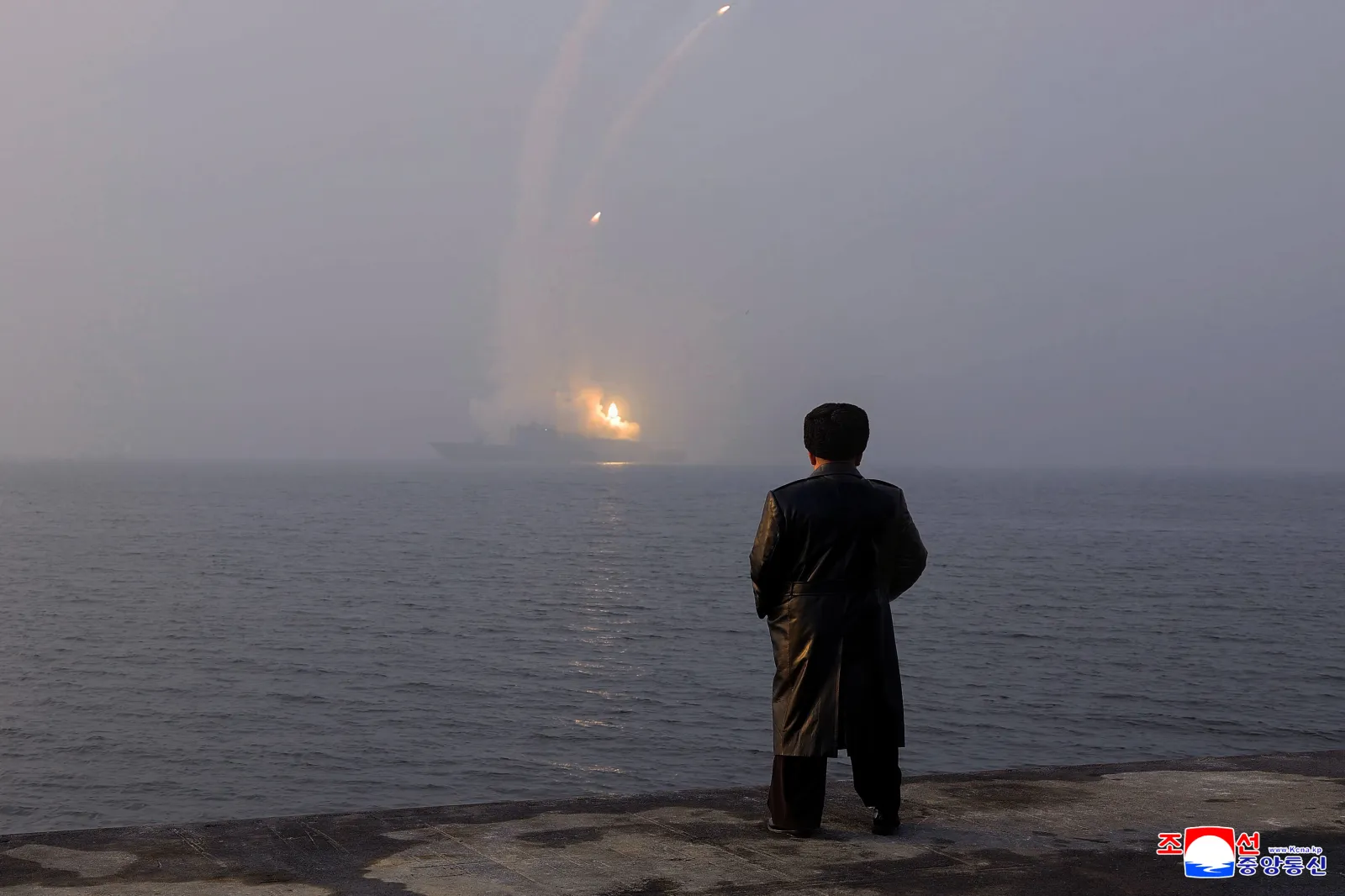
Sunday's launches are the latest in a sustained escalation. Just last week, Kim Jong Un personally supervised missile tests from the country's destroyer, afterward calling for the "limitless expansion" of nuclear forces and issuing new directives to sharpen North Korea's nuclear attack and rapid-response capabilities. North Korea also tested an upgraded solid-fuel engine — a significant development because solid-fuel missiles are easier to conceal and deploy than liquid-fuel weapons. South Korea's spy agency told lawmakers the test was likely tied to building a more powerful intercontinental ballistic missile capable of carrying multiple nuclear warheads.
International Atomic Energy Agency Director General Rafael Grossi confirmed last week a "rapid increase" in activities at North Korean nuclear facilities, warning of probable advances in uranium enrichment capacity. In late March, Kim declared North Korea's nuclear-armed status irreversible.
The broader geopolitical window is not lost on analysts. "As the U.S. is focused on Iran, the North sees this as a golden time to upgrade their nuclear power and missile capability," said Lim Eul-chul, a professor at Kyungnam University.
The Diplomatic Freeze
Alongside the military escalation, North Korea has made clear it has no interest in warming relations with Seoul.
Earlier this month, Jang Kum Chol, first vice minister at Pyongyang's Foreign Ministry, declared South Korea would always remain North Korea's "most hostile enemy state," deriding Seoul as "world-startling fools" after South Korean officials interpreted a statement by Kim Jong Un's sister, Kim Yo Jong, as meaningful diplomatic progress. Jang said the statement was intended as a warning, not an opening.
North Korea has refused to return to talks with South Korea or the U.S. since Kim Jong Un's diplomacy with President Donald Trump collapsed in 2019, instead deepening ties with Russia and China.
Last September, Kim traveled to Beijing for his first summit with Chinese President Xi Jinping in six years. Chinese Foreign Minister Wang Yi is expected to visit Pyongyang this week for a two-day trip.
...
What Happens Next
The launches arrive ahead of a U.S.-China summit planned for May 14-15, where Trump and Xi are expected to discuss North Korea among other issues.
Reporting from the Associated Press contributed to this article.
Update 4/18/26, 8:59 p.m. ET: This article has been updated with additional information.
View 0 Comments
Submit Correction
View Editorial & AI Guidelines