10
Loading video...

By Jordan King
Reporter
0
Share
Newsweek is a Trust Project member
See more of our trusted coverage when you search.Prefer Newsweek on Googleto see more of our trusted coverage when you search.
A group searching for the remains of Noah’s Ark in a boat-shaped rock formation in Turkey said they found pieces of charred wood that show “clear manmade marks consistent with tool work performed long ago.”
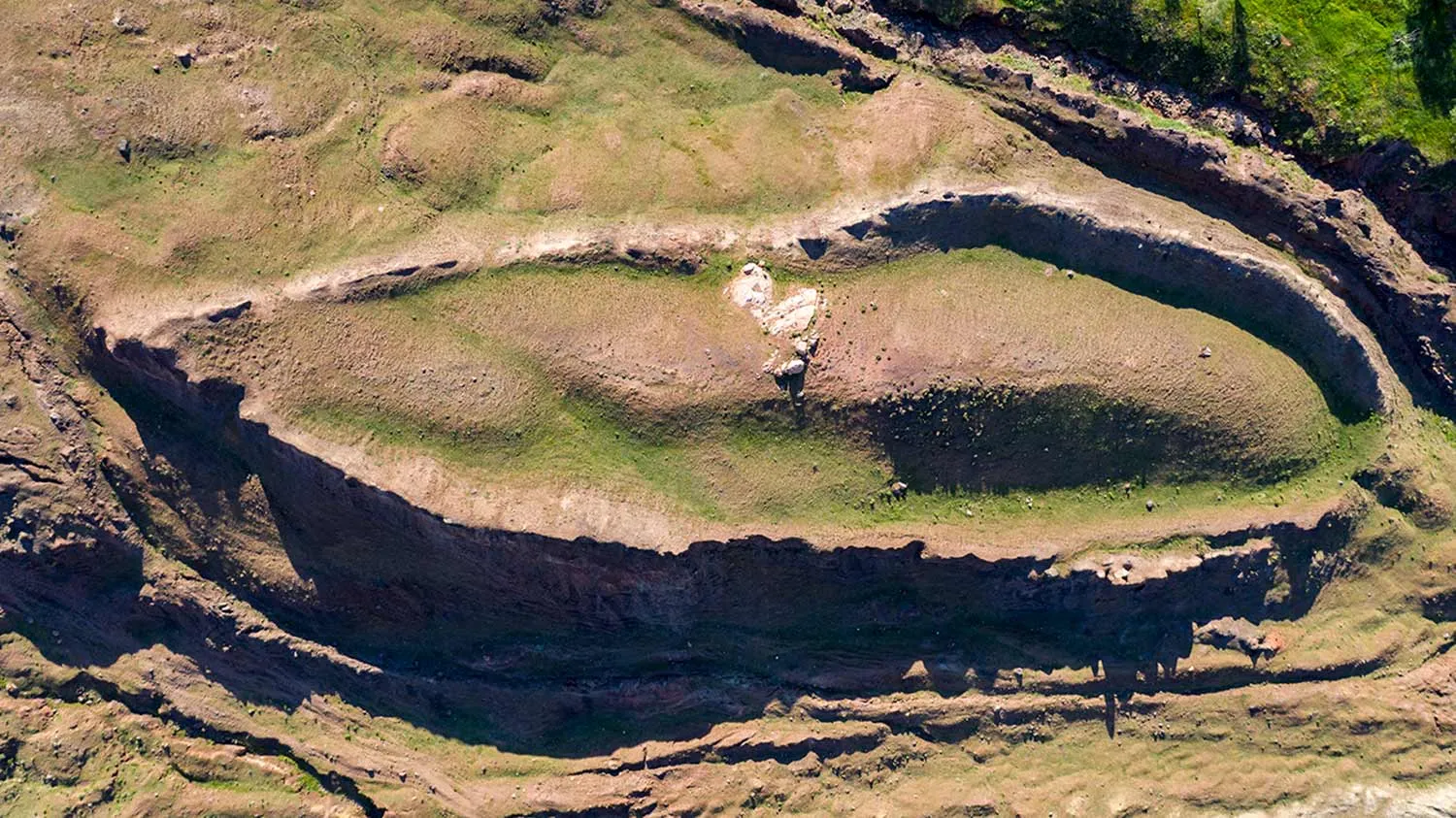
Members of the U.S.-based group Noah’s Ark Scans have repeatedly said they believe they will find evidence that the biblical ship is buried at the famous Durupınar Formation, a site that has attracted many hoping to find Noah’s Ark. It lies south of Mount Ararat in eastern Turkey, a region referenced in the biblical account of the Ark. Genesis (8:4) says that, as floodwaters receded, "the ark came to rest on the mountains of Ararat."
Multiple studies have concluded the ship is not buried there, with one calling it a “completely natural rock formation,” but Noah’s Ark Scans is hoping it will be able to challenge these findings by proving there is wood in the formation, which the group argues will indicate a human-made structure.
Read More on News
Images shared with Newsweek show what the group says are charred wood fragments it said were recovered from around 30 feet underground.

...
Laboratory tests have not yet been carried out, but the group argued that the pieces show signs that human tools were used on them.
“The fragments display sharp, cut edges and other indications of intentional shaping, distinguishing them from naturally occurring or weathered wood,” Noah’s Ark Scans said in its update on Tuesday.
Noah’s Ark Scans founder Andrew Jones added: “After decades of searching, this could be a crucial piece of the puzzle.”
The group stressed that “laboratory results will determine the next steps and that no final conclusions have been drawn.”
Newsweek has not independently verified any of Noah’s Ark Scans’ findings—a final report on its expedition is expected in late April or May next year.
Charred Wood Remains
Noah’s Ark Scans said it has recovered enough wood samples to fill several small bags, which have been sent to four different labs for analysis.
The pieces are “darkened, cracked, and heavily charred, with visible grain patterns and growth rings,” the group said.
Archeology Professor Cenker Atila, at Turkey’s Sivas Cumhuriyet University who leads the Noah’s Ark research project said he believes the wood is “very ancient.”
He said these wood fragments are “one of the most significant discoveries,” with one of them “clearly [showing] signs of human workmanship.”
“Its surface appears to have been slightly shaped and flattened using an axe or a knife,” Atila said.

...
What Noah’s Ark Hunters Found Before This
Last week, the group revealed footage from what it said could be the "hull" of the ark.
Noah’s Ark Scans said there was "a distinct band following the boat’s outline" that "appeared different from the ground on either side of it." The team had interpreted this as "a possible outer shell, with mud inside and outside—the kind of pattern they said could fit a wooden boat buried in mud."
The researchers plan to test soil in the area "at various depths to analyze its composition," Jones previously told Newsweek.
Water can collect underground naturally—the U.S. Geological Survey says that groundwater separated from a larger body of water "typically is isolated from the regional water table by low-permeability beds" (layers of rock that water cannot easily pass through).
Noah’s Ark Scans has also published a preliminary report based on its scans, but this has not yet been peer-reviewed. The findings are based on preliminary field observations, not laboratory tests.
...
In the preliminary report, Khosrow Bakhtar, of Bakhtar Research and Engineering, interprets radar data as indicating a human-made structure beneath the Durupınar Formation’s surface.
Bakhtar described the imagery as showing "organized patterns, corridors, chambers, and hallways lying inside the 515-foot boat-shaped Formation in the Mountains of Ararat."
"Whatever the object is beneath the surface is extraordinary," Bakhtar said. "In 40 years of this work, I have never seen anything like it. It could be a ship. It could be a spaceship. What I can say from the radar is that it is organized, it is structural, and a solid geological mass would not have returned such a strong signature."
"If it was from geologic origin, we would have not seen it at all since we masked the subsurface geologic features" he said.
What Have Other Studies Said About the Durupınar Formation?
One of the best-known studies about the formation was carried out in 1996, by geologist Lorence Gene Collins and former Ark believer David Franklin Fasold, who once said that the length and average overall width of the site was "exactly the same as prescribed in the Bible."
But he and Collins later wrote a paper called "Bogus Noah's Ark from Turkey Exposed as a Common Geologic Structure," published in the Journal of Geoscience Education. It described Fasold’s previous evidence as "circumstantial."
"Evidence from microscopic studies and photo analyses demonstrates that the supposed Ark near Dogubayazit is a completely natural rock formation," Collins and Fasold said in their 1996 study. "It cannot have been Noah's Ark nor even a man-made model."
Noah’s Ark Scans says it is using techniques that were not available to researchers in 1996.
Contact Newsweek editors on this story: Ben Kelly and Yannick Demoustier.
View 0 Comments
Submit Correction
View Editorial & AI Guidelines