...


By Hollie Silverman and John Feng
0
Share
Newsweek is a Trust Project member
See more of our trusted coverage when you search.Prefer Newsweek on Googleto see more of our trusted coverage when you search.
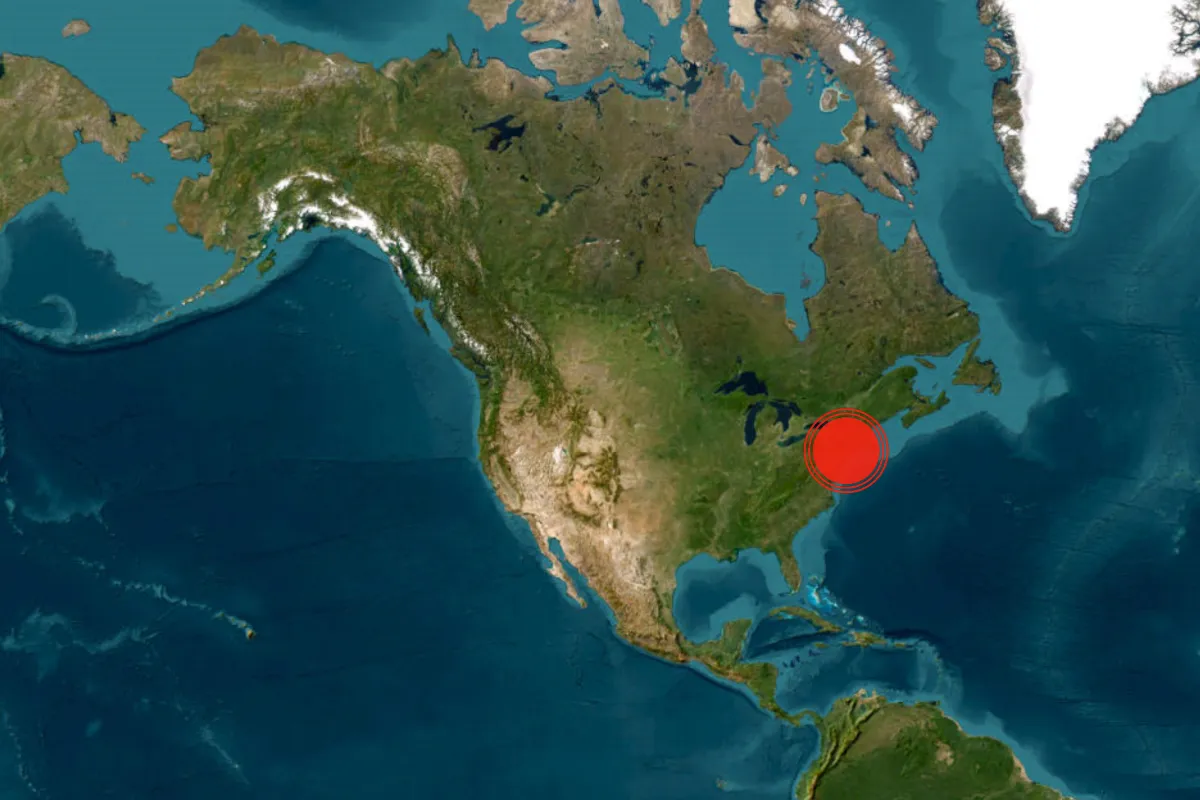
A 2.3 magnitude earthquake struck in New York's Westchester County on Tuesday, data from the United States Geological Survey (USGS) shows.
The earthquake hit in Sleepy Hollow, about 25 miles north of Manhattan, according to the USGS map. The seismic activity occurred at a shallow depth of 4.5 miles, meaning it may have been felt more than a deeper earthquake would have.
Several hundred people reported they had felt the earthquake on the USGS website, with reports coming in from as far north as Oneonta and across the five boroughs, along with New Jersey and Connecticut
Read More on News
There was no immediate word on damage or injuries. No tsunami warning was issued.
Why It Matters
The area has recorded occasional earthquakes over the past century and a half, including a magnitude 4.4 event on September 9, 1948—the strongest on record for Westchester County by epicenter—and a magnitude 3.5 in 1874. More recently, a magnitude 2.2 earthquake was recorded in Hastings-on-Hudson on May 19, 2023.
What To Know
USGS recorded a magnitude 2.3 earthquake at approximately 10:17 a.m. ET on March 10.
Local outlets said there were no immediate reports of injuries or damage linked to the tremor as of late morning Monday. USGS continued to review the event parameters
Earthquakes in the northeastern United States occur less frequently than on the West Coast but can be felt over wider areas due to older, denser crustal rocks. In April 2024, a magnitude 4.8 earthquake centered near Whitehouse Station, New Jersey, shook parts of New York City, New Jersey, and the wider region.
The Dobbs Ferry Fault, which extends from the larger Ramapo Fault Zone, lies along the eastern side of the Hudson River and has been historically associated with seismic activity in the Lower Hudson Valley. Monday’s event occurred near this zone, according to News 12 reporting.
USGS operates a citizen-science platform called “Did You Feel It?” to collect crowdsourced shaking reports and create intensity maps that inform scientific review and emergency managers. Residents can report experiences and view maps on the USGS site.
Where Was the Epicenter of This Quake?
The epicenter was identified near Sleepy Hollow, New York, in Westchester County. Residents in nearby communities, including Dobbs Ferry, reported brief shaking, News 12 reported.
USGS invited the public to submit DYFI reports to map the intensity and extent of the tremor.
What Causes Earthquakes?
Most earthquakes occur when stress builds along faults in the Earth’s crust and is released as seismic energy after rocks slip past each other. In the eastern United States, these are often intraplate earthquakes linked to ancient fault zones that remain susceptible to modern stress fields.
USGS explains that seismic waves radiate from the focus (hypocenter), while the epicenter is the point on the surface directly above that underground source. The shaking intensity people feel at the surface depends on magnitude, depth, distance from the epicenter, and local geology.
What Happens Next
USGS typically refines earthquake parameters in the hours after a tremor as additional data and public DYFI submissions arrive. Residents who felt shaking can submit a report to improve intensity mapping.
Update 3/10/26, 12:24 p.m. ET: This article was updated with additional information.
In a polarized era, the center is dismissed as bland. At Newsweek, ours is different: The Courageous Center—it's not "both sides," it's sharp, challenging and alive with ideas. We follow facts, not factions. If that sounds like the kind of journalism you want to see thrive, we need you.
When you become a Newsweek Member, you support a mission to keep the center strong and vibrant. Members enjoy: Ad-free browsing, exclusive content and editor conversations. Help keep the center courageous. Join today.


View 0 Comments
Submit Correction
View Editorial & AI Guidelines