...

By Hannah Millington
Health Reporter
0
Share
Newsweek is a Trust Project member
See more of our trusted coverage when you search.Prefer Newsweek on Googleto see more of our trusted coverage when you search.
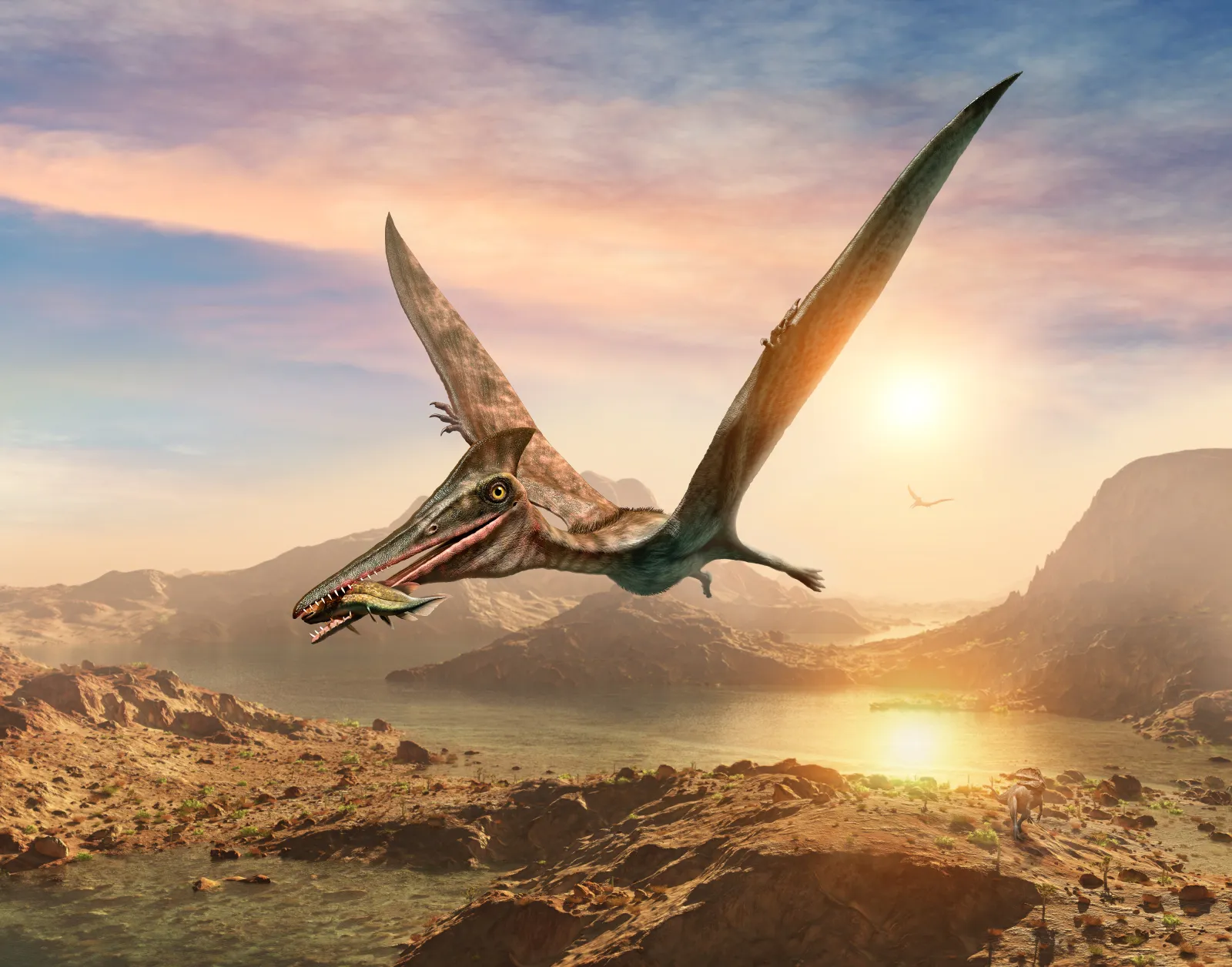
A new extinct flying reptile species has been discovered in fossilized dinosaur vomit.
Known as "regurgitalite," the remains of stomach content have been kept in Museu Câmara Cascudo at the Universidade Federal do Rio Grande do Norte in Brazil for many years and—until now—have been largely overlooked.
The specimen was kept among other fossils originating from the Araripe region, unfortunately, without precise provenance and date of collection, according to the researchers.
Read More on Science
The fossil consists of the partial remains of two of the newly discovered filter-feeding pterosaur species the team has named Bakiribu waridza, along with four fossil fish.
...
“Fracturing of the pterosaur bones most likely occurred during ingestion, as a result of mechanical processing by the predator. The absence of associated soft tissues is consistent with the hard-part bias of regurgitalites, produced by preferential digestion of soft tissues and may have been compounded by post-burial alteration,” the study authors explained in the paper.
The team conducted “phylogenetic analysis” to investigate the new species and “paleohistological analysis” that revealed well-preserved dentine and pulp cavities. While many discovered pterosaurs appear to have been native to the region, this is the first filter-feeding pterosaur from the tropics
“Bakiribu exhibits extremely elongated jaws and dense, brush-like tooth rows, similar to Pterodaustro [another filter-feeder] but distinct in tooth cross-section and spacing.”
Both are categorized as Ctenochasmatidae, a group of pterosaurs known for their long needle-like teeth.
The regurgitalite offers evidence of pterosaurs serving as prey to larger dinosaurs.
“Based on the spatial arrangement of the remains, it is plausible that the predator consumed the pterosaurs first, followed by the fish, and subsequently regurgitated a portion of the ingested mass, likely in response to mechanical discomfort or obstruction caused by pterosaur skeletal elements,” said the authors.
The team concluded spinosaurid dinosaurs and ornithocheiriform pterosaurs stand out as likely candidates, given their “piscivorous adaptations and documented presence in the region.” They added that direct evidence of pterosaur consumption by spinosaurids, a spinosaurid tooth embedded in an ornithocheiriform cervical vertebra, has been reported from the same formation.
The discovery also highlights the potential of long-held and previously ignored museum specimens to reveal further insights about evolution and our planet.
Do you have a tip on a science story that Newsweek should be covering? Do you have a question about the new species? Let us know via health@newsweek.com.
Reference
Pêgas, R. V., Aureliano, T., Holgado, B., Almeida, W. B. S., Santos, C. L. A., & Ghilardi, A. M. (2025). A regurgitalite reveals a new filter-feeding pterosaur from the Santana Group. Scientific Reports, 15(1), 37336. https://doi.org/10.1038/s41598-025-22983-3
View 0 Comments
Submit Correction
View Editorial & AI Guidelines