...


By Dan Gooding and Gabe Whisnant
0
Share
Newsweek is a Trust Project member
See more of our trusted coverage when you search.Prefer Newsweek on Googleto see more of our trusted coverage when you search.
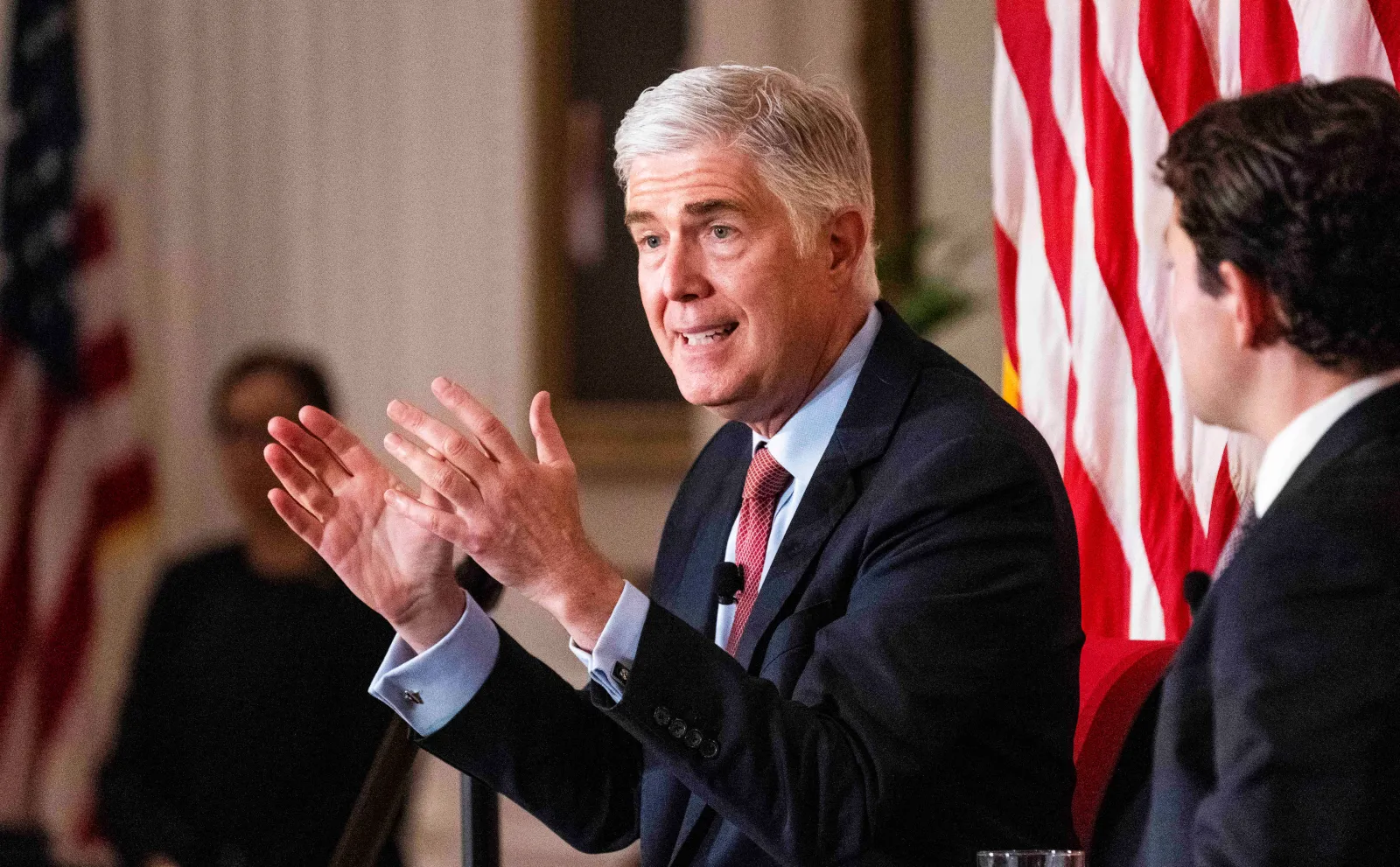
U.S. Supreme Court Justice Neil Gorsuch acknowledged Friday that the court’s decision to strike down some of President Donald Trump’s global tariffs would be “disappointing” to some but said the ruling reaffirmed a core constitutional principle that major economic decisions belong to Congress, not the president acting alone.
Writing for the majority, Chief Justice John Roberts said the Constitution “very clearly” gives Congress the power to impose taxes, including tariffs. The group said Trump had overreached in his presidential authority by unilaterally imposing tariffs under national emergency powers.
The decision was focused on tariffs enacted through the International Emergency Economic Powers Act (IEEPA), and did not cover all tariffs imposed over the past year.
Read More on Politics
Roberts was joined by fellow conservative justices Gorsuch and Amy Coney Barrett, along with all three liberal justices, Sonia Sotomayor, Elena Kagan and Ketanji Brown Jackson. Conservative Justices Samuel Alito, Clarence Thomas and Brett Kavanaugh dissented.
Writing separately in the case, Gorsuch framed the outcome as a defense of the legislative process, even as it dealt a sharp blow to one of Trump’s signature economic policies.
“For those who think it important for the Nation to impose more tariffs, I understand that today’s decision will be disappointing,” Gorsuch wrote, arguing that taxes and tariffs are deliberately routed through Congress to ensure deliberation, compromise and durability.
While the ruling immediately upended Trump’s sweeping trade actions, Gorsuch suggested that those frustrated by the outcome would ultimately come to appreciate the legislative process as “the bulwark of liberty it is.”
Why It Matters
Trump had warned of "chaos" if the Supreme Court ruled against him, writing on Truth Social in January that if the court did so, the U.S. was "screwed." Tariffs have been a core part of the president's economic plan, arguing they are crucial for encouraging American manufacturing after decades of jobs moving overseas. Critics have said the policy has led to price hikes felt by American consumers rather than the companies or countries affected.
The court, which currently has a 6-3 conservative majority, previously ruled in favor of the Trump administration on key issues such as immigration enforcement and cuts at federal government agencies. Gorsuch, Barrett and Coney Barrett were appointed by Trump during his first term.
...
What To Know
Gorsuch's take on the matter came in contrast to some of his fellow conservative justices on Friday, with Thomas disagreeing with his colleague's interpretation that it was up to Congress to decide on tariffs.
The cases brought by small businesses and states centered around the International Emergency Economic Powers Act (IEEPA), a law that allows the president to “deal with any unusual and extraordinary threat, which has its source in whole or substantial part outside the United States, to the national security, foreign policy, or economy of the United States, if the President declares a national emergency with respect to such threat.”
Trump cites the IEEPA in executive orders related to reciprocal tariffs, which he says he has the authority to implement over ongoing concerns around fentanyl making its way into the U.S. from Mexico and Canada, with China also seen as a key player in its manufacturing.
The challengers argued that the law does not mention tariffs, and Trump’s use of it fails several legal tests.
The court rejected the argument that the president has the “independent power to impose tariffs on imports from any country, of any product, at any rate, for any amount of time” under IEEPA’s use of the words “regulate” and “importation.”
While Trump and others in the administration voiced their disappointment, stocks soared on Friday after the ruling. The decision could ease cost pressures for companies and temper concerns about persistent inflation in the U.S. economy.
The S&P 500 rose 0.4 percent, while the Nasdaq Composite gained 0.7 percent. The Dow Jones Industrial Average edged up 45 points, or 0.1 percent, rebounding from a 200-point decline earlier in the day following weaker-than-expected economic data.
What People Are Saying
House Speaker Mike Johnson, on X on Friday: "No one can deny that the President’s use of tariffs has brought in billions of dollars and created immense leverage for America’s trade strategy and for securing strong, reciprocal America-first trade agreements with countries that had been taking advantage of American workers for decades."
Scott Lincicome, vice president of General Economics and Cato’s Herbert A. Stiefel Center for Trade Policy Studies, earlier told Newsweek: "The court’s decision is welcome news for American importers, the United States economy, and the rule of law, but there’s much more work to be done. Most immediately, the federal government must refund the tens of billions of dollars in customs duties that it illegally collected from American companies pursuant to an 'IEEPA tariff authority' it never actually had. That refund process could be easy, but it appears more likely that more litigation and paperwork will be required–a particularly unfair burden for smaller importers that lack the resources to litigate tariff refund claims yet never did anything wrong."
Senator Rand Paul, a Kentucky Republican, on X: "In defense of our Republic, the Supreme Court struck down using emergency powers to enact taxes. This ruling will also prevent a future President such as AOC from using emergency powers to enact socialism."
What Happens Next
Not all tariffs were affected by the decision, and the president was reported to have said he has an alternative plan ready to go.
Update 2/20/26, 12:40 p.m. ET: This article was updated with additional information.
Update 2/20/26 1:28 p.m. ET: This article was updated with additional information.
In a polarized era, the center is dismissed as bland. At Newsweek, ours is different: The Courageous Center—it's not "both sides," it's sharp, challenging and alive with ideas. We follow facts, not factions. If that sounds like the kind of journalism you want to see thrive, we need you.
When you become a Newsweek Member, you support a mission to keep the center strong and vibrant. Members enjoy: Ad-free browsing, exclusive content and editor conversations. Help keep the center courageous. Join today.


View 0 Comments
Submit Correction
View Editorial & AI Guidelines