...

By Andrew Stanton
Reporter
0
Share
Newsweek is a Trust Project member
See more of our trusted coverage when you search.Prefer Newsweek on Googleto see more of our trusted coverage when you search.
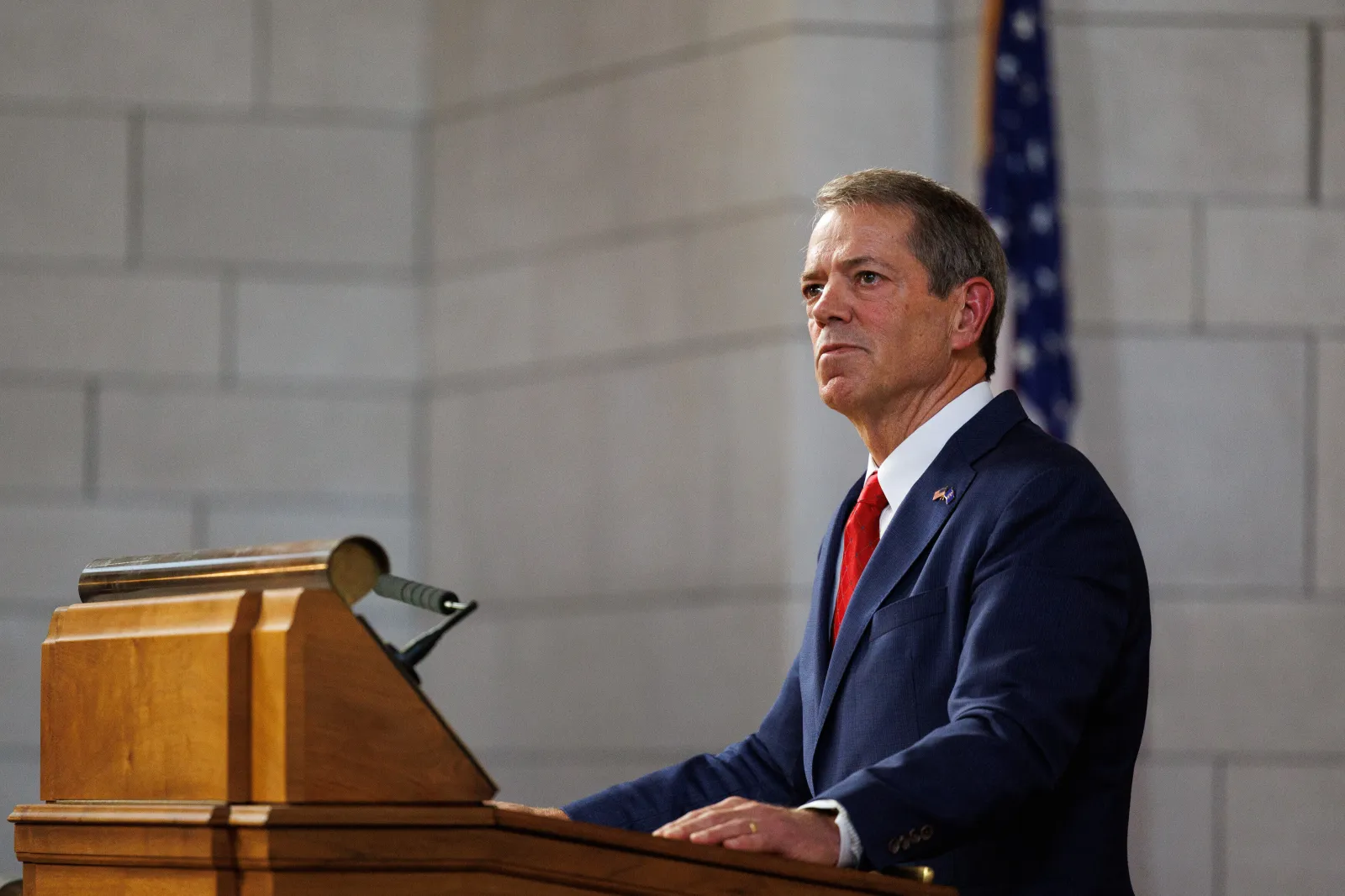
Nebraska Governor Jim Pillen, a Republican, during his State of the State address this week, backed a plan to change how the state elects presidents.
Newsweek reached out to Pillen’s office and the Nebraska Democratic Party for comment via email.
Why It Matters
Nebraska, along with Maine, is one of two states that do not use a winner-take-all electoral system in presidential races. Instead, it allocates two electoral votes for the statewide victor, while each candidate receives one additional vote per Congressional district they carry. In 2024, President Donald Trump won four of the state’s five votes, while former Vice President Kamala Harris won a single Electoral College vote for the Omaha-based seat she narrowly carried.
Read More on News
If this plan goes through, Republicans may benefit from not having to worry about the Second Congressional District, which is viewed as competitive for both parties. It backed both Harris and former President Joe Biden while electing centrist GOP Representative Don Bacon at the same time.
What to Know
Pillen, during his speech, urged legislators to pass a GOP-led bill that would establish a ballot question in November 2026 that would allow the state’s voters to decide whether to move to a winner-take-all system or stick with the current way it elects presidents.
...
“I call upon this Legislature to pass Senator Dorn’s LR24CA to place this question on the November 2026 ballot so that the people of this state can have the final say as to how their voice will be heard in America’s most important national election,” he said.
He said there is a “clear majority” in the legislature who would vote for that change, but that a “minority of this body has repeatedly obstructed the will of the majority of this body and the majority of this state by filibustering it to death.”
If the bill passes, it would be left up to voters. That doesn’t guarantee that it would pass, though Republicans do make up a majority of Nebraska, which gave Trump more than 59 percent of the vote in 2024.
There were efforts to change the state’s electoral system ahead of the 2024 election as polls showed a tight margin between Trump and Harris, but those efforts failed. Ultimately, Nebraska’s competitive district did not matter as Trump carried each swing state.
However, there are electoral scenarios where the district could have been a tiebreaker. If Harris had won the three closest states—Wisconsin, Michigan and Pennsylvania—she would have held 269 electoral votes, so the Second District would have pushed her over the top.
Kevin Smith, a professor of political science at the University of Nebraska-Lincoln, told Newsweek it is possible the state legislature could advance the bill but that it is a “long, long way from a sure thing.” If there is a ballot initiative, Smith said he believes it would pass but “wouldn’t be super confident in that prediction.”
“I haven’t seen any reliable polling on this. The working assumption would be that this is favored by Republicans who hold a strong registration advantage over Democrats, so it should pass,” he said.
The primary impact would be the “small amount of attention Nebraska gets during presidential campaigns” evaporating, Smith said, adding that Democrats would not see much of an incentive to campaign in such a solidly conservative state.
He also noted that there have been rumblings that Maine could also switch to a winner-take-all system if Nebraska does, meaning it could end up “just being a wash.”
“Barring something totally unforeseen, Nebraska becomes a sure thing for the Republican candidate and Maine becomes a sure thing for the Democratic candidate. The upshot is no real change in the electoral calculus,” he said.
The Omaha World-Herald reported that lawmakers have already voted on a bill to make Nebraska a winner-take-all state that failed to overcome the filibuster. The state legislature is officially nonpartisan, and two members who caucus with Republicans voted against it.
Maine is the only other state that splits its electoral votes. Democrats are generally favored statewide in presidential races, and the First Congressional District, based around the southern part of the state, is also safely Democratic. The Second District, however, is more conservative, having backed Trump in each of his three presidential bids.
What People Are Saying
Governor Jim Pillen said during his address: “We have arrived at the critical juncture in our long-running debate over whether Nebraska should unify and strengthen its voice in presidential elections, which this body decided to divide without the input of the people in a partisan act three decades ago.”
Nancy Pettito, executive director of Civic Nebraska, responded to his remarks in a statement Thursday: “Nebraska’s split electoral vote system has ensured that more Nebraskans are represented in presidential elections. When voters know their participation matters, engagement increases. Our current system reflects Nebraska values of independence, balance, and accountability, while preventing national political parties from taking our state for granted.
"There is no compelling reason to abandon a system that has served Nebraska well and given voters more voice and national relevance. Civic Nebraska urges lawmakers to protect Nebraska’s split electoral vote and reject efforts to move to winner-take-all.”
What Happens Next
It’s yet to be seen whether the legislature will advance the bill to create a ballot initiative. If so, no public polling has been conducted on whether it will pass. But it could have key implications for the 2028 presidential race.
Update 1/16/26, 3:20 p.m. ET: This article was updated with comment from Smith.
View 0 Comments
Submit Correction
View Editorial & AI Guidelines