10
Loading video...

By Ellie Cook
Senior Defense Reporter
Share
Newsweek is a Trust Project member
See more of our trusted coverage when you search.Prefer Newsweek on Googleto see more of our trusted coverage when you search.
NATO's most senior military commander has set out a plan for how the alliance would fight any nation that attacks one of its member states, amid warnings from top intelligence chiefs that Russia could mount an assault on NATO's eastern edge in the coming months.
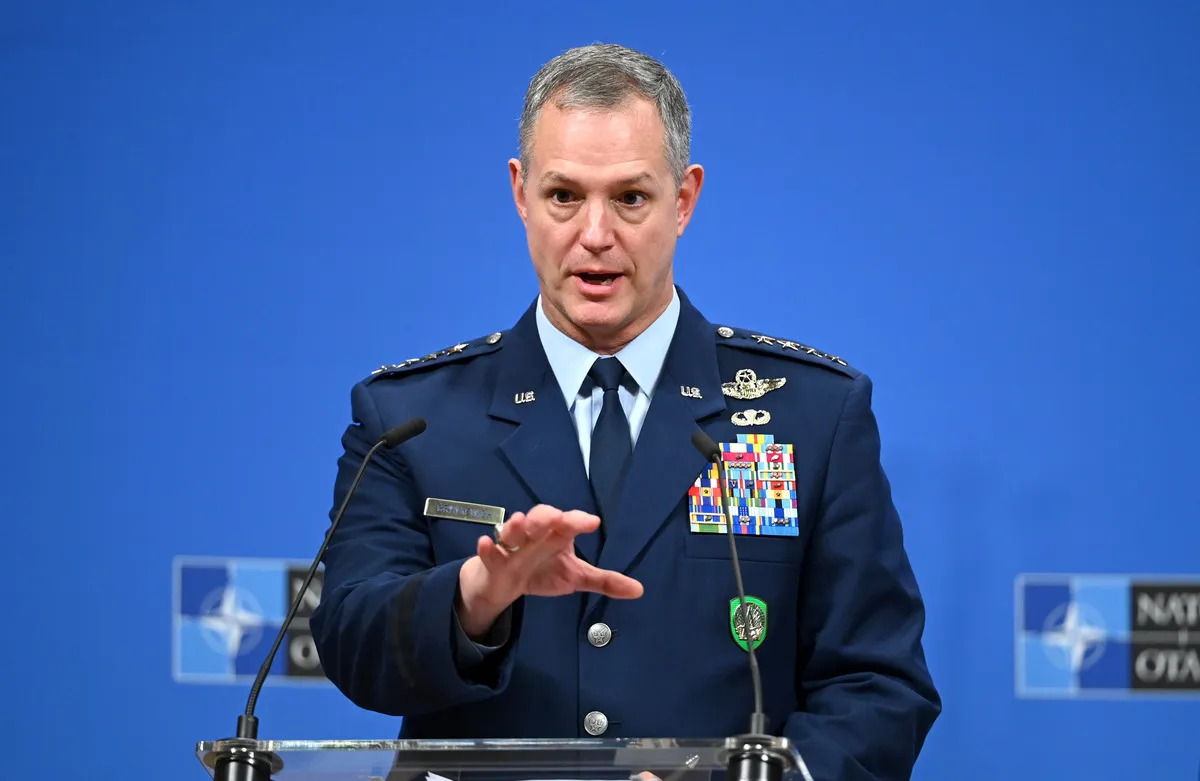
General Alexus Grynkewich, the current Supreme Allied Commander Europe (SACEUR), said all 32 members of NATO had agreed to a "common vision" he dubbed a "theory of victory."
This means the alliance will be able to continue making sure no country dares to attack one of its members and, if such an attack did happen, NATO will be able to defend itself, he said on Monday, speaking at a security forum in Warsaw, Poland.
Read More on World
...
NATO officials have warned in recent months Russia could escalate its so-called "hybrid warfare" assaults against alliance members, or even attempt a small-scale land grab against a NATO country in eastern Europe as early as this fall.
"Hybrid warfare" is a broad term, largely referring to activities that stop short of open fighting, such as cyberattacks, information campaigns or targeting vulnerable infrastructure like power grids or undersea cables.
Some form of limited land seizure or military operation against NATO territory is generally seen as the realistic worst-case scenario for the alliance, rather than an all-out, Ukraine-style invasion push.
Ukraine isn't protected by a clause in NATO's founding treaty, which obliges all member states to come to the defense of any other NATO country that is attacked in the way they see fit.
The idea is to deter Russia from launching military operations against any bit of NATO soil, because the armed forces of all its members—including the U.S., with its huge military and vast nuclear arsenal—could be called upon to fight any incursion.
Russia has dismissed claims it would attack NATO as "nonsense."
Grynkewich, a U.S. Air Force general, played down fears of an armed attack, insisting on Monday: "I do not assess that conflict is imminent or inevitable."
"But if someone is foolish enough to attack us, we will fight," he added, saying an assault on NATO would be "futile."
How Would NATO React?
But if NATO did come under attack, its commanders would sent land forces to the location of the breach and launch operations to destroy these advancing forces, Grynkewich said.
The alliance would deploy aircraft and ships to the area, using a mix of cheaper munitions and long-range precision weapons to hammer the enemy troops, the NATO general added. Space and cyber forces would be activated, but Grynkewich did not specify how they would be used.
Advanced sensors would pick up any other forms of attack and stop them before they can gain momentum, Grynkewich said.
If these enemy soldiers continue to attack—or bring in reserve troops—NATO would target "not just the attacking force itself, but anything and everything that supports, sustains, and controls that force," Grynkewich added. This would likely include areas like logistics operations and communications.
NATO would use lots of inexpensive weapons to overwhelm the invading troops, as well as a smaller number of costly, but highly accurate missiles, he said. "We will apply constant and unyielding pressure."
Alarm Bells Ringing
NATO countries are rushing to build up their military stockpiles, spend more on defense and beef up their militaries after pressure from President Donald Trump, the U.S. telegraphing to Europe and Canada it wants to end their reliance on U.S. troops and equipment so Washington can concentrate on China's potential plans for Taiwan.
But the U.S. looking to pull back from Europe comes as intelligence agencies on the continent warn Russia could attack as the U.S. draws away—potentially before European countries have built up their own replacements for American forces and equipment. The Pentagon is currently reviewing its troop deployments in Europe.
Denmark's military and foreign intelligence service said in a stark statement in late September that Moscow had upped its cyberattacks and sabotage operations in Europe, and described Russia as "more willing to take risks."
Danish intelligence assessed Russia would try to further turn up the pressure of its hybrid war against NATO "with greater consequences for the targeted countries than in the past."
In August, it emerged U.S. officials now assess Russia could launch a "limited" attack on NATO's eastern European edge as soon as this fall, according to The Wall Street Journal. This could involve sending a small number of Russian troops over into the Baltic states or Poland, or intensifying hybrid warfare operations, unnamed U.S. officials told the newspaper.
European NATO nations, particularly those pressed up on Russia's border or Ukrainian soil, have been further set on edge by a series of drone and missile incursions into their airspace, which some officials describe as Moscow probing NATO reactions, trying to weaken the alliance and hack at support for Ukraine.
Update 10/12/26, 10:30 a.m. ET: This article was updated with additional information.
Submit Correction
View Editorial & AI Guidelines