...

By Newsweek Editors
0
Share
Newsweek is a Trust Project member
See more of our trusted coverage when you search.Prefer Newsweek on Googleto see more of our trusted coverage when you search.
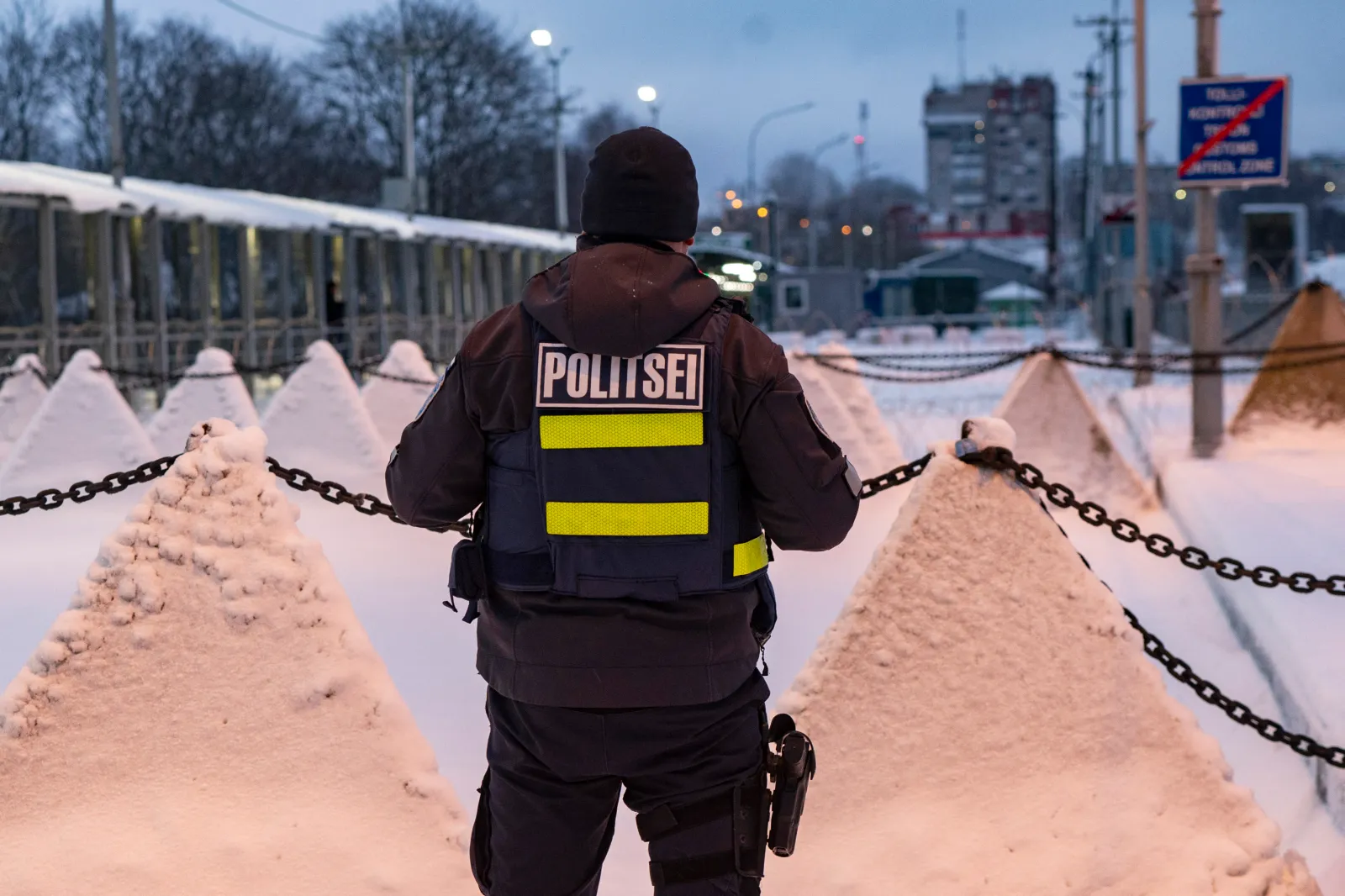
Two medieval fortresses face each across the Narva River separating Estonia and Russia. But the "Friendship Bridge" between them, built during the Cold War, now sits behind razor wire and rows of concrete tank traps known as "dragon's teeth" on the Estonian side. "The name is kind of ironic," the regional border chief, Eerik Purgel, told AFP.
On the bridge’s Estonian approach, the NATO flag flies alongside Estonia’s and the EU’s. Yet the mood, Narva’s mayor, Katri Raik, told the outlet, is "gloomy" as Russia’s full-scale war in Ukraine nears its fourth anniversary: "Here at the edge of Europe the war feels different…We see Russia across the border every day."
Nearby, another kind of tripwire is being laid. Last September, the European Commission celebrated the opening of what it called Europe’s largest rare-earth magnet factory in Narva, meant to produce permanent magnets for "electric vehicles, wind turbines and microelectronics." The commission also made the awkward admission that "more than 90 percent of magnets currently imported in the EU come from China."
Read More on News
So Narva has become an unusually concentrated symbol of Europe’s two great dependencies: American soldiers and Chinese supply chains. That is one of the many subtexts of this week’s Munich Security Conference, where leaders from more than 100 countries will gather from February 13 to 15.
The Munich Security Conference’s homepage now advertises its annual report with a warning: "The world has entered a period of wrecking-ball politics." Narva, unexpectedly, finds itself on the front line.
Common Knowledge
For Europeans, Narva is a tripwire: a small, Russian-speaking border city that could be tempted—or "protected," in Moscow’s euphemism—into becoming the Donbas of the Baltic. AFP notes that "some fear" the town could be President Vladimir Putin’s "next target."
That fear is now being threaded through Munich. A report prepared for the Munich Security Conference, The Guardian wrote, argues Europe has reached a "painful" realization that it must be "bolder" and more independent, because President Donald Trump’s America no longer reliably upholds liberal democratic norms or the postwar order.
In the American right’s version, the map looks different. Europe is a wealthy continent that has treated the generosity of U.S. taxpayers as an entitlement. The new Trump-era National Security Strategy says: "The days of the United States propping up the entire world order like Atlas are over."
Europe has already agreed, under U.S. pressure, notably from Trump, to carry more of its own weight. NATO commits members to invest 5 percent of GDP annually in defense and defense-related spending by 2035, against a previous target of 2 percent.
That fits with the view of right-leaning analysts who say the U.S. military cannot fight multiple wars simultaneously and should focus on deterring China.
Uncommon Knowledge
The underappreciated fact that Narva illuminates is not demography or even NATO doctrine. It's metallurgy.
The European Commission admits that the EU "does not produce any rare earth elements itself," and that "of its total rare earth magnet demand, 98 percent is met by Chinese imports."
Rare earth permanent magnets are, as the commission notes, among the most energy-efficient routes to electric motors and generators and show up everywhere from EV traction motors to wind turbines to the servo motors that animate robotic arms.
They are also, in less advertised fashion, part of modern military capability. A 2024 Government Accountability Office report notes that rare earth elements and other critical materials are essential to national security, embedded in many weapon systems, and supply disruptions pose "high potential for harm." It also notes that the Pentagon's purchases represent less than 0.1 percent of global demand, undoubtedly a factor behind Trump's push for Greenland.
This is why Narva and its rare-earth magnet factory is a useful, though alarming, tripwire. In a city of around 50,000 people, about half of residents are Estonian, a third hold Russian citizenship, and about 7,000 are stateless. Russians and the stateless do not have the right to vote, and Estonian, not Russian, is being taught in many schools, even though most residents speak Russian.
A German political scientist, Carlo Masala, told AFP that depriving Russian citizens in Estonia of local voting rights is "a perfect gateway for Russian propaganda"—a way for Moscow to argue minorities are threatened and must be protected, "if necessary by military means."
The military arithmetic is stark. Russia’s authorized active-duty force is estimated at 1.5 million, though it's unknown how strong it is after heavy losses in Ukraine. That would make it roughly 35 times Estonia’s 43,000-strong non-permanent forces, even though Estonia nears the 5 percent spending target.
Russian provocation, however, is generally in a gray zone. One clear category is airspace violations. On September 19, 2025, Estonia said three Russian MiG-31 fighter jets entered Estonian airspace near Vaindloo Island for around 12 minutes, ignoring radio contact. Russian aircraft have violated Estonian airspace more than 40 times since 2014, with a peak year in 2016 and a lull in 2023-24, according to Estonian statistics.
On the ground (and in the water), Estonia has faced "nuisance" operations. On May 23, 2024, Estonian officials said Russian border guards removed 25 navigation buoys placed by Estonia in the Narva River. The EU publicly condemned the move and demanded an explanation.
In spring 2024, Finland’s flag carrier Finnair suspended flights to Tartu, Estonia's second largest city, after GPS interference prevented two landings. Estonia’s foreign minister described the disruption as a possible hybrid attack and pointed the finger at Russia. By mid-2025, Estonia said that Russian GPS jamming had caused over €500,000 ($600,000) in damages in a three-month period, and that Russia had also attempted to take control of border-guard surveillance drones.
On Christmas Day in 2024, the Estlink-2 subsea power cable failed, and Finnish authorities said five undersea telecommunications cables between Finland and Estonia were also damaged. In 2025, Finnish prosecutors charged officers of a Russia-linked tanker, the Eagle S, over allegations that the ship’s anchor dragged and caused the damage.
Estonia also claims Russia uses recruitment, proxies, and petty sabotage to keep it off balance. In 2024, Estonia’s Internal Security Service said it detained 10 people suspected of committing sabotage and vandalism "on orders from Russian special services," including attacks on the interior minister’s car and a journalist’s car.
Put all this together and Narva stops looking like a remote border. It becomes a choke point where Europe’s security and industrial aspirations meet—and where a crisis could disrupt not just NATO credibility but a supply chain the EU has publicly admitted is overwhelmingly dependent on a strategic rival.
If you’re enjoying Uncommon Knowledge, please share. If you have suggestions for future editions or feedback, email subscriber.feedback@newsweek.com. We want to hear your voice.
View 0 Comments
Submit Correction
View Editorial & AI Guidelines