10
Loading video...


By Brendan Cole and Hannah Parry
0
Share
Newsweek is a Trust Project member
See more of our trusted coverage when you search.Prefer Newsweek on Googleto see more of our trusted coverage when you search.
President Donald Trump revisited his grievances with NATO on the first day of its summit in Ankara, Turkey, lambasting its members for not helping in the war he launched against Iran despite the money the U.S. has “invested” in the alliance “to protect European countries” from Russia.
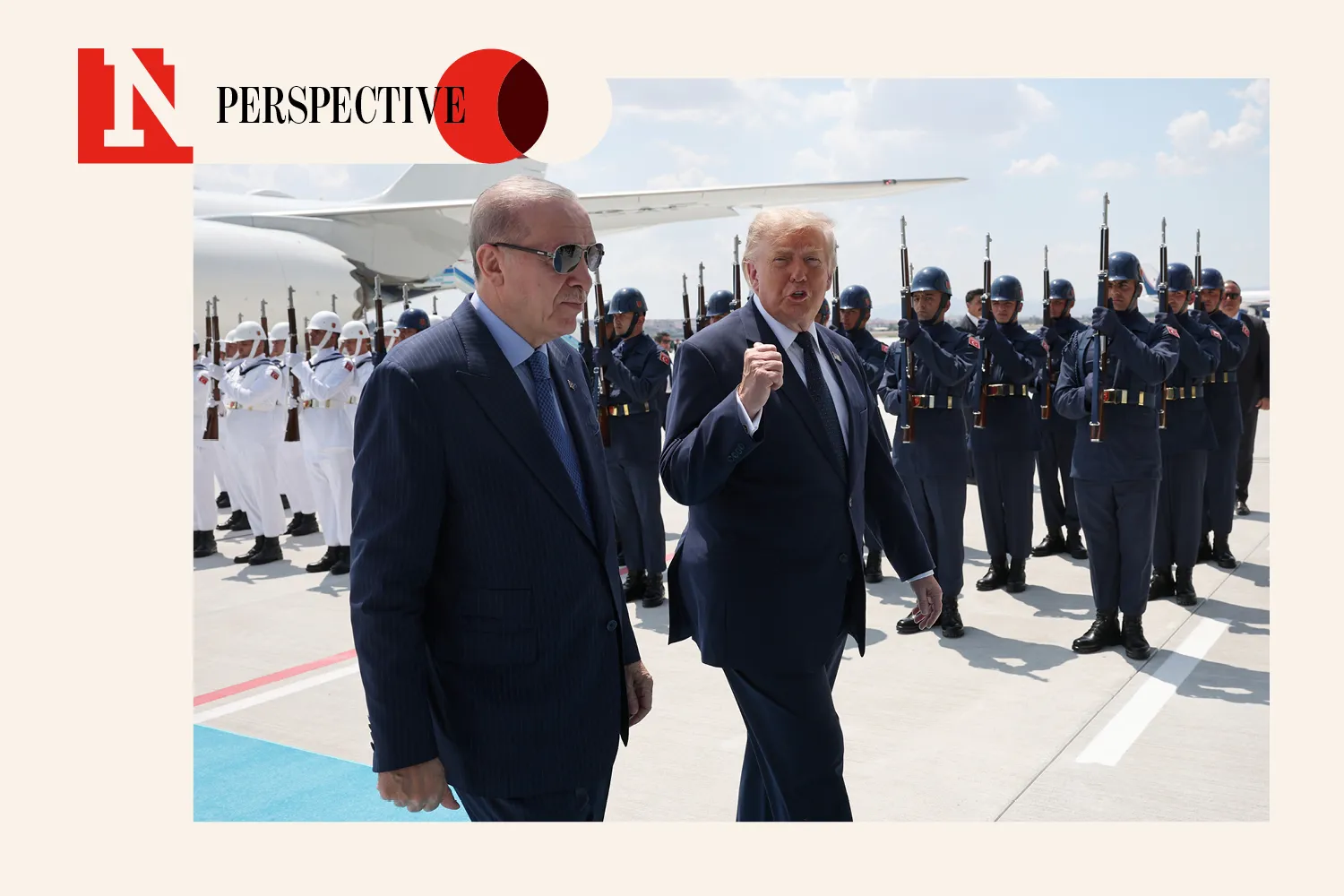
Trump, who was greeted by Turkish President Recep Tayyip Erdoğa and his wife outside of the dinner for NATO leaders, told the summit news conference on Tuesday, “Germany turned us down, and France turned us down,” referring to what he has condemned as a reluctance among fellow NATO members to help the U.S. in the Iran war.
“Why are we spending hundreds of billions of dollars, and they're not there for us? We've always been there for them,” Trump said in an address in which he also threatened to pull American troops from Europe over the high levels of non-white immigration to European countries.
Read More on World
Trump's comments reflect the heightened tensions between the U.S. and the rest of the 32-member defensive alliance. On Wednesday, Trump is scheduled to meet Ukrainian President Volodymyr Zelensky, who has lamented a shortage of Patriot interceptor missiles.

...
Zelensky's complaint followed Russia’s bombardment on Sunday, which killed 21 people only days after strikes killed another 22, as the Ukrainian leader urged allies to increase air defense commitments.
But Zelensky’s plea for “strong decisions” by NATO to counter Russia stepping up its combined missile and drone attacks follow reports the U.S. used up around a half of its Patriot missile interceptors and THAAD interceptors during the war on Iran.
On Tuesday, the Ukrainian president argued again that his country should be allowed to join NATO, asking at the defense summit, “I have a question for you. Do you really believe it? Do you really believe it would be right to leave outside NATO, a country and a people with this level of defensive capability?”
“If we already have these capabilities, if Ukrainians already know how to fight like this, then it does make sense for these capabilities to become a part of the alliance’s collective defense that would make all of us stronger," he added.
Depleted American stockpiles will raise concerns among NATO members who may have to look elsewhere to defend themselves.
“All the interceptors used up in the Middle East really strained global PAC-2 and PAC-3 (Patriot Advanced Capability) stocks, created real bottlenecks in the supply chain, and Russia knows it,” said Yuriy Boyechko, CEO of Hope for Ukraine, which helps communities on the frontline of the war.

...
Air Defense Systems Fracturing
Boyechko told Newsweek that Ukraine's defensive shield is fracturing under a severe shortage of air defense interceptors akin to what it had in 2022 when Vladimir Putin launched his full-scale invasion.
“That’s why we’re seeing these mixed attacks now—cheap drones first to make us burn through ammo then ballistic missiles right after,” he said, forcing Ukraine’s command to choose what to protect when reserves are already stretched thin.

...
“All those anti-ballistic missiles used in the Middle East came from the same pools we rely on for resupply,” he said.
“Allies got more protective of what they had left once stocks started shrinking, so transfers to us slowed down, which leaves our skies more exposed to ballistic and hypersonic stuff.”
Iran War Depletes US Stockpiles
On March 5, Zelensky expressed frustration at U.S. priorities in which he noted that over just three days of fighting the Iran war, more than 800 Patriot missiles had been used—more than Ukraine has received since 2022.
This figure was not independently confirmed but a Center for Strategic and International Studies (CSIS) report released April 21 illustrated the cost of the Iran war on critical munitions stockpiles. It said that the U.S. had used 45 percent of its critical Patriot missile interceptors, and over 53 percent of its THAAD (Terminal High Altitude Area Defenses) interceptors during the Iran war.

...

...
The think tank said that in 39 days of the war’s air and missile campaign before an April 8 ceasefire, U.S. forces had expended more than half of its pre-war inventory in four out of seven munitions.
Before the Iran war, stockpiles were deemed insufficient for a peer competitor fight but given that replenishing munitions to pre-war levels could take between one and four years the shortfall “is now even more acute,” the CSIS said.
It said many munitions had acceptable inventories so if critical munitions run low or run out, the U.S. can “continue the fight.”
“Diminished inventories will also affect the U.S. supply of Patriot, THAADs, and Precision Strike Missiles (PrSMs) to Ukraine and other allies and partners that use them,” the report concluded.
The U.S. has this year delayed or cancelled deliveries of key arms shipments to Europe, including Tomahawk cruise missiles, HIMARS mobile rocket artillery, and PAC-3 missiles.

...
Turkey’s Clout in NATO on Show
Turkey has NATO’s second largest military after the U.S., and it plays a key security role for eastern Europe and further south with the biggest threat coming from Russia.
Turkey’s strategic position on the Black Sea allowed it to stop Moscow from reinforcing the Russian Black Sea fleet through the Montreux Convention in which Ankara closed the Bosphorus and Dardanelles to the warships.
Trump has stepped back from U.S. commitments to Kyiv's fight. He has also lambasted NATO members for not spending enough on defense, not helping in his war on Iran, and made repeated threats to pull the U.S. out of the alliance.
But Erdoğan is one of the few leaders in Trump’s good books and his invitation to the U.S. president was enough to get him to attend. During Tuesday's news conference, Trump suggested he would not have attended if had not been for Erdoğan.

...
Trump also signaled Tuesday that his administration plans to lift U.S. sanctions on Turkey, a move that could pave the way for Ankara to rejoin the F-35 fighter jet program after years of exclusion.
Trump was asked at the summit whether the U.S. would remove restrictions that have prevented Turkey from purchasing and helping manufacture the stealth aircraft—a ban imposed during Trump's first term after Ankara acquired Russia's S-400 air defense system.
"It's a decision we're going to make. We have a very good relationship," Trump told reporters. "Why wouldn't we do that, have a better relationship with Turkey? Turkey has been in many ways much more loyal than other countries that we think would be loyal, so something certainly we would consider."
Later in the press conference, Trump went further, saying the sanctions would be removed. "I can tell you, we're going to be taking the sanctions off," he said. "We're going to be taking the sanctions off. It's time to do that. Okay, you don't want to sanction friends. It's very simple."
Related Story
Donald Trump’s Hidden Allies at the NATO Summit: Ranked
However, Sinan Ciddi, Turkey program director at the Foundation of Defense of Democracies (FDD), a Washington, D.C. think tank, has warned American lawmakers against approving advanced U.S. defense transfers to Turkey, especially F-35 fighter jets and F110 high-performance engines.
The first Trump administration blocked F-35 purchases after Ankara had acquired the Russian S-400 air defense system seen as incompatible with the alliance.
Ciddi told U.S. lawmakers Erdoğan’s government is an escalating threat to NATO's southeastern flank and not the stabilizing force that he attempts to portray.
“The United States and its allies should approach Ankara with clarity rather than wishful thinking,” he said in testimony last month to the Tom Lantos Human Rights Commission, a bipartisan body in the U.S. House of Representatives.
“Turkey is one of the key actors that will stabilize NATO,” said Yörük Işık, a geopolitical analyst based in Istanbul, told Newsweek. “Turkey's role comes into the plugging the huge gap will be left by the departure of United States.”
“There is no other actor on the continent that can replace Turkey's role and manpower and the ability to manufacture stuff at speed and at volume,” added Işık who runs the consultancy the Bosphorus Observer.

...
NATO Secretary-General Mark Rutte announced on Tuesday that the alliance would get a strategic airlift fleet of Airbus A400M transport planes, add an A330 MRTT tanker to its fleet and spend about $4.5 billion to acquire up to 10 Saab GlobalEye surveillance planes to replace its aging AWACS (airborne early warning and control) aircraft.
Ciddi said NATO members are very complimentary towards Turkey as a defense partner in public but in private most expressed concerns over whether its capability would be useful to counter the threat posed by Russia. “At the very least we're not sure if Turkey would ever deploy that to European or NATO security.”
But Işık from the Bosphorus Observer said that the Trump administration’s upending of NATO means that the Ankara summit “is very important because this is the first time the Allies are reshuffling their responsibilities.”
Trump Says Greenland Should Be Under US Control
Trump doubled down on his opinion that Greenland “should be controlled by the United States, not by Denmark,” as he took aim at his NATO ally.
“That's what hurt my relationship with NATO, because Greenland doesn't help Denmark,” Trump said at the summit in Turkey on Tuesday. “Denmark doesn't spend money to really help Greenland, but it's an important part for the United States, and it's surrounded by China ships and Russian ships,” he continued.
"They [Denmark] wouldn't go along with it, and with all the money we spend to help them with Russia, and we don't have to spend any money. We could remove all of our soldiers out of Europe. Because as you've probably noticed, Europe’s a very different place than it was 20 years ago.”
Trump has consistently argued that the U.S. should control Greenland because of its strategic military importance and its natural resources. However, Greenland is an autonomous territory within the Kingdom of Denmark, with its own elected government, and its leaders have consistently said the island is not for sale and that its future should be decided by the people of Greenland. Danish officials have likewise rejected any transfer of sovereignty.
Danish Prime Minister Mette Frederiksen told Reuters after Trump's latest comments, “It is a well known position of the United States that it wants to own and take over Greenland. I hope that it is equally well known everywhere that this is not going to happen."
Contact Newsweek editors on this story: Frances Mao and Edward Pearcey.
Update 7/7/26, 11:52 a.m. ET: This article was updated with a new headline and additional information.
View 0 Comments
Submit Correction
View Editorial & AI Guidelines