...

By Jordan King
Reporter
0
Share
Newsweek is a Trust Project member
See more of our trusted coverage when you search.Prefer Newsweek on Googleto see more of our trusted coverage when you search.
A NATO commander warned that its forces could capture Russia's heavily fortified Kaliningrad region "in a timeframe that is unheard of" if necessary.
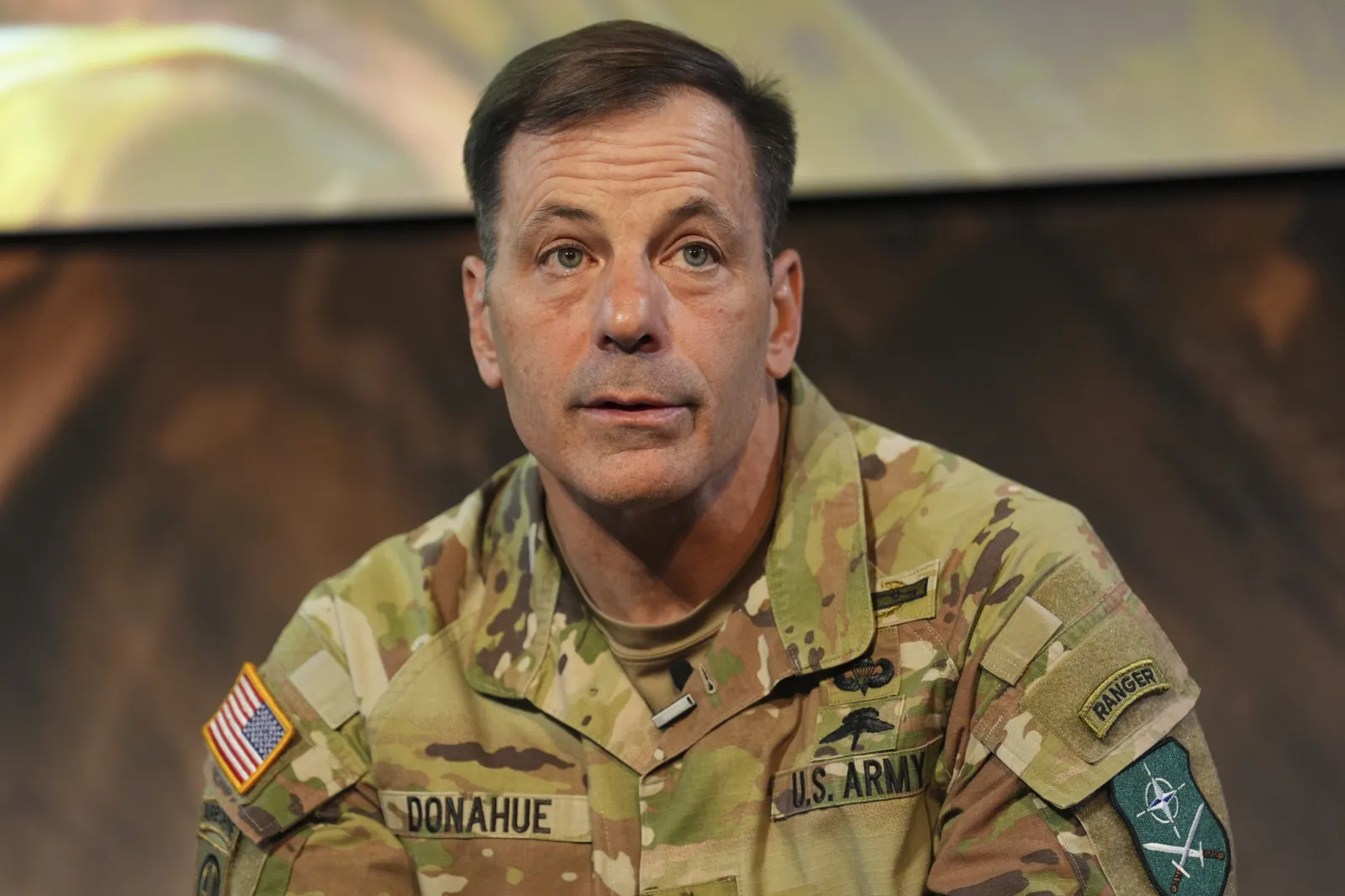
General Christopher Donahue, commander of U.S. Army Europe and Africa, made the remark as the alliance unveiled a new Eastern Flank defense plan at the Association of the U.S. Army's inaugural LandEuro conference on Wednesday.
It comes amid fears that Russian President Vladimir Putin could seize NATO territory if not stopped in Ukraine, which Ukrainian President Volodymyr Zelensky and NATO Secretary General Mark Rutte have warned about before.
Read More on News
Why It Matters
The warnings by Donahue and NATO leaders reflected growing concern about Russia's intent and military buildup, especially following the invasion of Ukraine on February 24, 2022, and a series of hostile actions, including cyberattacks and territorial advances.
NATO's new posture, built on the Eastern Flank Deterrence Line strategy, reported on by Defense News, seeks to shift the alliance from a peacetime to a war-ready footing to deter or repel any Russian attempt to seize territory in Europe.
NATO members face repeated warnings from intelligence and defense officials that Russia could directly threaten alliance territory within the next five years, signaling an urgent need for coordinated defense investments and operational reforms.
France's National Strategic Review named Russia the "most direct threat" to European interests and stability, while Western leaders cautioned that unchecked Russian aggression could escalate into a broader European conflict.
...
What To Know
Donahue outlined the new Eastern Flank Deterrence Line, a NATO plan to increase ground-based capabilities, promote allied interoperability and enable rapid mobilization against Russian threats.
The approach prioritizes standardized systems, digital coordination and common weapon launchers, with an emphasis on interoperability and cost-effectiveness.
Speaking specifically about Kaliningrad, Donahue said modern allied capabilities could "take that down from the ground" faster than ever before.
"We've already planned that and we've already developed it," he said. "The mass and momentum problem that Russia poses to us...we've developed the capability to make sure that we can stop that mass and momentum problem."
The small oblast, spanning just 47 miles across, is surrounded by NATO members Poland and Lithuania, and has been heavily militarized by Russia since the end of the Soviet era.
Russian officials have repeatedly warned that any NATO attack on Kaliningrad would be viewed as a direct assault on Russia, with lawmaker Leonid Slutsky, head of the Russian parliament's Foreign Affairs Committee, threatening "corresponding retaliatory measures, including the use of nuclear weapons," according to the Russian state-owned TASS news agency.
What To Know About Kaliningrad
Kaliningrad is a Russian exclave on the Baltic Sea, separated from mainland Russia and bordered by Poland to the south and Lithuania to the north and east.
Formerly known as Königsberg, it became part of the Soviet Union after World War II under the terms of the Potsdam Agreement.
Today, it is an outpost of Russian power in the heart of NATO territory and is among the most heavily fortified regions in Europe.
Kaliningrad hosts significant Russian ground forces, air defense systems and naval assets, including reported deployment of nuclear-capable missiles, giving Moscow a forward operating base in the region and raising the stakes of any military confrontation.
Who People Are Saying
General Christopher Donahue, commander of U.S. Army Europe and Africa: "We know what we have to develop and the use case that we're using is you have to [deter] from the ground. The land domain is not becoming less important, it's becoming more important. You can now take down [anti-access, aerial-denial] A2AD bubbles from the ground. You can now take over sea from the ground. All of those things we are watching happen in Ukraine."
Leonid Slutsky, head of the Russian parliament's Foreign Affairs Committee: "An attack on the Kaliningrad region is tantamount to an attack on Russia."
Ukrainian President Volodymyr Zelensky, earlier this year: "If we do not stand firm, [Putin] will advance further. Considering all of this, I believe it could escalate into a world war."
What Happens Next
NATO's Eastern Flank Deterrence Line is set to boost allied land power and digital integration, including new AI-driven data systems and standardized launchers. The initiative aims to enable rapid response, high interoperability and lower operating costs. Member states have been urged to accelerate defense investments to match Russia's surging military spending and evolving threat landscape.
Western governments continue to monitor Russia's actions in Ukraine and along NATO borders.
View 0 Comments
Submit Correction
View Editorial & AI Guidelines