...

By Ellie Cook
Senior Defense Reporter
0
Share
Newsweek is a Trust Project member
See more of our trusted coverage when you search.Prefer Newsweek on Googleto see more of our trusted coverage when you search.
U.S. relations with Europe and Canada are still "extremely strong," the deputy commander of NATO forces in Europe has said, despite questions over America's future footprint in Europe.
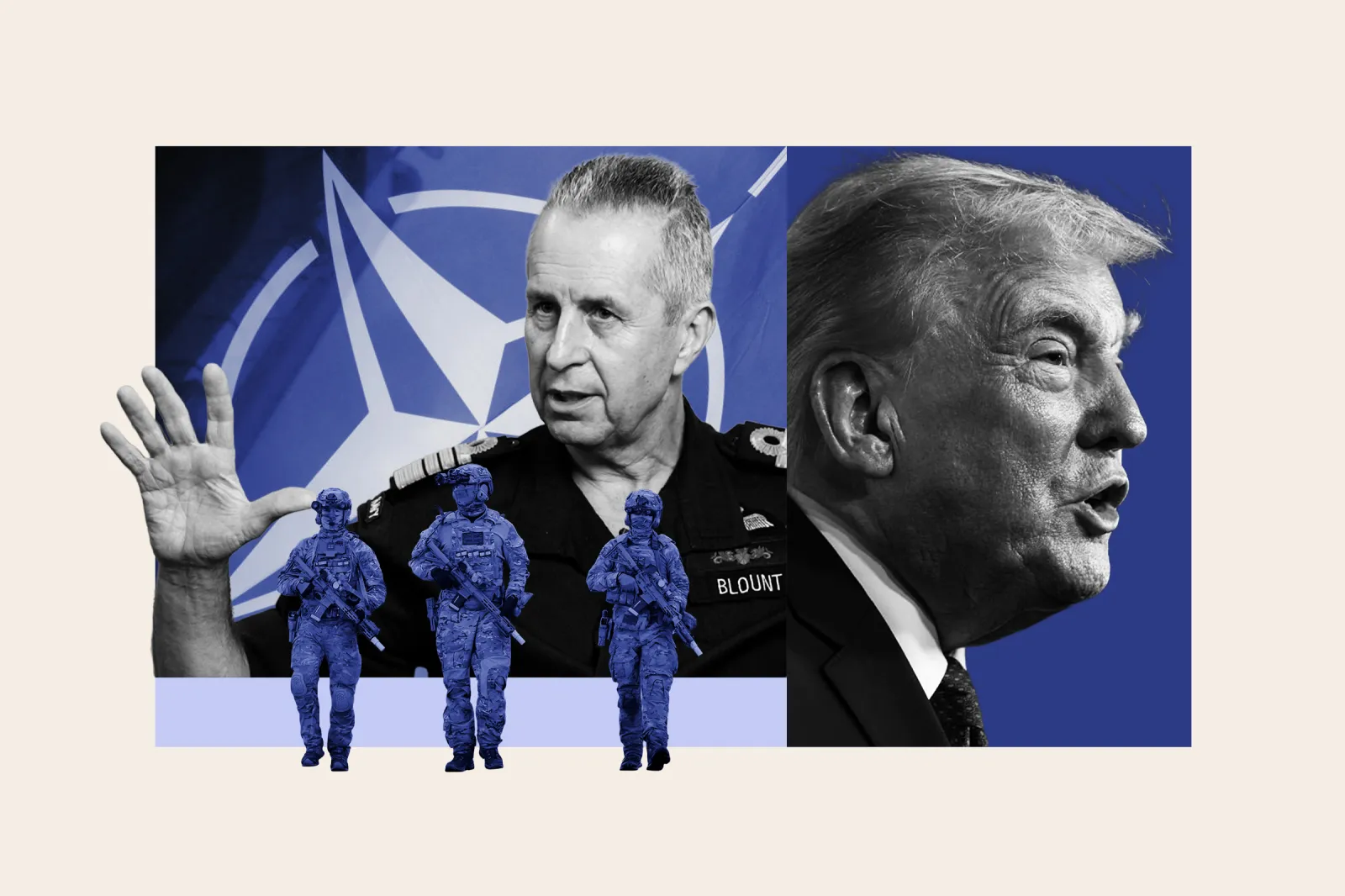
In an interview with Newsweek, Admiral Sir Keith Blount played down fears of fracture between America and its closest allies, describing U.S. pressure on the continent over military spending as "an absolute rallying cry."
"I have absolutely no doubt that transatlantic union is extremely strong," he said.
Read More on World
The outgoing Deputy Supreme Allied Commander Europe (DSACEUR**)** spoke to Newsweek ahead of this weekend's Munich Security Conference in Germany where the focus will be squarely on how the White House has hacked away at decades of close bonds with Europe, tearing apart the certainty states had in their relationship with Washington.
Vice President JD Vance used last year's Munich gathering to berate the continent's leaders, accusing European governments of suppressing free speech - an early indication of the disdain the administration would continue to harbor for Europe.
"You can't make an assumption that America's presence will last forever," Defense Secretary Pete Hegseth separately warned a year ago.
President Donald Trump has long indicated he wants Europe to shoulder more responsibility for its own defense; and most European officials agree the continent has dropped the ball.

...
But the way American critiques were delivered packed a real punch, as did the administration's insistence it must control Greenland. Part of NATO member Denmark, the American desire to control Greenland — apparently at any cost — undermined the very basis of the alliance for some of its members and observers.
The U.S. is by far the most influential member of NATO, having long propped up Europe by providing most of the alliance's most expensive military capabilities, such as space-based assets and intelligence.
NATO's nuclear deterrent also hinges on the US's vast arsenal of strategic and tactical nuclear weapons.
Panicked by the U.S.'s warnings, and the reality of what an American focus on the Indo-Pacific could mean for a Europe still contending with Russia's invasion of Ukraine, NATO members quickly pledged to increase their own military spending.
NATO collectively agreed last summer to spend 5 percent of each country's GDP on defense, a figure that was unfathomable at the start of 2025.
'Take The Medicine and Get On With It'
While Europe's politicians and diplomats have been nervous, the continent's senior military officers have been less unnerved by the Trump administration.
Blount, Britain's most senior military official in NATO, said he agreed with the gist of U.S. censures and that other members of NATO should be upping their contributions.
But he rubbished the notion that there would be a dramatic, sudden withdrawal of American troops from Europe.
"I really don't think that we're going to suddenly wake up one morning and suddenly find the U.S. has just gone and hasn't told us," Blount said.
"That's not the way that this is going to work at all."

...
He said the U.S. will have an ongoing dialogue with Europe, which presents the continent with an "opportunity" to step in and take over in some areas.
"When we fill those gaps, we'll feel better for having done it," Blount added.
"We've just got to take the medicine and get on with it."
Shifting Ground in Europe
There are already signs that the alliance has shifted. NATO announced this month that European countries will lead all three of NATO's commands in charge of planning and executing the alliance's military operations.
The U.S. is currently in charge of the Virginia-based Joint Force Command Norfolk and Joint Force Command Naples, which the U.K. and Italy will take over. A German air force general is in charge of the third command, based in the Netherlands.
The changes will slowly come into force over the next few years. But the U.S. will become responsible for NATO's Maritime Command, currently led by a Brit, as well as Land Command, Air Command and Special Operations Forces, which it is already responsible for.
"A lot of those [American] guys have only recently been appointed. New guys into command doesn't look like a complete abdication of European security contribution to me," Blount said.
The top commander of European NATO forces, known as SACEUR, is an American Air Force general.
Rumblings last year, suggesting the U.S. would hand off its leadership of NATO forces across the continent, petered out after bipartisan alarm among U.S. lawmakers.
Trump then signed into law an act which limits just how much the Pentagon can scale back the number of American forces deployed in Europe. It also blocked Washington from surrendering the SACEUR position without strong justification.
"The U.S. has the most extensive inventory of the highest level of military capability anywhere in the world," Blount said.
"I'm not hearing, or picking up on anything, to suggest that just all of that is suddenly going to disappear."
'Not a Retreat from Europe'
If that dreaded scenario did happen, Europe would be met with a phenomenal bill. The continent would need to spend at least $1 trillion over the next quarter of a century to replace the capabilities and equipment currently provided by the United States, experts estimate.
In a discouraging sign to Europe, Hegseth sent the Pentagon's policy chief, Elbridge Colby, to the latest NATO defense ministers meeting in Brussels this week, instead of attending himself.
Colby doubled down on the White House's interest in its own geographic backyard, an increasingly formal policy dubbed the "Donroe Doctrine."
"The United States is prioritizing the most consequential threats to Americans' interests, especially the defense of the U.S. homeland and interests in the Western Hemisphere, as well as reinforcing deterrence by denial in the Western Pacific," Colby said. He did not mention concern for Europe.
"Europe must assume primary responsibility for its own conventional defense," Colby said. But he was quick to add: "That is not a retreat from Europe."
"There is nothing anti-European about this vision," Colby said.
View 0 Comments
Submit Correction
View Editorial & AI Guidelines