10
Loading video...

By Jess Thomson
Science Reporter
0
Share
Newsweek is a Trust Project member
See more of our trusted coverage when you search.Prefer Newsweek on Googleto see more of our trusted coverage when you search.
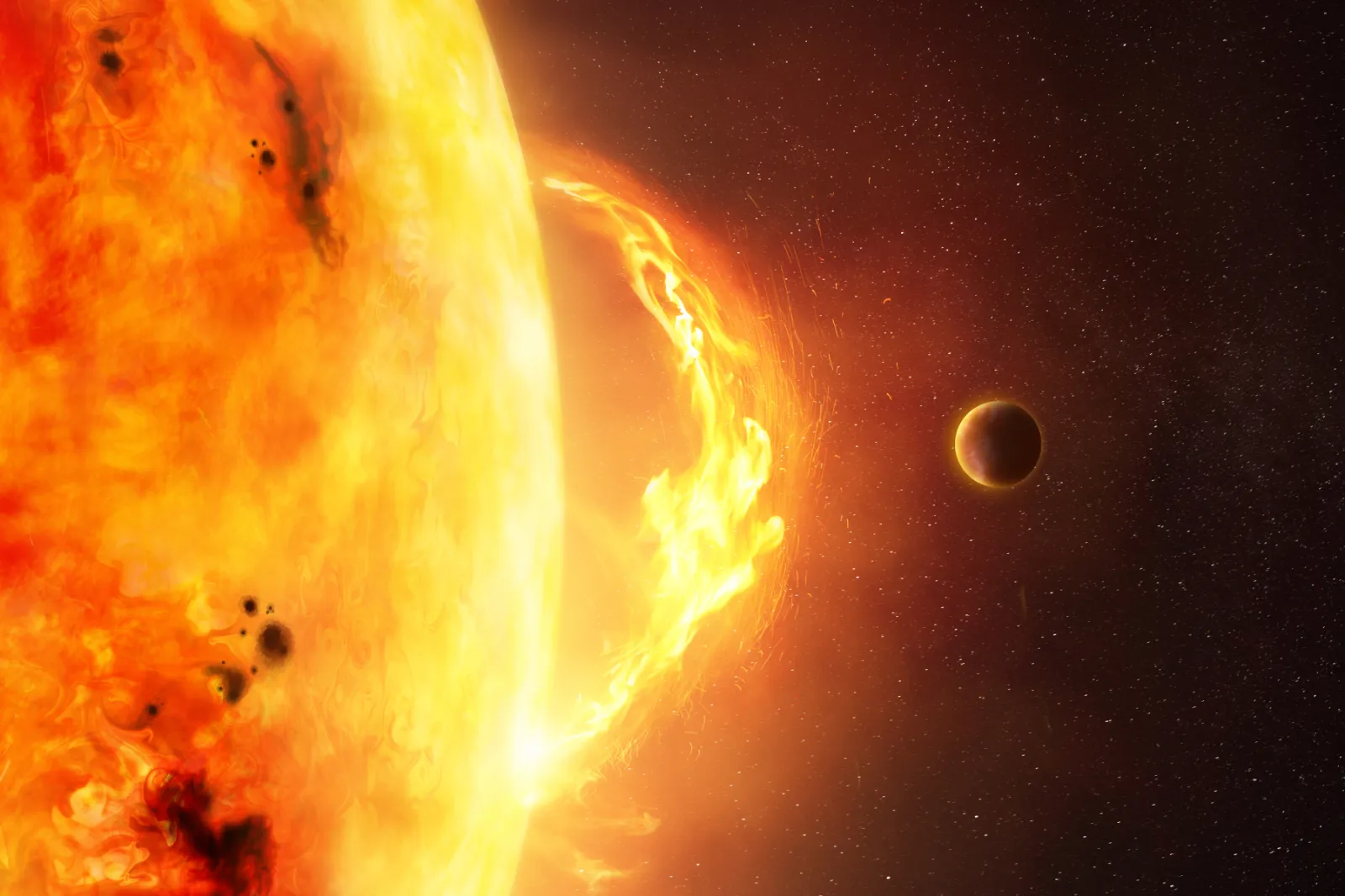
The sun has suddenly become much more active, bursting with sunspots and sending plumes of hot plasma out into space.
In the last week alone, sunspot numbers have increased by 10 times, dotting the sun's surface with black pockmarks spewing out several coronal mass ejections every day.
One of these coronal mass ejections (CMEs) may be due to hit the Earth in the coming days, a NASA model has shown, with one possibly due to collide with our magnetic field and atmosphere late on November 25. This will be confirmed after scientists fully analyze the trajectories of the storms.
Read More
‘Spectacular’ Cosmic Light Show to Dominate Night Skies This Weekend5 min read

Dark Matter’s Secrets Crash to Earth in Chicken Roast Bag4 min read

Brilliant Fireball Captured Searing Through the Sky Above Western Australia5 min read

...
Coronal mass ejections are huge clouds of solar plasma that are spat out of the sun in regions of high magnetic activity, which can include sunspots. The sun may also send out solar flares, which are bright bursts of electromagnetic energy.
"Solar flares and CME are both caused by the sun through its magnetic field being twisted and stressed through motions in the sun," Daniel Brown, an associate professor in astronomy and science communication at Nottingham Trent University in the U.K., told Newsweek. "However, a solar flare is the immense release of light triggered by the snapping and rearranging of the magnetic fields on the sun. That will go hand in hand typically with the release of a CME. But it will take a day or more for the particles to arrive while the light and radiation reaches us in just over 8 minutes. So a good comparison is that a flare is the flash of a muzzle while the CME is actually the cannonball traveling and possibly hitting us."
When the particles of a CME hit the Earth's magnetic field and atmosphere, it can trigger a geomagnetic storm.
"A geomagnetic storm occurs when the Earth's magnetic field is seriously disrupted by eruptions from the sun," Huw Morgan, head of the Solar Physics group at Aberystwyth University in the U.K., told Newsweek. "When a large plasma storm erupts from the sun, and that storm carries a magnetic field which is oriented in an opposite direction to Earth's magnetic field, we have a 'perfect storm,' and a larger geomagnetic storm."
Geomagnetic storms vary in strength depending on the power of the CME that caused it, being measured on a scale between G1 (minor) to G5 (extreme), according to NOAA. The most powerful of the storms are the least common: while there may be 1700 G1 storms per 11-year solar cycle, we may only see 100 G4 storms and 4 G5 storms during that same period.
These geomagnetic storms can cause spectacular displays of aurora much further towards the equator than normal, with more powerful storms causing the northern lights to creep further and further south.
This occurs because charged particles in the Earth's atmosphere are influenced and disturbed by the solar plasma hitting us, subsequently reacting with gases like nitrogen and oxygen in the air and causing them to glow.
"Under quiet conditions, charged particles (both from the solar wind and the ionosphere) can become trapped in the magnetosphere, happily bouncing from hemisphere-to-hemisphere, pole-to-pole. Under these circumstances, some of these charged particles will collide with upper atmospheric particles, causing auroras in the polar regions," Brett Carter, an associate professor in space science at RMIT University in Australia, told Newsweek.
However, when a CME hits and causes a geomagnetic storm, these particles are forced deeper into the atmosphere, causing them to react with more gases and cause the aurora to be brighter and visible further.

...
Other than pretty lights in the sky, geomagnetic storms can also lead to some impacts on infrastructure, including fluctuations and outages in the power grid and radio blackouts.
"The affected infrastructure that is of most importance is large-scale power grids, without which modern society would not be able to function. Other than that, pipelines, High Frequency (HF) radio/radar and satellites in orbit are significantly affected," Carter said. "Pipelines are known to also carry geomagnetically induced currents, which accelerates their corrosion. Satellites can experience increased surface charging due to the plasma environment in orbit, and this can affect the onboard electronics and operation of the satellite.
"Further, due to the huge amount of energy being dumped in the Earth's atmosphere during these big storms, the atmosphere actually swells and this causes more satellite drag in low-Earth orbit (up to about 1,000 km altitude, where the majority of our satellites are). Increased satellite drag further complicates efforts to keep track of everything in orbit, and making sure that collisions don't take place. The really minor geomagnetic storm in February 2022 that resulted in the loss of the majority of a Starlink deployment is a perfect example of how varying satellite drag can complicate space operations."
Do you have a tip on a science story that Newsweek should be covering? Do you have a question about CMEs? Let us know via science@newsweek.com.
View 0 Comments
Submit Correction
View Editorial & AI Guidelines