
...

By Soo Kim
Reporter
0
Share
Newsweek is a Trust Project member
See more of our trusted coverage when you search.Prefer Newsweek on Googleto see more of our trusted coverage when you search.
Researchers at the Massachusetts Institute of Technology (MIT) have developed a housing concept that challenges how long homes can last and evolve through time.
Known as the Heirloom House, the project is designed to last for a millennium while remaining flexible enough to adapt to daily use, shifting climates, and generational change.
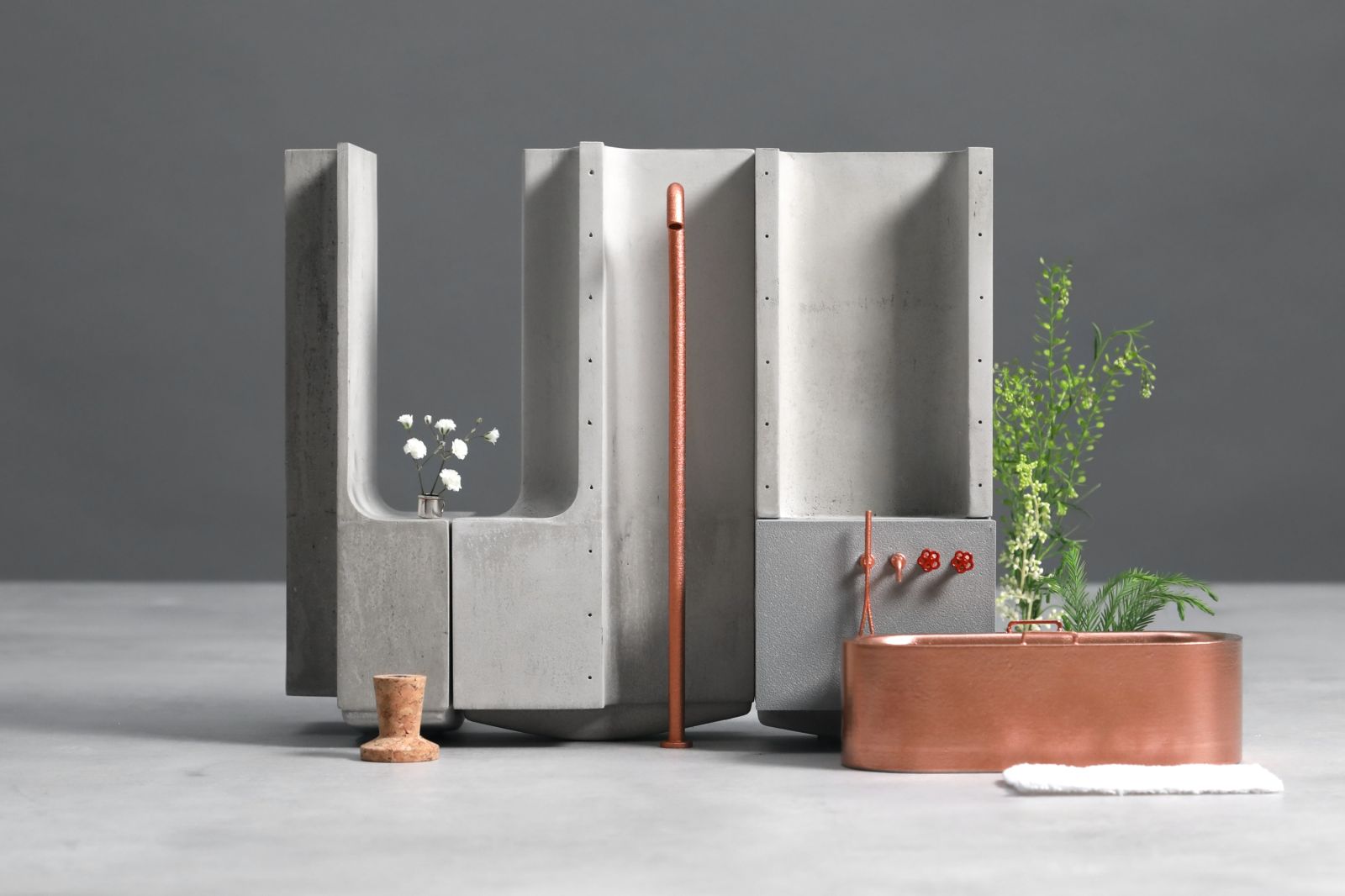
Created by Matter Design, a research lab based at MIT and the University of Michigan, in collaboration with CEMEX Global R&D, the Heirloom House is conceived as a system that can “endure a millennium, yet transform in an instant,” according to the lab’s website. Rather than relying on lightweight or disposable construction, the house is composed of nine large concrete elements, described as "megaliths," that are engineered to be both extremely durable and surprisingly mobile.
Read More on Home & Garden
Each concrete piece sits on a uniquely computed base that allows the massive structures to wobble, pivot, and even “walk” into new configurations, according to the website. Despite their size and weight, the elements are calibrated to be rearranged repeatedly, enabling daily adjustments, seasonal shifts, or larger reconfigurations across generations, allowing adaptation “with no demolition, no waste.”
...
‘Extremely Durable, Non-Combustible’ Concrete
Brandon Clifford, director of Matter Design and an associate professor at MIT, told Newsweek that the project aims to rethink both permanence and change in residential architecture.
Clifford explained that the Heirloom House is organized around the most basic requirements of domestic life. The concrete elements are designed to function as fixed dimensional references rather than static rooms.
“The Heirloom House is built around a set of large, solid concrete elements that function as the irreducible dimensions of residential living,” the professor said. These elements can be combined to define kitchens, bathrooms, and sleeping areas, while also aligning with standard bed sizes and human-scale measurements such as counter height and bench depth.
The house’s proposed 1,000‑year lifespan is rooted in both material choice and design logic. Clifford explained that high‑performance concrete was selected for its durability and resistance to common forms of building degradation.
“The primary material is high‑performance concrete, which is extremely durable, non‑combustible, and resistant to rot, pests, and environmental degradation,” he said.
However, Clifford cautioned that durability alone often creates a different problem**—**buildings that physically last but quickly become obsolete. He described this as a major issue in the construction industry, where long‑lasting materials are frequently paired with inflexible layouts.

...
Referencing a December 2025 MIT study published in Buildings & Cities, Clifford said the research highlights a critical challenge in architecture. “The challenge is not designing buildings that can physically last for centuries, but predicting how they will be used over time,” he told Newsweek. Most buildings, he added, fail not because they deteriorate, but because they no longer make sense economically or programmatically.
To address that issue, the Heirloom House elements are engineered to be both stable and mobile. Clifford said each concrete piece is computationally calibrated to balance on a single point, allowing it to remain steady during everyday use while still being movable by occupants.
“For this reason, the Heirloom House elements are designed to endure for 1,000 years while remaining capable of immediate transformation,” he said. In a recent paper titled “Kinetic Bases: A Tool for Moving Massive Architectural Elements,” the research team outlined the method used to allow the elements to pivot and “walk” when repositioned.
A Replaceable Base Like ‘The Sole of a Shoe’
While the concrete elements themselves are designed for extreme longevity, Clifford said the system anticipates wear in the parts that interact most directly with the ground.
“The bases—where each element meets the ground—are the components most exposed to wear and abrasion,” he said. To address this, the bases are designed to be replaceable, “much like a cobbler replaces the sole of a shoe.”
“They can also be exchanged to alter how an element moves,” Clifford said. Some components are meant to shift frequently, even daily, while others are intended to move only seasonally or during major life changes.
Because each element operates on a different timeline, Clifford said the bases can be calibrated to balance ease of movement with stability, depending on how often a piece is meant to be reconfigured.
...
Affordability Over Time
Clifford emphasized that the Heirloom House is not intended to compete with conventional housing or furniture on upfront cost. Instead, the project proposes a longer‑term view of affordability.
“Heirloom House is not intended to compete on cost with single‑use furniture—nor should it,” he told Newsweek. By framing the project around a 1,000‑year lifespan, the team considers cost across multiple generations rather than a single lifetime.
This approach, Clifford said, challenges the logic of the 30‑year mortgage, which assumes one generation of use. The Heirloom House instead asks designers to think like ancestors, assuming responsibility for future users.
Clifford explained: “This shift forces a different kind of design thinking. It requires imagining how materials endure, how uses evolve, and how future generations might reinterpret or even reject what we currently consider essential.”
Ultimately, he said, the goal is not to “preserve a fixed idea of living, but how to create an architecture that can absorb change—one that remains useful, adaptable, and meaningful across deep time.”
Do you have a design-related story to share? Let us know via life@newsweek.com, and your story could be featured on Newsweek.

...
View 0 Comments
Submit Correction
View Editorial & AI Guidelines