10
Loading video...



By Billal Rahman, Dan Gooding, and Hollie Silverman
0
Share
Newsweek is a Trust Project member
See more of our trusted coverage when you search.Prefer Newsweek on Googleto see more of our trusted coverage when you search.
The U.S. Border Patrol is tracking a migrant caravan that departed San Pedro Sula, Honduras, on September 20, according to the Department of Homeland Security (DHS), as the group continues its journey north through Mexico toward the southern border.
A DHS spokesperson told Newsweek that U.S. Border Patrol is “closely engaged with its international partners” to monitor the caravan’s movement and any further developments.
"The message to the caravan is you will not be allowed into our country," White House spokeswoman Lauren Bis told Newsweek in an emailed statement Monday. "Our border is closed to lawbreakers. President Trump delivered the most secure border in history and has had 16 months of ZERO releases at the border. The days of catch and release are over."
Read More on News
“Any illegal aliens who pay cartels to smuggle them in the United States should expect the same outcome: arrest, prosecution where appropriate, and immediate deportation."
So-called migrant caravans have been a feature of south-north migration toward the United States for several years, only growing in frequency during the surge at the U.S.-Mexico border from 2020 through late 2024. They do not always make it to the border, with some immigrant splitting off to stay in Mexico or being detained by Mexican authorities.
"Caravans are typically used by people with no means to pay coyotes and used as a measure, albeit imperfect, for their security," Dr. Manuel Orozco, director of Migration, Remittances and Development at Inter-American Dialogue, told Newsweek. "People who join are from different countries, not only Honduras; as well as some people stranded in Mexico who chose to try again."
...
'Faith and Hope' Caravan: What We Know
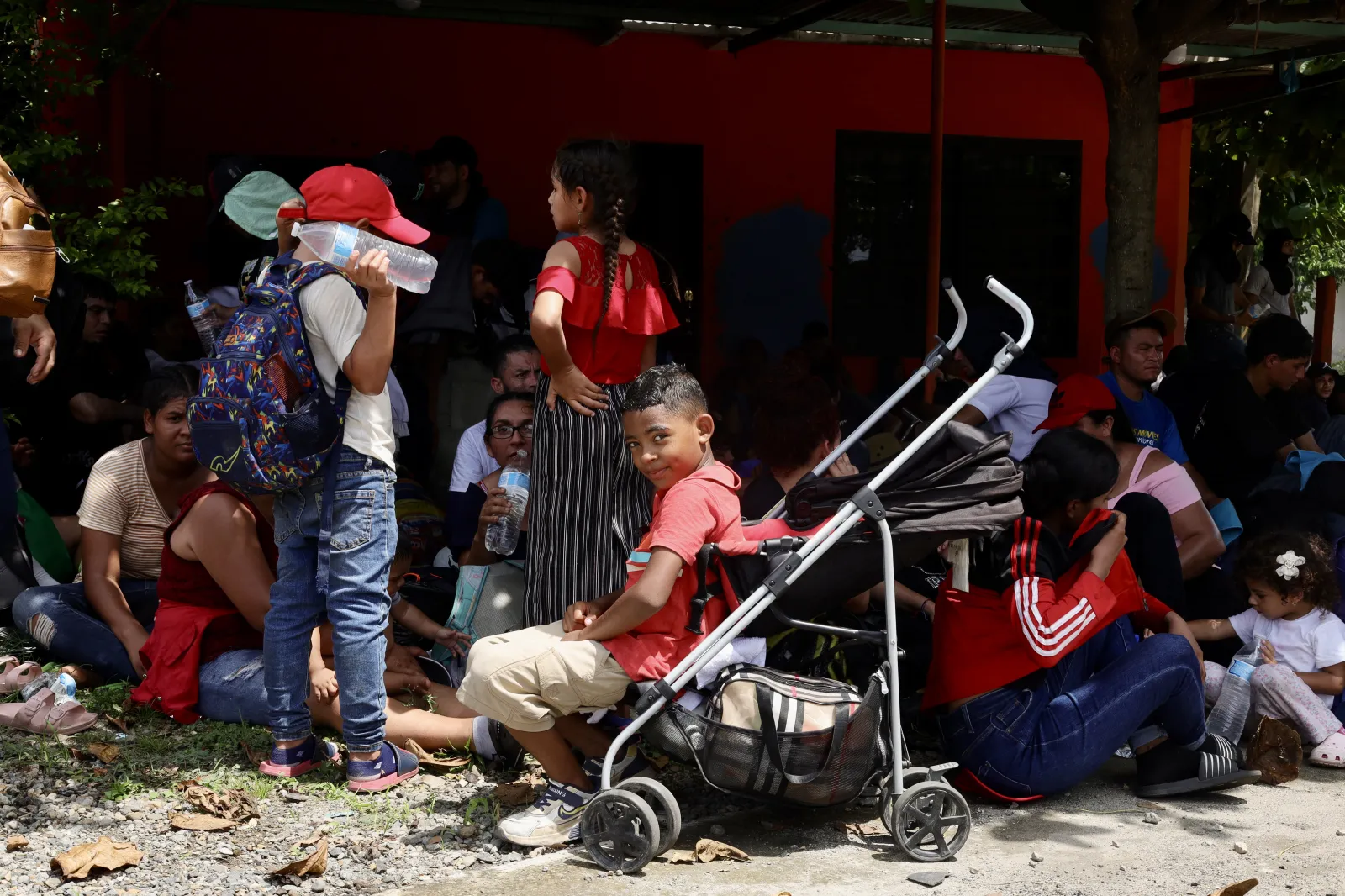
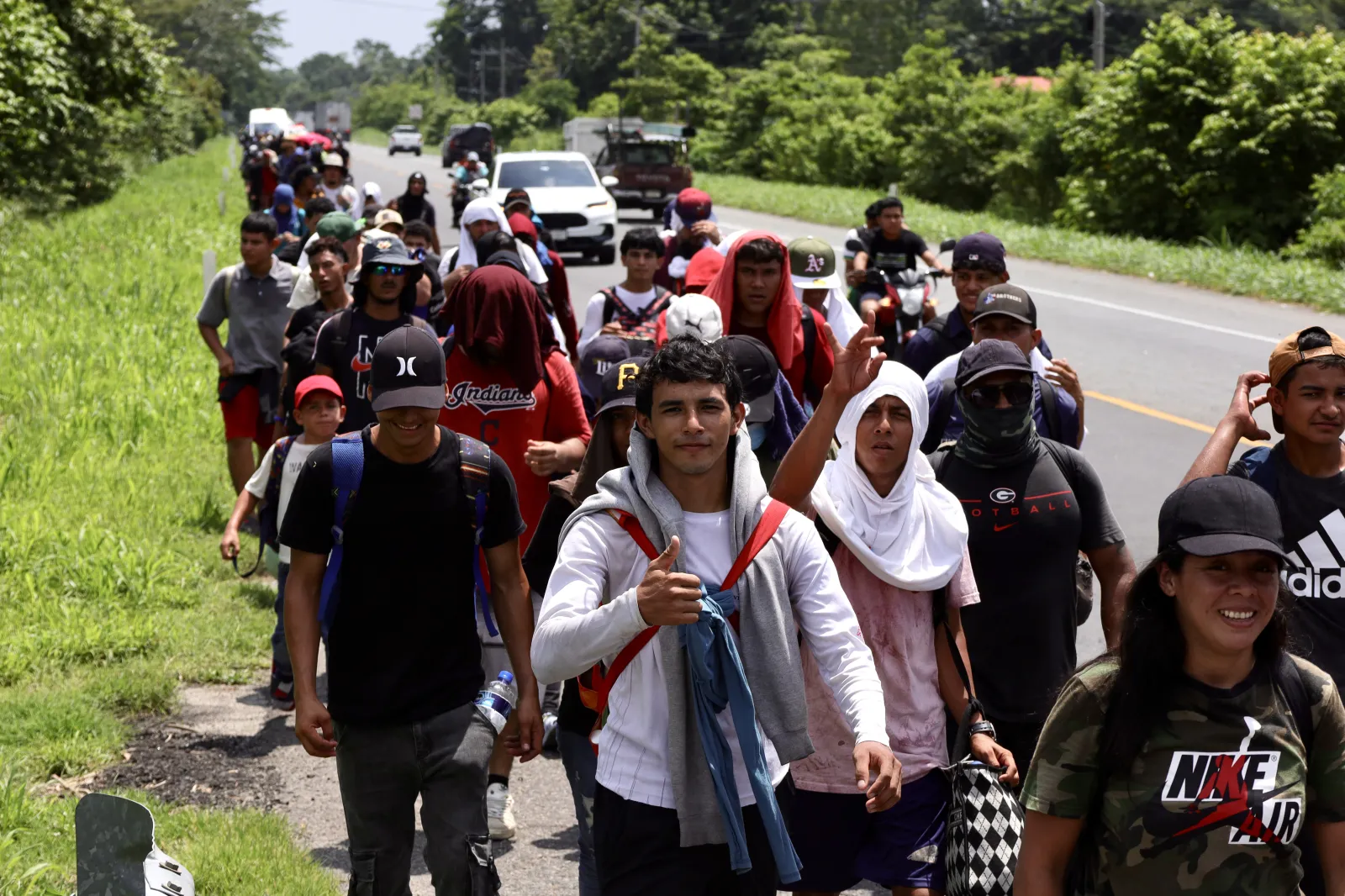
More than 600 migrants are reportedly traveling north through Mexico in a caravan bound for the U.S. border, a journey that began in Honduras and comes as the Trump administration is clamping down on migration ahead of November's midterms.
The journey began on September 20, when between 200 and 400 Honduran migrants left San Pedro Sula in small groups and headed toward the border with Guatemala, according to the Spanish news agency EFE.
By early Monday, September 28, a caravan known as "Fe y Esperanza," or "Faith and Hope," had grown to more than 600 migrants as it resumed its journey from Tapachula, southern Mexico, toward the country's northern border with the United States, EFE reported. The group included people from Honduras, El Salvador, Guatemala, Ecuador and Haiti.
Related Story

Trump Admin Accused of Stealing Water for Border Wall Construction
Rapid Fall in U.S.-Mexico Border Crossings
It comes amid President Donald Trump’s sweeping crackdown on illegal immigration, which has curbed unlawful crossings at the U.S.-Mexico border.
Since returning to office in January 2025, Trump has declared a national emergency at the southern border, deployed active-duty military personnel and National Guard troops to support border operations, imposed extensive restrictions on asylum access, and pursued a policy of detaining and removing migrants who cross illegally rather than releasing them into the United States.
Border crossings have plummeted under those measures. U.S. Border Patrol recorded 8,870 apprehensions along the southwest border in August 2026, according to DHS, 94 percent below the monthly average during the Biden administration.
DHS also said Border Patrol released no migrants into the country that month, extending a run of zero releases to 16 consecutive months.
A DHS spokesperson also said the border has remained “closed and secured” for the past 16 months under Trump, and warned that migrants attempting to enter the United States illegally will be apprehended, prosecuted, and removed.
Newsweek has contacted Mexico’s government for comment.
Access to asylum at the southern border has also been sharply curtailed. Trump issued a proclamation on his first day back in office seeking to prevent migrants covered by the order from invoking asylum and other protections, although the policy has faced continuing litigation.
What Is Driving the Caravan?
The caravan nevertheless remains hundreds of miles from the U.S. border, and it is unclear how many members of the current group will ultimately reach northern Mexico or attempt to enter the United States.
Previous migrant caravans have often failed to reach the U.S. border as organized groups. Mexican authorities have routinely intercepted and dispersed caravans traveling north, including by detaining migrants or transporting them elsewhere in Mexico.
Migrants interviewed by EFE cited economic hardship among their reasons for leaving Honduras. One woman traveling with two children said there was no work available to her in the country. Another migrant acknowledged that reaching the United States would be difficult but said he would nevertheless try.
"The destination may be the Mex-US border and [immigrants] are going aware that there are many restrictions in place but it seems they may have separate plans once near the border on how to proceed," Orozco said. "I am uncertain to the goal given the restrictions and controls.
"However, I have learned that the intention to migrate has stayed the same among Central Americans compared to 2024; before the border restrictions and policy changes. The intention to migrate strongly correlates with those with a relative returned, but also with being young and the state of the economy."
Orozco added that the number of deported people returned to Latin America may reach more than 200,000, on top of the 140,000 in 2025, meaning a drop in remittances—or funds—being sent back home from the U.S.

...

...

...

...

...

...
1 of 6
According to Guatemala’s Institute of Migration, Honduran nationals can enter Guatemala without a visa under the CA-4 regional agreement, while Mexico’s National Migration Institute states that Honduran nationals generally require a visa to enter Mexico, subject to certain exemptions.
EFE reported that the group had arrived in Tapachula the previous Thursday with around 300 people but subsequently grew as migrants who were already in southern Mexico joined it.
The changing composition means the group of more than 600 people currently traveling through Mexico should not be characterized as consisting entirely of the Honduran migrants who originally left San Pedro Sula.
U.S. authorities have warned migrants against attempting to enter the United States unlawfully.
How Is the US Responding?
On September 21, the U.S. Embassy in Tegucigalpa wrote on X that "the borders of the United States are closed to those who violate the law."
"Do not risk your life or that of your family by undertaking the dangerous journey to the north. Do not believe the lies of human traffickers. If you attempt to enter the United States illegally, you will be deported."
The Department of Homeland Security has also responded to the caravan on X, writing "Our time has come," in a video post featuring a sports hype reel including former Philadelphia Eagles safety Brian Dawkins, set to a Korn song. There were requests from the NFL and Dawkins himself to take the video down.
The caravan has also generated political reaction in the United States, where Republicans have seized on its emergence to raise concerns about border security and immigration in the run-up to the November midterms.
...
Representative Nancy Mace, a South Carolina Republican, wrote on X: "They're not betting on crossing Trump's border. They're betting on a Democrat Congress in November. Don't give them one."
GOP former Georgia Representative Marjorie Taylor Greene, meanwhile, questioned the timing of the caravan and accused Republicans of emphasizing the issue to influence voters.
"We have not seen a caravan headed to the U.S. southern border in several years, why now?" Greene wrote on X. "Oh yeah, there is an election coming and the GOP needs to scare you into voting because nothing else is working."
José Zelaya, a Honduran migrant from San Pedro Sula, told EFE that he had left with seven members of his family on September 20 and wanted to reach the United States, in part so he could provide financial help to relatives he had left behind.
Zelaya also rejected the idea that anyone was directing the migrants, telling EFE that the group had no leaders beyond "hunger" and "necessity."
Map Shows Migrant Caravans Travel Routes Towards US

...
Migrant caravans have become a recurring feature of migration through Central America and Mexico. A 2023 study by Rice University’s Baker Institute for Public Policy identified 30 caravans between 2017 and the end of 2022, rising from one in 2017 to 14 in 2022. Most began in San Pedro Sula, Honduras, while others formed in Mexico, and ranged from hundreds of migrants to groups numbering in the thousands.
A map included in the study, based on UNICEF research from 2018, charts routes from Honduras through Guatemala and southern Mexico before branching across Mexico toward several points on the U.S. border, including Tijuana, Nogales, Ciudad Juárez, Piedras Negras, Nuevo Laredo, Reynosa, and Matamoros. The study found that caravans can grow as migrants join along the way, but account for only a small proportion of overall migration through Central America and Mexico.
Contact Newsweek editors on this story: John Fitzpatrick, James Debens and Emma Lee-Sang
Update, 09/29/2026 7:19 a.m. ET: this article was updated with further information.
View 0 Comments
Submit Correction
View Editorial & AI Guidelines