10
Loading video...

By Billal Rahman
Immigration Reporter
0
Share
Newsweek is a Trust Project member
See more of our trusted coverage when you search.Prefer Newsweek on Googleto see more of our trusted coverage when you search.
A migrant caravan trying to reach the United States is reportedly struggling with food shortages and limited humanitarian assistance while still hundreds of miles from the U.S.-Mexico border.
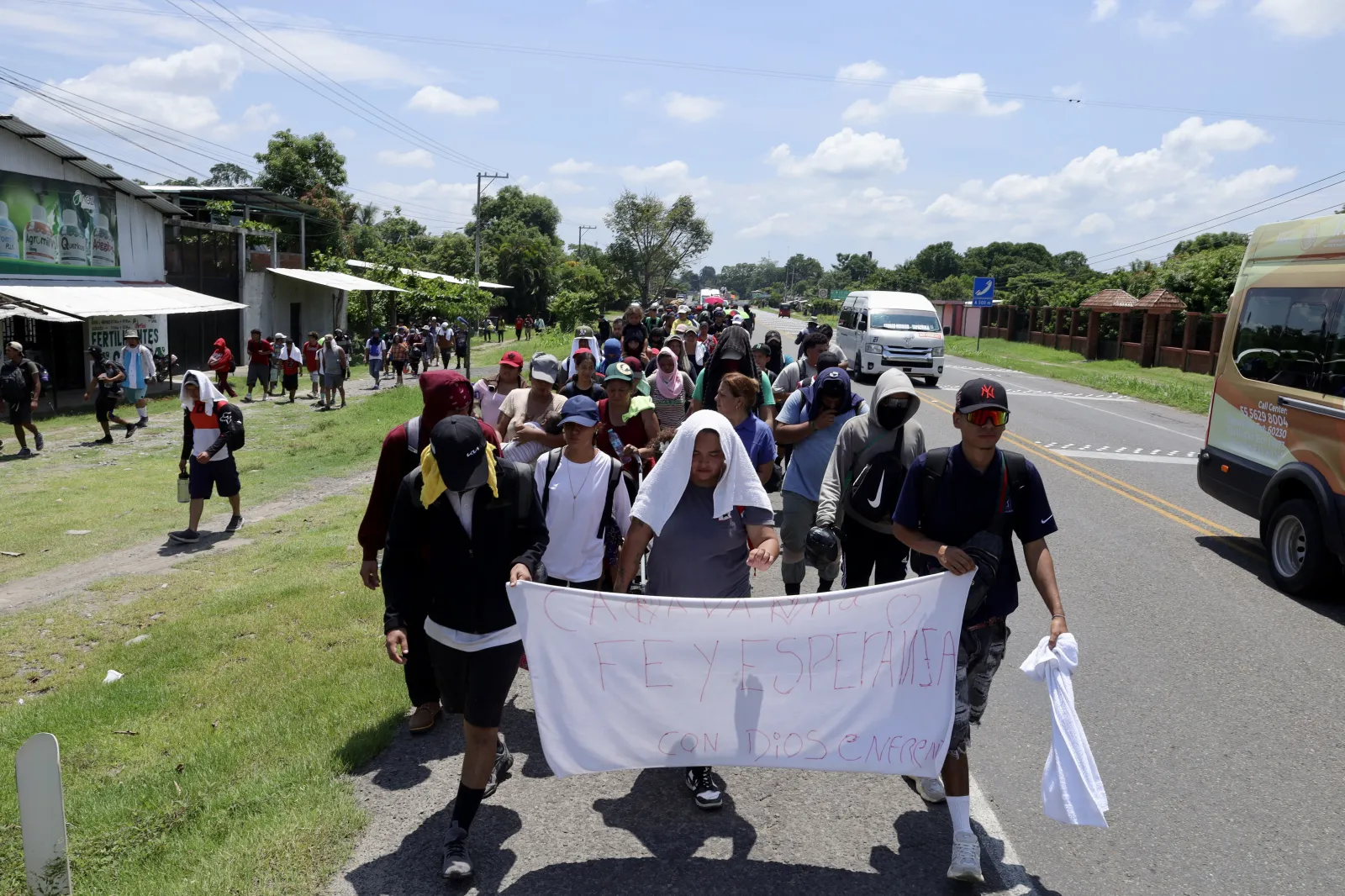
About 350 migrants were traveling Tuesday through the southern Mexican state of Chiapas, where some families have gone days without eating, according to interviews published by the Mexican newspaper La Jornada. The group had covered more than 150 kilometers, or about 93 miles, in nearly two weeks and was heading from Pijijiapan toward Tonalá.
The caravan, known as "Fe y Esperanza con Dios," or "Faith and Hope with God," began its journey in San Pedro Sula, Honduras, on September 20 and entered Mexico several days later. Most of the migrants are from Central America, although people of other nationalities have joined along the way.
Read More on News
Honduran migrant José Celaya, who is traveling with his wife, sister-in-law and four children, told La Jornada that migrants without money have been sharing what food they have. He said the group had been allowed to sleep in parks and sports facilities along its route, but charitable donations of food and other supplies had been insufficient.
"There are many women with children who have no money; sometimes, we support each other, we share a plate of food," Celaya told the outlet.
Celaya said the family nevertheless intended to continue north because returning home was not an option for them.
A Department of Homeland Security (DHS) spokesperson told Newsweek on September 28 that U.S. Border Patrol was "actively tracking" the caravan, which departed San Pedro Sula, Honduras, on September 20. The spokesperson said the agency was working with international partners to monitor the group and warned that people who attempt to enter the United States illegally would be apprehended, prosecuted, and removed.
...
Few Caravans Make It Out of Southern Mexico
The group's immediate challenge is reaching Oaxaca, the state bordering Chiapas to the west.
The current caravan is the latest in a series that have struggled to travel beyond southern Mexico.
20 migrant caravans have left Tapachula since President Claudia Sheinbaum took office in October 2024, and none has made it beyond Oaxaca, according to La Jornada.
Earlier caravans have faced a combination of illness, difficult weather and intervention by Mexican immigration authorities. La Jornada reported that a March caravan of about 500 migrants was dispersed by Mexico's National Migration Institute, while a group that left in April with about 1,000 people dissolved in Oaxaca after nearly three weeks of walking. A June caravan of about 200 people also experienced foot injuries, fever, coughs and gastrointestinal illnesses after traveling more than 100 kilometers through sun and heavy rain, according to the newspaper.
The "Sueños sin Fronteras" caravan left Tapachula with about 600 people on August 20, La Jornada reported. By the time it reached Arriaga after roughly 250 kilometers of walking, only about half remained. Some migrants had quit the journey, others had approached immigration authorities, and others continued independently. The remaining members ultimately accepted transportation from Mexico's National Migration Institute to Tuxtla Gutiérrez, effectively bringing the organized caravan to an end.
Why Migrants Travel in Caravans
A 2023 study by Rice University’s Baker Institute for Public Policy tracked 30 migrant caravans between 2017 and the end of 2022, most originating in San Pedro Sula, Honduras, or southern Mexico. The researchers found that caravans represent only a small share of overall migration through Central America and Mexico, despite attracting significant political and media attention. They cited poverty, violence, political instability, corruption, and extreme weather among the factors driving migrants to leave their home countries.
The study also pointed to the practical reasons migrants travel together. Caravans can provide safety in numbers during journeys that may stretch hundreds of miles, while migrants often rely on local residents, charities and government agencies for food, shelter, and other assistance along the way. The researchers said the groups have ranged from hundreds to thousands of people, but noted that many were stopped or broken apart before reaching the U.S.-Mexico border.
White House spokeswoman Lauren Bis told Newsweek on September 28 the administration's message to the caravan was that its members "will not be allowed into our country," adding that the border was closed to people attempting to enter illegally. Bis said those who pay cartels to smuggle them into the United States should expect "arrest, prosecution where appropriate, and immediate deportation."
Honduran Man Arrested Along Caravan Route
The caravan's journey was also disrupted by the arrest of a Honduran man traveling with the group.
Chiapas’ Secretariat of Public Security said in a Facebook post that state officers arrested Jason "N," a Honduran national, in the municipality of Mapastepec after checking his information on international databases and finding what authorities described as a valid Red Notice from Honduras.
The agency said Jason was traveling with the migrant caravan when he was detained. It said he was turned over to Mexican immigration authorities for the process of transferring him to Honduran authorities. The statement did not identify the alleged offense underlying the Red Notice nor provide his full name.
Newsweek’s reporters and editors used Martyn, our AI assistant, to produce this story. Learn more about Martyn here.
Contact Newsweek editors on this story: Tobias Meyjes and James Debens
View 0 Comments
Submit Correction
View Editorial & AI Guidelines